Diwali Myth Meaning & Symbolism
A festival of lights celebrating the return of Lord Rama after vanquishing the demon king Ravana, symbolizing the victory of inner light over spiritual darkness.
The Tale of Diwali
Listen, and let the story settle in your bones. The air in the kingdom of Ayodhya was thick, not with monsoon rain, but with a deeper, more chilling damp: the damp of an empty throne, of a city holding its breath for fourteen long years. The streets, once ringing with the justice of their king, were silent. The palace, a skeleton of memory.
Our tale does not begin in this silence, but in a far darker place—across the roaring sea, on the island of Lanka. Here, in a palace of cold marble and darker magic, sat Ravana, the ten-headed lord of demons. His sin was not mere wickedness; it was a cosmic theft. He had stolen light itself, in the form of Sita, from the heart of the exiled prince Rama. He took her not for love, but for possession, to claim what symbolized the rightful order of the world.
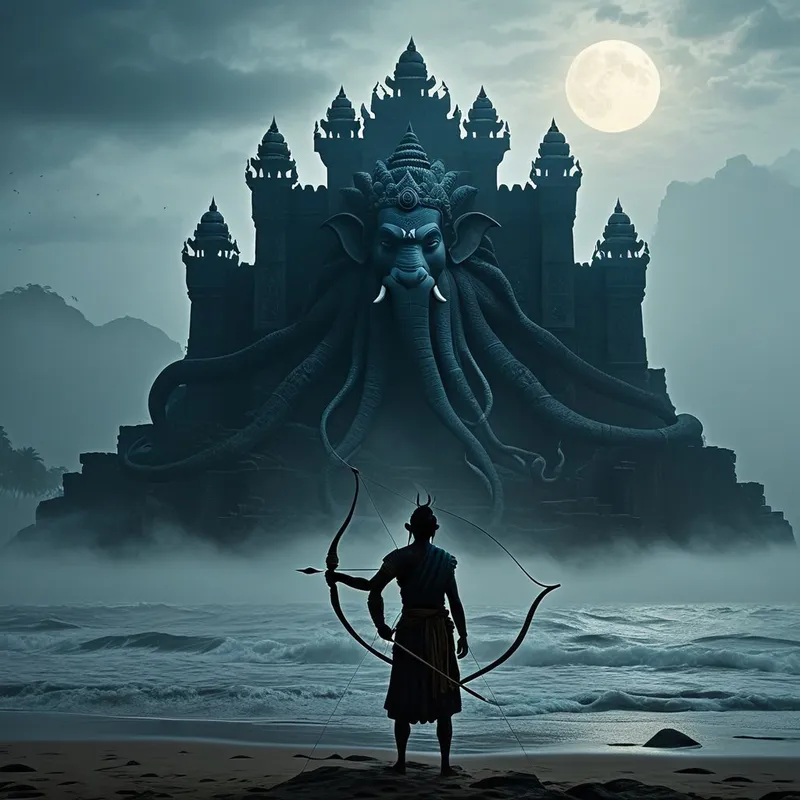
And Rama? He stood on the wind-lashed shore, the salt spray mixing with the fire in his eyes. He was not alone. By his side stood his ever-loyal brother Lakshmana, and an army born of an unlikely alliance: the Vanaras, leaping, roaring, their fur bristling with purpose. The bridge to Lanka, built of stones bearing the name of Rama, stretched across the impossible sea. The great war that shook the heavens was not just a clash of arms. It was the shriek of Ravana’s celestial chariot against the twang of Rama’s bow, the Pinaka. It was the scent of blood and burnt magic, the taste of dust and destiny.
The climax came not in a blind rage, but in a chilling focus. Ravana, invincible in his arrogance, met Rama’s gaze. And Rama, guided by the wisdom of his allies, drew a single, fated arrow—the Brahmastra. It did not simply fly; it sang a hymn of finality. It pierced the demon king’s heart, and with a roar that was both defeat and release, the shadow that had gripped the world began to dissolve.
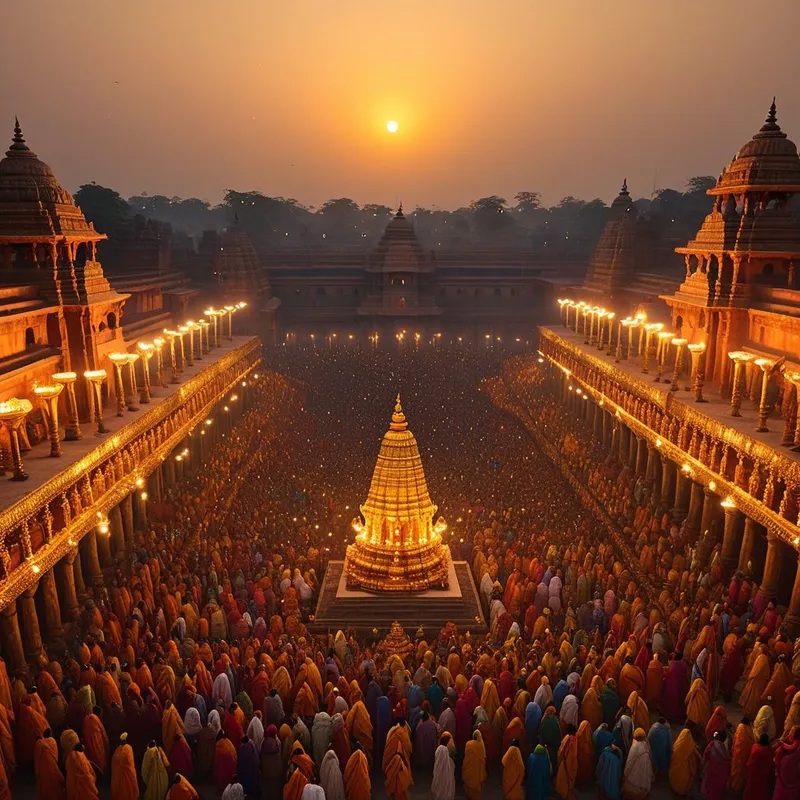
Now, picture the long road home. Fourteen years of exile ended. The news flew ahead of them on the wings of birds, rustling through the leaves: He returns. And Ayodhya, that silent city, erupted. To guide their king through the moonless night of Kartik Amavasya, every citizen, from the highest minister to the lowliest potter, lit a lamp. They placed them in rows on rooftops, in windows, along paths, on the banks of the sacred Sarayu. The kingdom became a constellation fallen to earth, a river of fireflies welcoming its soul home.
And when Rama, Sita, and Lakshmana finally crossed the threshold, the light did not just illuminate the palace. It filled the hollow spaces in every heart. The darkness was not fought; it was forgotten, drowned in a sea of gentle, unwavering flames. The victory was not just Rama’s. It was the victory of a people who remembered how to shine.
Cultural Origins & Context
The story of Diwali is woven from the grand epic, the Ramayana, attributed to the sage Valmiki. For millennia, this narrative has not been merely read but performed, recited, and sung. It traveled through the oral traditions of bards and the dramatic retellings of Ram Lila, where entire communities would gather for nights to witness the cosmic drama unfold in their village square.
Societally, Diwali and its foundational myth function as a profound cultural reset. Occurring at the juncture of the harvest and the new financial year, it intertwines the spiritual with the material. The lighting of lamps (diyas) to guide Rama home translates into the invitation of Lakshmi into one’s home and ledgers. The myth provided, and still provides, a shared narrative of hope—that no exile is permanent, no darkness absolute, and that righteous order (dharma) will ultimately be restored through perseverance, alliance, and unwavering inner light.
Symbolic Architecture
At its core, Diwali is not a historical record but a map of the psyche. Rama represents the conscious Self, the principle of order, duty, and integrity. His exile to the forest is the soul’s necessary journey into the unconscious, the vana of one’s own unresolved depths.
The true battle is never against an external monster, but for the retrieval of a lost part of the soul from the fortress of our own ignorance.
Ravana is not pure evil; he is a formidable shadow figure—a being of immense scholarship and power, yet utterly consumed by ego (ahamkara) and unbridled desire. He is what happens when brilliant potential is hijacked by possession. The theft of Sita symbolizes the capture of our inner vitality, sovereignty, and creative life-force by these compulsive, egoic structures.
The victory, therefore, is the reintegration of the Self. The lighting of the lamps is the critical act: it is the conscious illumination (prakasha) of all corners of the inner kingdom, ensuring no part of the psyche remains in the shadow of neglect or fear. It is the celebration of consciousness reclaiming its rightful seat after a long struggle with the unconscious.
The Dreamer's Resonance
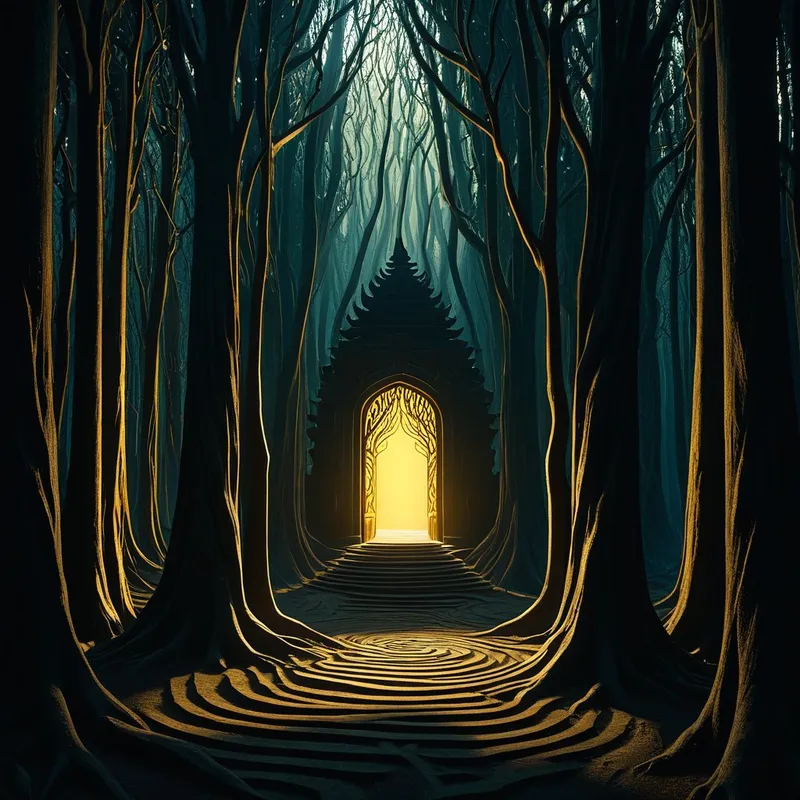
When this mythic pattern stirs in the modern dreamer, it often manifests as a profound sense of exile or a quest. One might dream of being lost in a vast, dark forest (the unconscious), searching for a missing person or a cherished object (the lost Sita, the lost Self). The demonic figure may not appear as a ten-headed king, but as a looming institutional authority, a suffocating relationship, or a pervasive, inner voice of cynicism and despair—the Ravana of one’s personal psychology.
Somatically, this process can feel like a heavy weight in the chest, a constriction—the fortress of Lanka built around the heart. The turning point in the dream may involve finding an unexpected ally (the Hanuman-like friend, the sudden insight), or discovering a simple tool—a key, a thread, a small lamp—that represents the focused intention needed to begin the journey back. The dream of return is often accompanied by feelings of immense relief and lightness, a somatic memory of Ayodhya’s illuminated welcome.
Alchemical Translation
The alchemical journey of Diwali is a masterclass in psychic transmutation, a blueprint for individuation. The first stage is separation: the painful but necessary exile from the familiar comforts of the persona (Ayodhya). One is cast into the nigredo, the dark night of the soul, the forest of confusion.
The bridge to the demon’s island is built stone by stone, each one inscribed with the name of the Self. No rescue is possible without first declaring who you are.
The battle with Ravana represents the confrontatio—the direct engagement with the shadow. This is not about annihilation, but about seeing the shadow’s power and its source. Ravana’s defeat by a divine weapon signifies that the ego-complex must be pierced by a transpersonal truth, a value or insight greater than one’s personal identity.
The final, glorious stage is illumination and return. This is the albedo, the whitening. The countless lamps are the multitude of conscious realizations, the individual insights and healed parts that, together, light the path for the redeemed Self to return home. The kingdom you return to is not the one you left; it is a psyche now consciously illuminated, where the ruler (the ego) is finally in right relationship with the true King (the Self). You do not just celebrate light; you become the festival.
Associated Symbols
Explore related symbols from the CaleaDream lexicon: