
The Alchemy of Return
The Somatic Echo
It begins not as a thought, but as a hollow. A low-grade ache behind the sternum, a subtle vertigo when you stand still. It’s the body’s memory of an absence, a phantom limb of the soul. You might feel a gravitational pull toward a certain silence, a specific quality of light—late afternoon sun through a dusty window, the particular chill of an autumn evening. This is the somatic echo of the theme of Return. It is the psyche’s internal compass needle trembling, pointing not to a place on a map, but to a coordinate in your own history, a chamber in your inner architecture that was sealed, its contents left in trust for a future self. The feeling is one of unfinished business, but of a sacred, not a mundane, kind. It is the whisper of a covenant you made with yourself and forgot.
The Dreamer's Log
The dream is always the same. I am walking through the infinite, humming corridors of a derelict data-center. The air is cool and smells of ozone and static. I know, with a certainty that bypasses logic, that I left something vital here—a core file, an encryption key to my own system. I pass identical black server towers, their status lights a silent chorus of red and amber. Then, in a forgotten sub-basement, I find it: a single, outdated terminal, its screen glowing with a persistent, patient green cursor. It is waiting for my command. I wake with my heart pounding, not from fear, but from a profound sense of recognition.
This is the alchemical call: the system has preserved the lost code, and the dreamer is finally ready to input the command that will initiate the reintegration sequence.

The False Lead
Return is not nostalgia. Nostalgia is a sentimental loop, a warm bath in a curated memory that asks nothing of you but to linger. Return is its antithesis—it is an active, often disquieting summons. It is not about going "back" to a happier time, but about retrieving a specific, potent essence that was abandoned or left behind for safekeeping during a time of trauma, adaptation, or sheer survival. It is not a regression, but a reclamation. Misinterpreting this call as a desire to escape the present is the False Lead; it will have you chasing the scenery of the past, while the treasure remains buried in the psychological soil beneath your feet.
Psychological Architecture
The work of Return is the deepest kind of Shadow retrieval. We are not hunting for a repressed monster, but for a lost child—a discarded capacity, a banished passion, a muted truth. In the language of Internal Family Systems, these are not "exiles" in the typical wounded sense, but "guardians in exile." They are parts of the self that were too vibrant, too sensitive, or too powerful for the world you inhabited at the time. To survive, you placed them in a vault and forgot the combination. The Return is the remembering.
This is the core of Individuation: the process is not about becoming someone new, but about becoming whole by recovering who you always were. The journey feels like descending into the basement of your own psyche to turn the lights back on, room by room. You will meet the protector parts that stand guard at the door—the Manager who says "We're fine as we are," and the Firefighter who distracts you with chaos or numbing. The alchemy happens when you thank them for their service, and gently step past. The retrieved essence—be it creative fury, gentle vulnerability, or unapologetic authority—does not simply rejoin you. It must be integrated, which means the entire internal system must reorganize around this returning sovereign. Old identities crack. Relationships shift. This is the price, and the promise, of coming home to yourself.
Mythic Resonance
This theme pulses through the oldest stories we tell. It is the heart of the Odyssey, but not in Odysseus's bloody homecoming to Ithaca. The deeper return is his descent to the Land of the Dead in Book XI. To find his way home, he must first go to the ultimate place of the past, to consult the blind prophet Tiresias. He does not go to reminisce; he goes for vital intelligence—the conditions for his return. He must listen to the ghosts of his own history to navigate the future.
Similarly, the Egyptian myth of Osiris speaks not of a return to life, but of a return to wholeness. Osiris is dismembered, his parts scattered across the land. Isis does not merely mourn him; she undertakes the sacred, meticulous work of re-membering. She finds each piece and binds it back together, creating a new, integrated form that can rule the underworld—the realm of soul and memory. The psyche’s work of Return is this Isis-work: the patient, loving gathering of our own scattered fragments into a new, cohesive sovereignty.
Symbolic Nodes
- Forgotten Rooms or Basements: Undiscovered aspects of the self.
- Old Keys, Passwords, or Maps: Access to lost knowledge or identity.
- Retracing Steps / Backtracking: The need to psychologically revisit.
- Meeting a Younger Version of Oneself: Direct encounter with the lost part.
- A Persistent, Waiting Object (phone, letter, terminal): The call itself, patient and unresolved.
- Crossing the Same River or Bridge Again: Confronting a past threshold with new awareness.
- Retrieving an Object from a Locker, Vault, or Attic: The act of reclamation.
Archetypal Resonance
The energy of Return is most purely channeled through The Explorer Archetype. While the Hero goes forth to conquer, the Explorer’s quest is one of discovery and retrieval. This archetype feels the somatic echo as wanderlust for the inner landscape, a pull toward the psychic frontier where the map ends. Its shadow—the Alienated or Aimless Wanderer—manifests when we mistake the journey for the destination, circling the past without ever landing to integrate what we find. The Explorer’s alchemical potential lies in its courage to venture into the forgotten interior not to escape, but to bring back the vital report, the lost artifact of self, and in doing so, re-chart the territory of the soul so it becomes familiar, sovereign ground.
The Alchemical Process
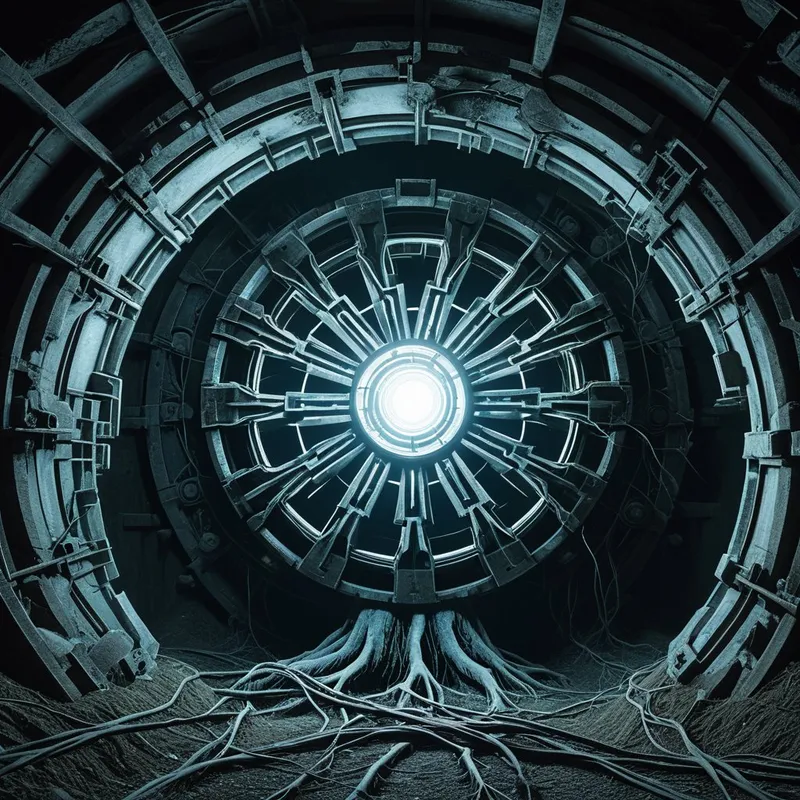
The transmutation here is Recovery and Reintegration. The prima materia is the feeling of absence, the hollow echo. The heat is applied through the intense, often grief-laden, process of conscious recollection—not just of events, but of the sensory and emotional truths that were too potent to carry at the time. The pressure is the friction between who you had to become to survive and who you were before the fragmentation.
This is not a gentle simmer. It is the forge-heat of honestly asking: "What did I leave behind to be loved? To be safe? To belong?" The grief that arises is the solvent. As you allow yourself to feel the full weight of that old abandonment—not of a person, but of a part of your own spirit—the sealed vault begins to dissolve. The retrieved essence, once molten with old pain and pristine potential, is then poured into the mold of your present life. It cools into a new strength, a new capacity. The hollow fills not with memory, but with presence. The sovereign is the one who has returned from their own exile, carrying the flag of their reclaimed territory.
The Integration Protocol
Question 1: When you feel that somatic hollow, that pull, what is the first memory—not an event, but a sensation (a smell, a quality of light, a texture)—that surfaces? Don't analyze it; just describe it.
Question 2: What is one belief, one rule for being, that you adopted at the same time you lost touch with that essential part of yourself? (e.g., "Vulnerability is dangerous," "My creativity is impractical," "My anger is unacceptable.")
Question 3: If that lost part could send a one-sentence message to your present life, what would it be? Let it speak without censorship.
Action 1 (Somatic Anchoring): When the echo arises, place a hand over your sternum. Breathe into that space for three cycles. On the fourth inhale, imagine drawing breath from a place in your past that holds resonance—a childhood room, a patch of woods, a shoreline. Hold it. On the exhale, release it into your present surroundings. You are not bringing the past forward; you are establishing an airway.
Action 2 (Unstructured Reclamation): Set a timer for 10 minutes. With non-dominant hand, let yourself draw or write abstractly. No words, no forms. Just let the line move. The goal is not art, but to bypass the managerial mind. Afterward, write a single line with your dominant hand: "This is what wants to return."
Action 3 (Ritual of Reception): Find a small object—a stone, a coin, a key. Hold it and state aloud: "I am ready to receive what was left in trust." Place it on your windowsill or altar for one lunar cycle. Observe what shifts in your internal atmosphere.
Final Validation
This is perhaps the most arduous journey—to turn and face the road you have walked, not with regret, but with a reclaiming intent. It asks for the courage to grieve not for what was done to you, but for what you, in your brilliant survival, had to leave behind. Do not mistake this ache for brokenness. It is the opposite. It is the sign of a system preparing for a greater wholeness, the strain of a sealed door beginning to yield. The treasure was never lost. It was kept safe, in the perfect darkness, waiting for you to grow strong enough to carry it. The return is always, and only, to yourself. And you are already here.