Dichotomy of Apollo and Dionysus Myth Meaning & Symbolism
The primal myth of two divine brothers embodying the opposing forces of measured light and wild ecstasy, whose eternal tension shapes the soul.
The Tale of the Dichotomy of Apollo and Dionysus
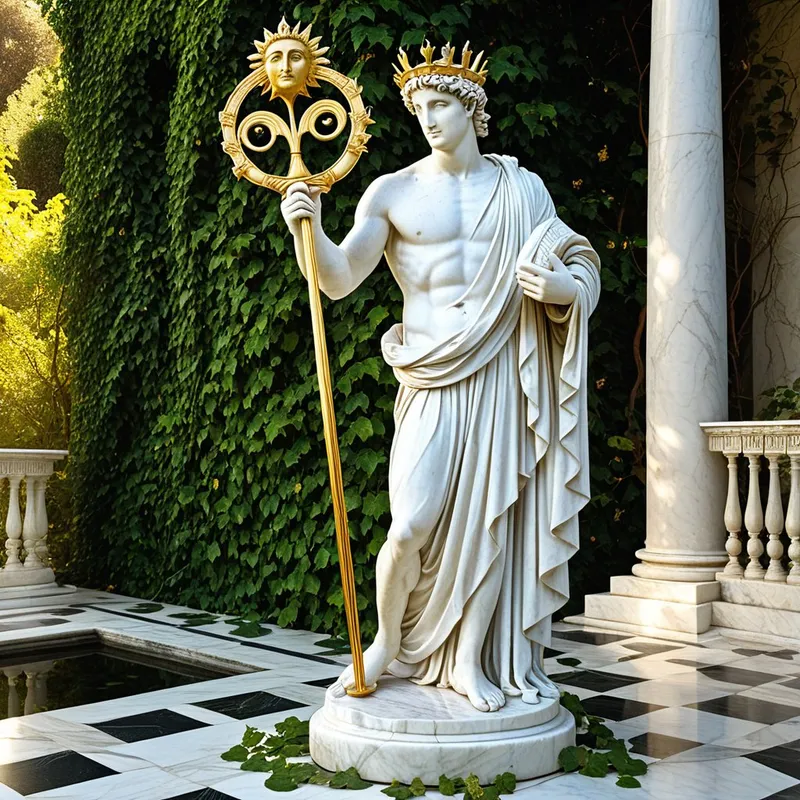
Hear now of the two faces of the world, born not of mortal womb, but of the sky’s thunder and the sea’s deep sigh. In the high halls of Olympus, where the air is clear and reason sits upon a throne of light, dwells Apollo. His step is measured, his form a sculpture of perfect proportion. The sun is his chariot, the golden lyre his voice. Where he walks, boundaries appear: the straight road, the clear prophecy, the individual form standing distinct against the horizon. His is the realm of the “I,” the principle that says, “This, and not that.”
But from the dark earth and the secret fire of the womb comes another. Dionysus</abysus, the twice-born, the god who arrives. He is not found in the high citadel but on the mountain path, in the torch-lit grove where the night is alive. His breath is the scent of fermenting grapes and damp soil. His followers, the Maenads, move not as individuals but as one pulsing, singing body. The thyrsus in his hand is not a scepter of rule but a wand of unlocking. Where he walks, boundaries dissolve: the self flows into the other, the individual into the chorus, humanity into the beast, sanity into sacred madness. His is the realm of the “All,” the principle that whispers, “I am that too.”
They are brothers, yet they stand at the opposite ends of the soul’s great lyre. Apollo calls for clarity, for the beautiful illusion of the separate self gazing upon a world of distinct forms. Dionysus calls for surrender, for the terrifying joy of losing that self in the churning, creative chaos from which all forms are born. One god builds the temple with perfect lines; the other tears down its walls with revelry. One illuminates the dream; the other is the dreamer, lost in the dream. Their myth is not one of battle, but of eternal tension—the inhale and the exhale of existence itself. The world holds its breath in the space between them.
Cultural Origins & Context
This profound dichotomy was not merely a philosophical fancy, but a lived, cultural reality articulated most powerfully by the philosopher Friedrich Nietzsche in The Birth of Tragedy. However, its roots dig deep into the soil of ancient Greek experience. Apollo’s cult centers—Delphi, Delos—were places of order, prophecy, and civic religion. His priests gave measured counsel; his festivals celebrated poetry, athletics, and civic virtue.
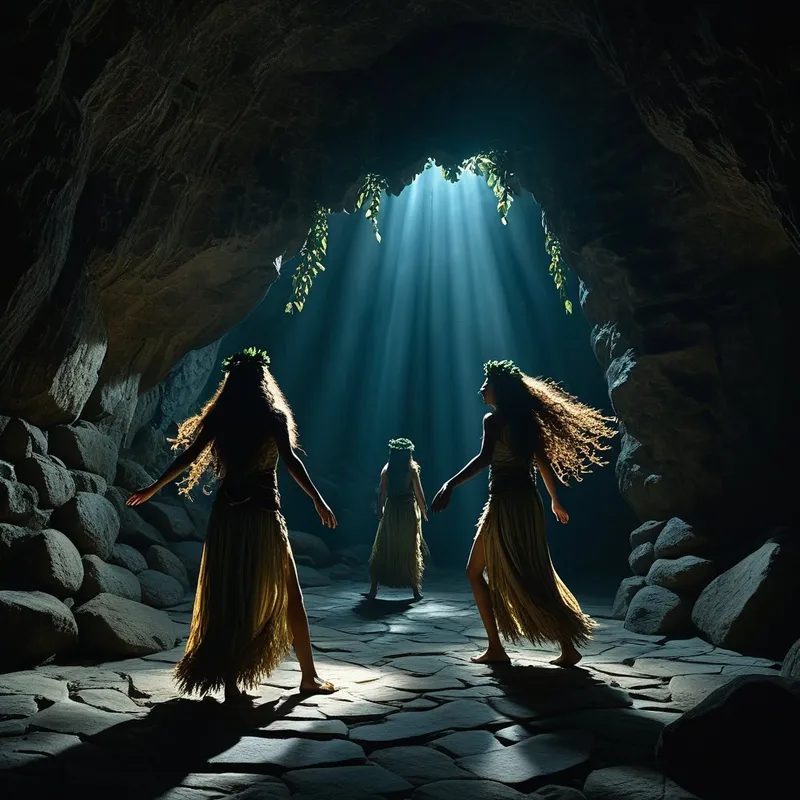
Dionysus, in contrast, was the god of the margins. His worship was often led by women and involved leaving the polis (the city-state) for the wilds of the mountain (oreibasia). The City Dionysia may have been a formalized, state-sponsored event, but at its heart lay the ecstatic, communal rites of the thiasos (his retinue). Greek tragedy itself, performed at Dionysus’s festival, was the cultural vessel for this tension. The structured, poetic dialogue (Apollonian) gave form to the raw, catastrophic passions of the heroes (Dionysian). The myth was passed down not as a single story, but as a pervasive pattern evident in art, ritual, and literature, serving to contain and express the two fundamental, and opposing, human impulses toward order and ecstatic release.
Symbolic Architecture
Apollo and Dionysus are not just gods; they are primordial psychological principles. Apollo symbolizes the principium individuationis—the principle of individuation. He is the force that creates the ego, the persona, the clear boundary between self and world. He is light, form, logic, dream, and the beautiful appearance that veils the underlying chaos. He is the sculptor of the soul.
Apollo’s gift is the dream of separation, the beautiful illusion that allows us to say "I am."
Dionysus symbolizes the undifferentiated, primal unity—the Urgrund. He is the force that dissolves the ego, returning the individual to the oceanic state of the collective unconscious, to nature, to the ecstatic terror and joy of non-being from which being springs. He is intoxication, instinct, chaos, embodiment, and the raw, creative drive that shatters forms to make new ones.
Dionysus’s gift is the ecstasy of dissolution, the terrifying truth that whispers, "You are also everything you are not."
Their dichotomy maps onto countless human experiences: reason versus emotion, civilization versus nature, conscious control versus unconscious impulse, the isolated self versus the communal body. The myth warns that an excess of Apollo leads to sterile rigidity, a life of mere appearance without substance. An excess of Dionysus leads to formless disintegration, madness, and the loss of self in the abyss.
The Dreamer's Resonance
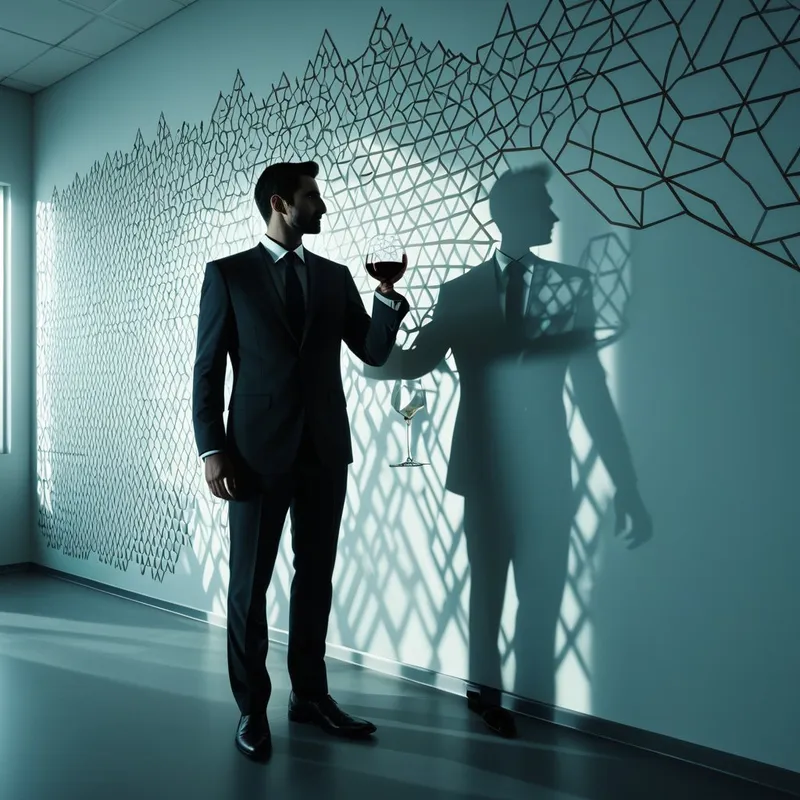
When this myth stirs in the modern psyche, it often manifests in dreams of stark opposition or unsettling fusion. You may dream of being trapped in a perfectly ordered, glass-walled building that begins to be overgrown with wild, suffocating vines. You might see two figures—one in a sharp suit giving a presentation, the other a wild dancer—who are revealed to be the same person. Or you may experience the somatic terror of dissolution: your body melting into a crowd, your face losing its features in a mirror.
Such dreams signal a profound somatic and psychological process: the ego’s confrontation with what it has excluded. The Apollonian dream-self, our conscious identity, is being challenged by the Dionysian shadow—the repressed instincts, emotions, and chaotic creative energies. The dream is the psyche’s attempt to re-introduce this lost vitality, often in a frightening form because the conscious mind perceives it as annihilation. The tension in the dream is the tension of integration; the psyche is trying to heal its one-sidedness, to bring the wild god in from the cold mountain.
Alchemical Translation
The individuation process, the alchemical work of becoming whole, is modeled perfectly in the reconciliation of this dichotomy. It is not about choosing Apollo or Dionysus, but about forging a sacred marriage between them. The first stage is often an Apollonian phase: building a strong enough ego, a coherent enough “I,” to have something that can later be surrendered without complete destruction. This is the cultivation of discipline, self-knowledge, and form.
The crucible moment is the Dionysian nigredo: the voluntary or involuntary dissolution of that rigid structure. This is the dark night, the creative chaos, the midlife crisis, the breakdown that makes a breakthrough possible. It feels like madness because it is the death of the old self.
The alchemical gold is born not from light alone, nor from darkness alone, but from the conscious tension between them.
The final stage is the coniunctio oppositorum—the conjunction of opposites. Here, the integrated self learns to hold the tension. One gains the Apollonian capacity for clarity, choice, and beautiful expression, but it is now infused with Dionysian depth, passion, and connection to the unconscious wellspring. The individual becomes a vessel through which the formless creative chaos can flow into meaningful form. The lyre of Apollo is played with the ecstatic spirit of Dionysus. One becomes, in the truest sense, a living myth—a conscious participant in the eternal dialogue between the dream of individuality and the truth of the boundless whole.
Associated Symbols
Explore related symbols from the CaleaDream lexicon: