Dhanvantari Myth Meaning & Symbolism
The celestial physician who arose from the churning sea of creation, bearing the pot of immortality, embodying the divine origin of healing.
The Tale of Dhanvantari
Listen, and let the story be told of the time before time, when the cosmos was a sea of potential, and the gods themselves grew weary. A great malaise had fallen upon the Devas. Their radiance was dimming, their strength sapped by the relentless shadow of mortality. Across the chasm, the Asuras, the demons, hungered for a power that would make them invincible, rulers of all the worlds.
A council was called on the shores of the Kshirasagara, the ocean of milk. Its waters were not of this earth, but of pure potential, white and endless under a starless sky. The great Vishnu spoke, his voice the sound of deep tides. "There is a way," he intoned. "But it requires a union of opposites. You must churn this ocean itself. From its depths will arise Amrita. But you cannot do this alone. You need the strength of your opposites. You must enlist the Asuras."
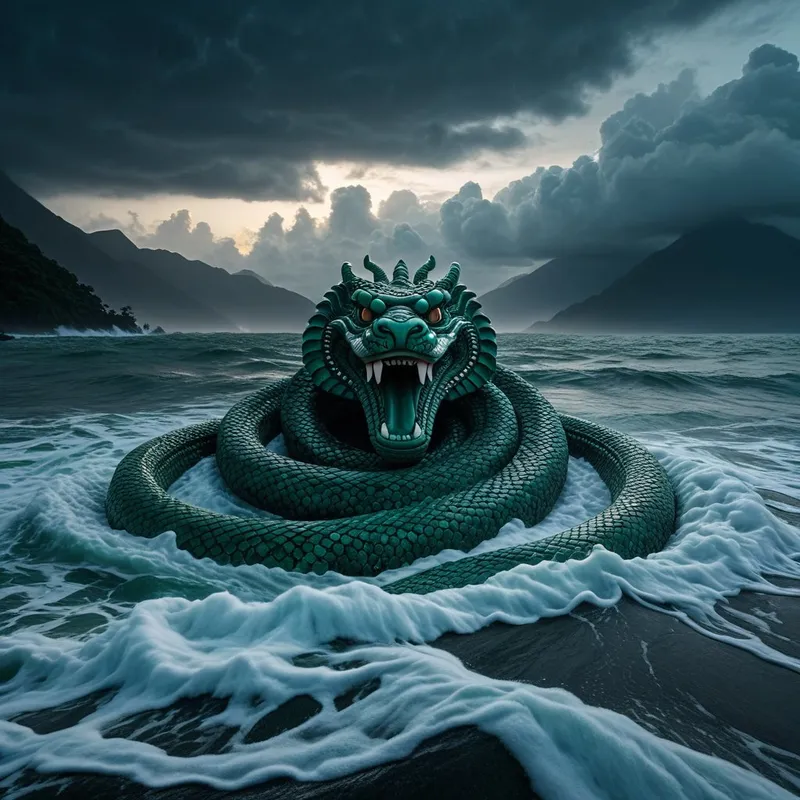
A pact was struck, fragile as sea-foam. For a churning rod, they uprooted the mighty mountain Mandara. For a churning rope, they persuaded the king of serpents, Vasuki, to coil himself around the mountain's peak. The Devas took the serpent's tail. The Asuras, suspecting trickery, grasped the head. And they began to pull.
The air filled with the groan of stone and the hiss of the great serpent. The ocean frothed and swirled, a tempest of cream and pearl. For centuries they pulled, their arms burning, their resolve tested. The first fruits of their labor were not nectar, but poison—a virulent, world-destroying toxin called Halahala, which threatened to end all things. In desperation, they called to Shiva, who swallowed the poison, holding it in his throat, turning his neck blue, saving creation through containment.
And still they churned. From the depths emerged wonders and terrors: the wish-fulfilling cow, the goddess of wine, the moon, a celestial parasol. The ocean yielded its treasures, but not the one they sought. Fatigue turned to despair. Then, as the cosmic dawn broke in colors unseen on earth, the waters began to glow with a soft, golden light. The churning reached a crescendo. And from the very heart of the whirlpool, he emerged.
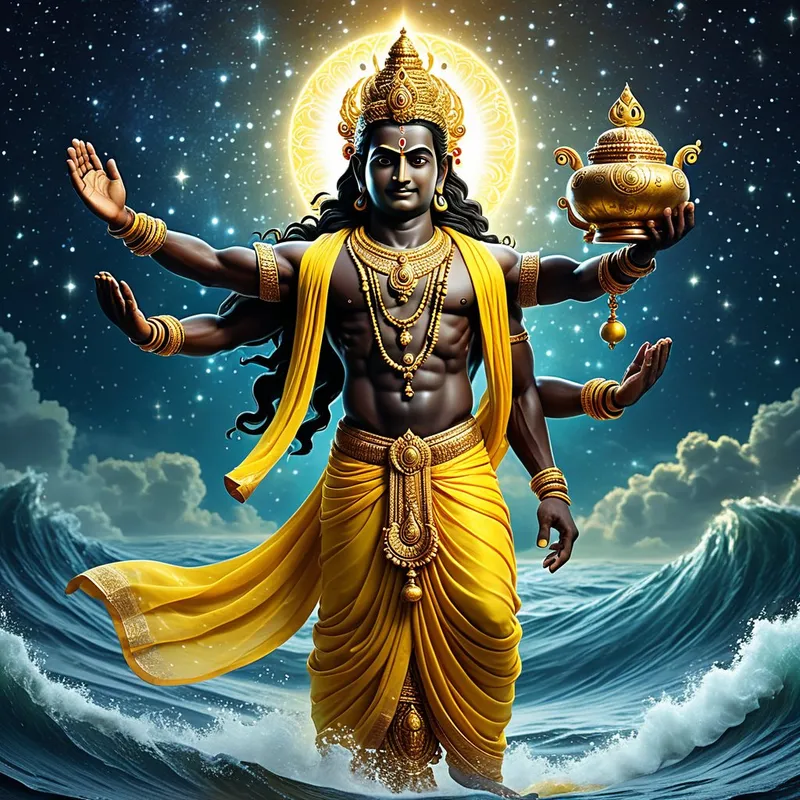
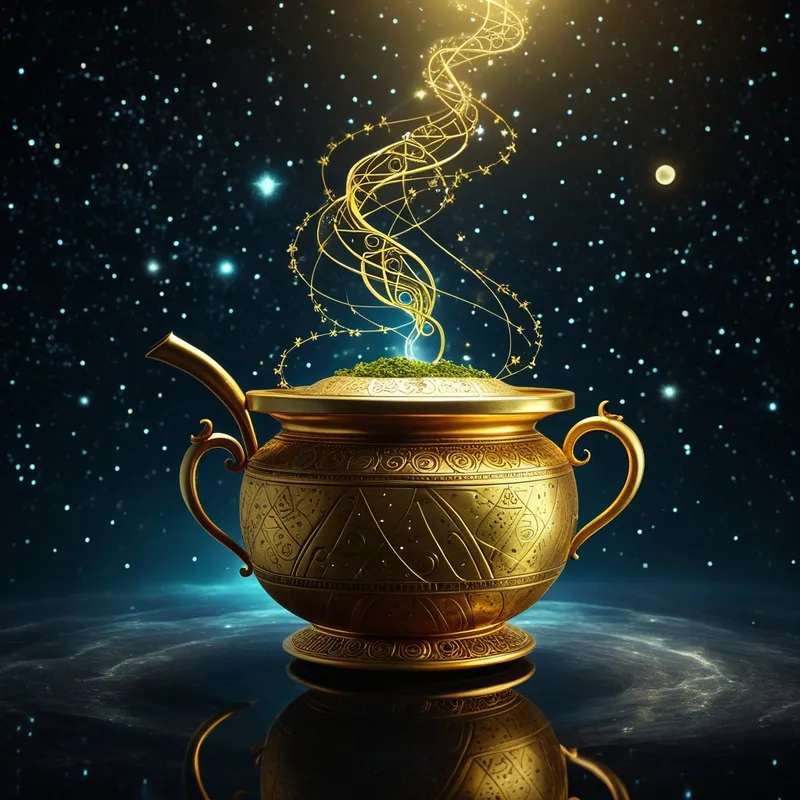
He rose not with the thunder of a god of war, but with the serene authority of one who understands the fabric of life. His skin was the blue-black of a healing night sky, his eyes held the calm of deep, still waters. He was adorned in yellow silks, the color of healing turmeric and the vital sun. In one of his four hands, he held aloft the shining, radiant pot, the Kamandalu, brimming with the liquid light of Amrita. He was Dhanvantari, the physician of the gods, the embodiment of healing itself, born not from a womb, but from the collective striving of the universe. He had arrived, and with him, the promise of wholeness.
Cultural Origins & Context
The myth of Dhanvantari is inextricably woven into the grand narrative of the Samudra Manthan, a foundational story found in ancient texts like the Mahabharata, the Vishnu Purana, and the Bhagavata Purana. It functioned as a cosmic etiology, explaining the divine origin of medicine (Ayurveda). Dhanvantari is not merely a character in a story; he is considered an avatar of Vishnu, signifying that the act of preserving life and health is a sacred, divine function.
In society, this myth was told by priests, scholars, and practitioners of Ayurveda to sanctify the healer's art. It positioned medicine not as a mere technical skill, but as a sacred knowledge (Vidya) revealed by the divine. The story served to elevate the physician's role, connecting their work to the primordial, cosmic struggle for immortality and balance. Festivals like Diwali and Dhanvantari Jayanti honor him, with rituals that include cleaning medical instruments and offering prayers for health, embedding the myth into the cyclical rhythm of communal and personal well-being.
Symbolic Architecture
The myth is a profound allegory for the process of achieving wholeness, where healing is the ultimate treasure wrested from chaos.
The elixir is always found in the depths of the very chaos we seek to avoid.
The Kshirasagara represents the unconscious, the primordial soup of potential from which all forms of life and consciousness emerge. The churning is the necessary, often painful, process of engaging with this depth—the psychological work of confronting shadow, integrating opposites, and stirring up what lies buried. The Devas and Asuras symbolize the eternal internal conflict between our aspirational, ordered selves (light, spirit) and our primal, desirous selves (shadow, matter). Wholeness cannot be achieved by one alone; it requires the tension and cooperation of both.
Dhanvantari’s emergence after the poison is critical. The Halahala represents the toxic byproducts of inner work: repressed trauma, shame, rage. True healing cannot bypass this stage; the poison must first be acknowledged and contained (as Shiva does) before the nectar can appear. Dhanvantari himself is the archetype of the healer that arises from within the system. He is not an external savior, but the embodied result of the churning process—the innate, guiding intelligence of the organism toward balance and life.
The Dreamer's Resonance
When this myth stirs in the modern psyche, it often manifests in dreams of profound inner turmoil yielding to a moment of clarity or remedy. One might dream of being lost in a vast, foggy sea, or of engaging in a exhausting, seemingly pointless task of pulling a great weight. These are somatic echoes of the "churning."
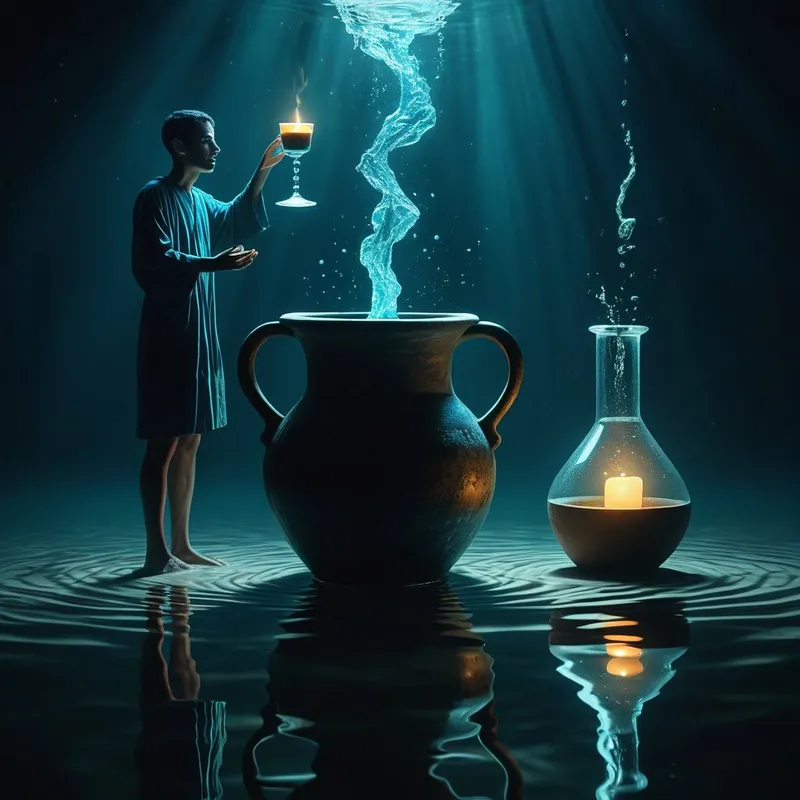
The dreamer may then encounter a figure of calm authority—a doctor, a wise stranger, or even a luminous version of themselves—offering a simple cup of water that feels like life itself. This is Dhanvantari’s arrival. Alternatively, the dream may focus on the vessel, the Kamandalu: finding a precious vial in muddy water, or protecting a fragile, glowing object. Such dreams signal a critical phase in a healing journey. The psyche is announcing that through the arduous work of confronting inner conflict (the churning), a core, healing intelligence is now emerging. It is the dreamer’s own inner physician coming online, offering the "nectar" of self-compassion, correct diagnosis, or the intuitive next step toward wholeness.
Alchemical Translation
The individuation process, the journey toward becoming an integrated Self, is perfectly modeled by the Samudra Manthan. We begin in a state of potential, but also of malaise—a sense that something vital is missing. The alchemical work begins with the opus contra naturam, the work against nature, which here is the conscious decision to engage in the difficult churning of self-examination.
The mountain of the ego must be turned by the serpent of instinct, pulled by the gods of our ideals and the demons of our passions.
The first product is inevitably the poison: the shadow material, the neuroses, the painful memories we have submerged. The Shiva-function, the transcendent consciousness, must activate to contain this toxicity without being destroyed by it, turning it into a transformative attribute (the blue throat). This is the stage of nigredo, the blackening, essential for purification.
Only after enduring this does the true treasure manifest. Dhanvantari’s emergence is the arrival of the Mercurius, the guiding spirit of the work. He represents the synthesis that arises from the conflict. For the modern individual, this is the moment when struggle crystallizes into wisdom. The "Amrita" is not literal immortality, but the achievement of psychic integrity—a state where one is no longer at war with oneself. The healer (Dhanvantari) and the healed become one. The individual becomes the vessel (Kamandalu) and the content (Amrita) of their own wholeness, having distilled it from the chaotic ocean of their own experience.
Associated Symbols
Explore related symbols from the CaleaDream lexicon: