Dewi Ratih Myth Meaning & Symbolism
The myth of the moon goddess Dewi Ratih, whose celestial dance and sacrifice created the rhythm of time and the enduring light of love in the darkness.
The Tale of Dewi Ratih
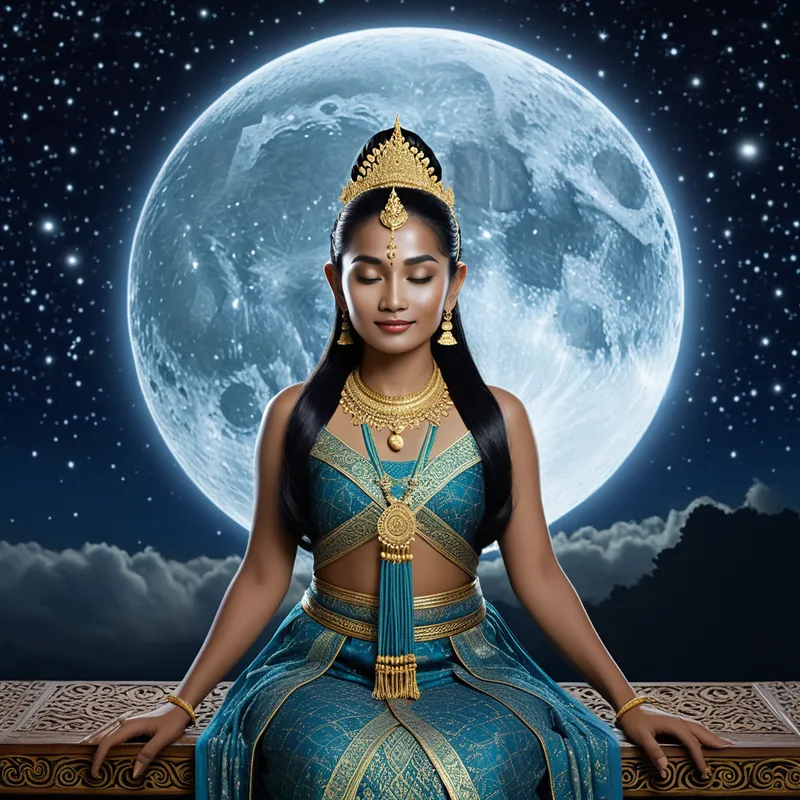
Listen. Before there was time as we know it, there was only the great, silent breath of the cosmos. In the heavens above the ancient isles of Java, there dwelt a radiance so gentle it could soothe the most restless soul. This was Dewi Ratih, the Moon. She was not a cold stone in the sky, but a living goddess, a celestial dancer whose pavilion was the silver orb itself. Her light was a balm, a lullaby for the world below. With her was her eternal consort, Bathara Surya, the Sun, whose fierce gold brought forth the day.
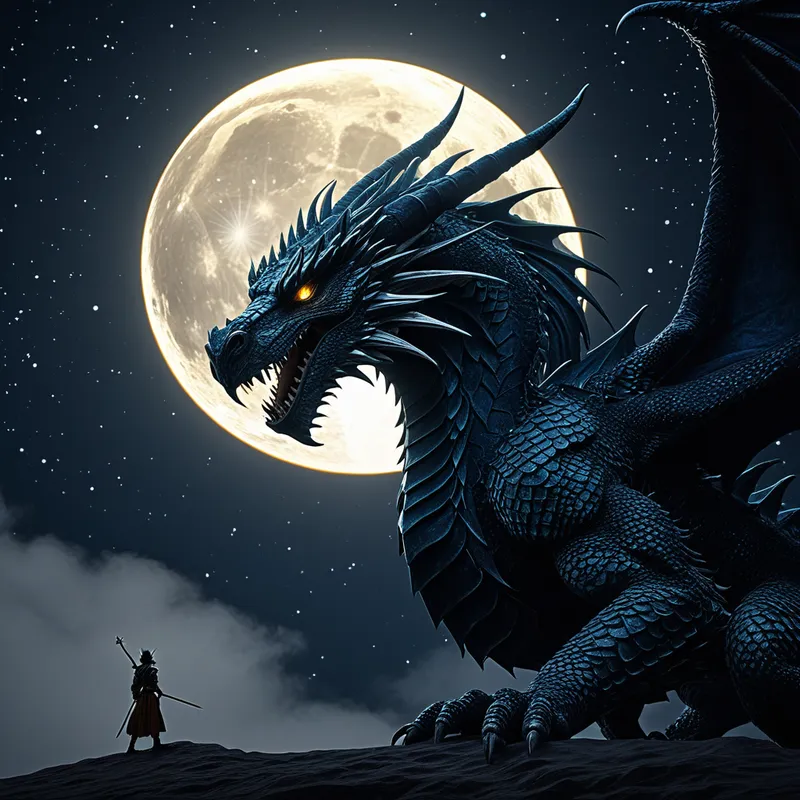
Their dance was the first rhythm: her soft silver retreating as his brilliant gold advanced, a perfect, loving balance that ordered the universe. But in the deep wells of shadow, where not even starlight reached, a being of pure hunger stirred. This was Kala Rau, a mighty asura. He had drunk the amerta, the nectar of immortality, but the gods had severed his head before the elixir could pass his throat. Now, a disembodied head with a ravenous maw, he sailed the heavens, eternally jealous of the luminous order of Ratih and Surya. His desire was not for balance, but for consumption—to swallow the light itself and plunge creation into his own endless night.
The conflict began not with a roar, but with a creeping chill. The first night it happened, the creatures of the Earth looked up and gasped. A blot of absolute blackness, a maw of nothingness, was sliding over Dewi Ratih’s gentle face. Kala Rau had caught her. The world held its breath. The comforting rhythm was broken; the familiar lullaby was being swallowed. In that terrible silence, you could feel the terror of primordial chaos returning.
But Dewi Ratih did not scream. In that moment of cosmic violation, she understood the nature of the hunger that sought to devour her. It was a hunger for the very rhythm she embodied. And so, she made a choice—a choice that would echo through all of time. She allowed herself to be consumed. She surrendered her perfect, whole light into the darkness of Kala Rau’s throat.
Yet, she was immortal. Kala Rau could swallow her, but he could not digest her. Her luminous essence remained intact within him. And because she had drunk of the same immortal amerta, she was indestructible. After a moment of terrifying darkness, she would emerge again, whole and radiant, from the back of his throat. Bathara Surya, too, faced this devouring, and he too emerged, blazing. But the price was set. The perfect, untroubled dance was over. Now, their luminous love would forever be punctuated by moments of shadow, by the recurring hunger of the chaos that sought to destroy their rhythm. In her surrender, Dewi Ratih did not defeat the darkness; she integrated it. She made the eclipse part of the dance. The rhythm was no longer simple—it was profound, a pulse born of eternal return, of love persisting through periodic devouring.
Cultural Origins & Context
The myth of Dewi Ratih is deeply woven into the spiritual fabric of Java and Bali, a localized interpretation of the pan-Indian myth of the eclipse, where the demon Rahu chases the moon (Chandra). In the Indonesian archipelago, this story was not merely an astronomical explanation. It was transmitted through the oral traditions of dalang (shadow puppet masters) performing the Wayang Kulit, and preserved in ancient lontar palm-leaf manuscripts.
Her story functioned as a cosmological anchor. In agrarian societies governed by lunar calendars for planting and harvesting, and by solar cycles for the day, the myth explained the essential, sometimes frightening, interruptions to these cycles—the eclipses. It transformed these events from terrifying omens into part of a sacred, predictable narrative. Dewi Ratih’s endurance modeled resilience. She was invoked in rituals related to love and marriage, symbolizing a love that could withstand periodic "eclipses" of conflict or hardship. Her myth taught that rhythm is not the absence of disruption, but the graceful, inevitable recovery from it.
Symbolic Architecture
At its core, the myth of Dewi Ratih is a masterful symbolic map of consciousness itself. She represents the principle of Eros—not merely romantic love, but the connective, rhythmic, and reflective principle of the psyche. The Moon is the mirror of the Sun; it does not generate light but beautifully reflects it, symbolizing the reflective nature of the soul and the unconscious.
The eternal is not found in static perfection, but in the courageous return to light after each necessary descent into darkness.
Kala Rau is the embodiment of the devouring complex—that psychic force (be it trauma, addiction, rage, or deep-seated fear) that seems to swallow our wholeness, our light, our connection. The eclipse is the symbolic representation of depression, dissociation, or any state where our conscious identity is overtaken by a shadow content. The genius of the myth lies in its resolution: the light is not destroyed. It is swallowed, contained within the darkness, and then released. This teaches that our core Self (the Self) is indestructible, even when completely obscured. The rhythm of life, therefore, includes these periods of obscuration. They are not mistakes, but part of the cosmic, and psychological, dance.
The Dreamer's Resonance
When this mythic pattern stirs in the modern dreamer, it often manifests as dreams of being pursued, swallowed, or enveloped by a vast darkness or a monstrous entity. One may dream of a beloved light—a lamp, a moon, a child—being extinguished or consumed. Alternatively, the dream may feature a powerful, rhythmic event that is suddenly and terrifyingly interrupted.
Somatically, this can correlate with feelings of constriction in the throat or chest, a literal "swallowing" of one's voice or breath. Psychologically, the dreamer is likely experiencing an "eclipse" in their waking life: a relationship in shadow, a creative light dimmed, a personal rhythm broken by loss or crisis. The dream is not merely replaying the anxiety; it is, like the myth, asserting the pattern. It is the unconscious reminding the ego that this devouring is part of a cycle. The profound healing in such dreams lies in the moment after the terror—the often-unremembered moment of re-emergence, of catching one's breath again in the light. The psyche is rehearsing resilience, modeling Dewi Ratih’s passive, yet invincible, endurance.

Alchemical Translation
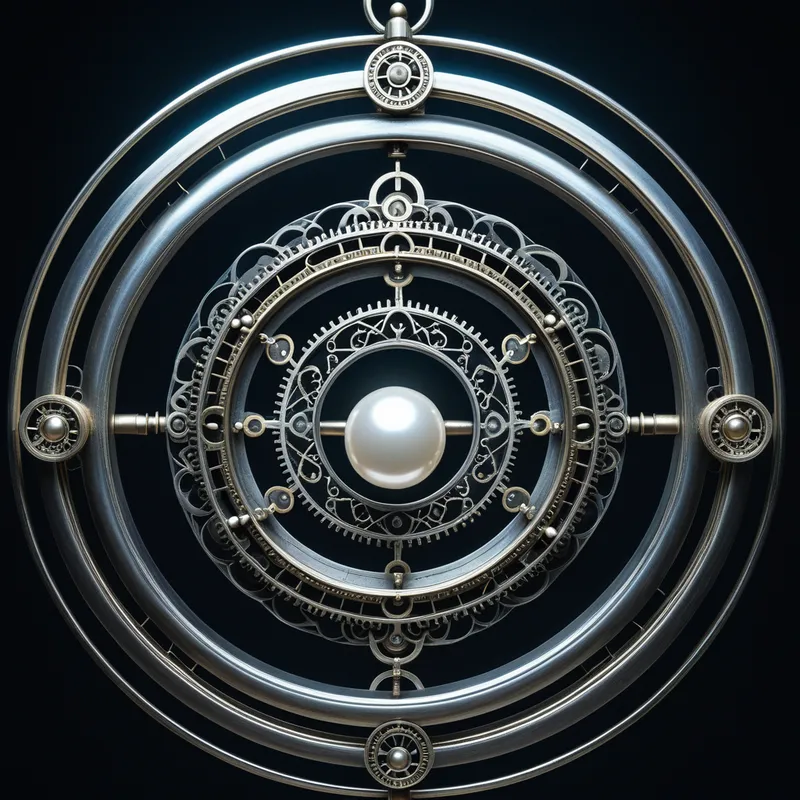
The individuation process, the journey toward psychic wholeness, is perfectly modeled by this myth. It is the alchemy of transforming a naive, perfect rhythm (the unconscious paradise of the initial lunar cycle) into a conscious, durable rhythm that incorporates the shadow.
The first, unconscious state is the simple alternation of sun and moon—the persona and the anima/animus in apparent harmony. Then, the Shadow, in the form of Kala Rau, erupts. It demands to be fed. The heroic ego’s initial impulse is to fight, to slay the dragon. But the myth proposes a more profound solution: sacrificial surrender. One must allow the complex to "swallow" the identified conscious attitude. This is the dark night of the soul, the nigredo of alchemy.
The goal is not to live in unbroken light, but to become the vessel that can contain both light and darkness, and still emerge whole.
Within the belly of the beast—within the depression, the grief, the failure—the work of separatio occurs. The immortal core of the Self (Dewi Ratih herself) is separated from the temporary identity that was consumed. Then comes the albedo, the re-emergence. The light returns, not because the dragon is dead, but because it has been integrated into the larger cycle. The individual no longer fears the eclipse, for they know it is temporary and part of their own cosmic law. They have achieved a rhythm that is conscious, resilient, and deeply loving precisely because it has survived devouring. They have become, in their own right, a celestial body whose light is defined by its courageous returns.
Associated Symbols
Explore related symbols from the CaleaDream lexicon:
- Moon — The primary symbol of Dewi Ratih, representing reflective consciousness, cyclical time, the rhythm of Eros, and the enduring light that returns after every period of darkness.
- Sun — As Bathara Surya, it represents the complementary principle of Logos, conscious clarity and vitality, whose dance with the Moon creates the fundamental rhythm of life.
- Dragon — Embodied by Kala Rau, it is the devouring shadow, the chaotic complex that threatens order, yet whose periodic assaults ultimately define and deepen the rhythm it seeks to destroy.
- Eclipse — The central event of the myth, symbolizing the temporary but total obscuration of light by shadow, a necessary crisis that tests and proves the immortality of the core Self.
- Rhythm — The ultimate creation of the myth, the cosmic order born from sacrifice, representing the pattern of all life, love, and psychological process that includes both light and darkness.
- Sacrifice — Dewi Ratih's conscious choice to be swallowed, representing the necessary surrender of a naive state to achieve a more profound, resilient form of wholeness.
- Light — The immortal essence of the goddess, symbolizing the indestructible core of the psyche, love, and consciousness that persists through all trials.
- Darkness — Not merely as evil, but as the necessary contrast and devouring force that gives rhythm its depth and meaning, the shadow that defines the light.
- Love — The enduring bond between Ratih and Surya, which transcends their periodic separations, modeling a love that is not static perfection but dynamic, resilient connection.
- Time — Created by the interrupted dance, it moves from a static eternal present to a cyclical progression marked by returns, symbolizing psychological growth through cycles of integration.
- Mirror — Dewi Ratih as the moon mirrors the sun's light, symbolizing the reflective capacity of the soul and the unconscious to receive and manifest consciousness in a different form.
- Return — The most critical action in the myth, the eternal re-emergence from darkness, symbolizing resilience, healing, and the promise that no state of suffering is final.