Deucalion and Pyrrha Myth Meaning & Symbolism
The sole survivors of a divine flood, guided by an oracle, repopulate the earth by casting the 'bones of their mother'—stones—behind them.
The Tale of Deucalion and Pyrrha
Listen, and hear the tale of the great unmaking.
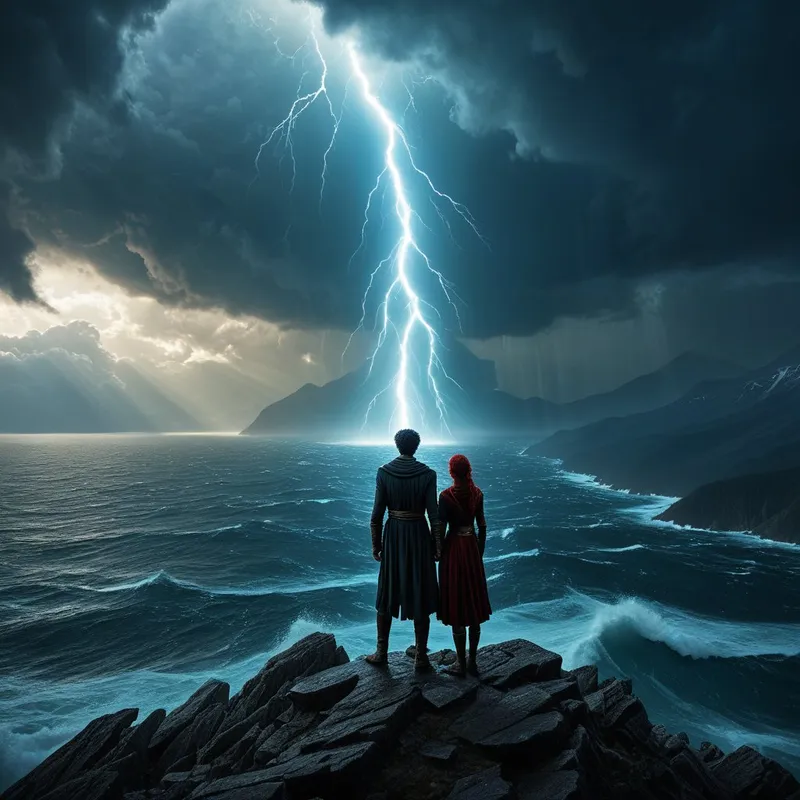
The age was of bronze, and the hearts of men had turned to match it—hard, clanging, pitiless. Zeus, looking down from Olympus, saw not piety but a seething corruption, a world poisoned by its own hubris. The air grew thick with the scent of impending wrath. In this grim twilight, one man, [Deucalion](/myths/deucalion “Myth from Greek culture.”/), son of the fore-thinker [Prometheus](/myths/prometheus “Myth from Greek culture.”/), was warned. His father, bound in eternal torment for his love of humankind, whispered a prophecy on [the wind](/myths/the-wind “Myth from Various culture.”/): build an ark.
Deucalion, with his wife Pyrrha, labored. They built not a grand ship, but a humble, pitched chest, a floating coffin for a dying world. As they sealed themselves within, [the sky](/myths/the-sky “Myth from Persian culture.”/) broke. The breath of the Notus wind became a roar. [Poseidon](/myths/poseidon “Myth from Greek culture.”/) unleashed his trident, and the rivers leapt from their beds, the seas climbed over the cliffs. The cries of a drowning world were muffled by [the deluge](/myths/the-deluge “Myth from Mesopotamian culture.”/), a nine-day-and-night symphony of erasure. All that was, was washed clean in a terrible, silent baptism.
Their chest was tossed on the fury, a leaf in a cosmic storm, until at last it ground to a halt on the only peak left piercing the universal sea: the twin-summitted Parnassus. The waters sighed and retreated, revealing a naked, muddy sphere, scoured of life, memory, and sound. They stepped onto the silent earth, the last man and the last woman, alone with the enormity of their survival and the crushing weight of their solitude.
Despair threatened to swallow them whole. But the will of the gods is a [labyrinth](/myths/labyrinth “Myth from Various culture.”/), not a dead end. They made their way to a sanctuary of [Themis](/myths/themis “Myth from Global/Universal culture.”/), its altar cold. With prayers choked by grief, they begged to know: how could two people re-people the empty womb of [the world](/myths/the-world “Myth from Tarot culture.”/)?
The oracle’s voice, ancient and dusty as stone, gave a riddle: “Depart from my temple, veil your heads, loosen the girdles of your garments, and cast behind you the bones of your great mother.”
Horror struck Pyrrha. To disturb the bones of the dead was an abomination! But Deucalion, his father’s cunning in his blood, saw through the shroud of the words. “Our great mother,” he said, his voice a whisper in the vast silence, “is Gaia herself. And the bones of Gaia… are the stones that lie upon her body.”
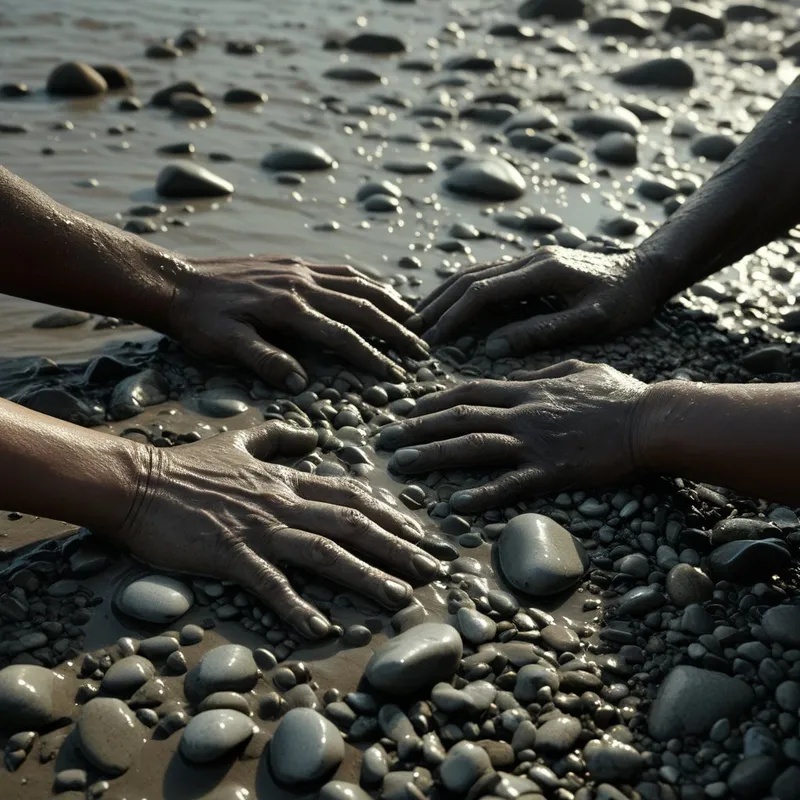
Hope, fragile as a newborn [thing](/myths/thing “Myth from Norse culture.”/), flickered. They veiled their heads, loosened their robes in a gesture of mourning and humility, and stooped to [the earth](/myths/the-earth “Myth from Hindu culture.”/). Without looking back, they picked up the rough, grey stones and cast them over their shoulders. A sound like soft thunder rumbled where the stones fell. The hard forms began to soften, to stretch. The stones cast by Deucalion became men, rising from the mud with strength in their limbs. The stones cast by Pyrrha became women, their forms gentle yet resilient. From the inanimate bones of the world, a new, living race was born: the Laoi, the people of stone, hardy and enduring. Life had not returned; it had been fundamentally remade.
Cultural Origins & Context
This myth of cosmic flood and regeneration is one of Greece’s most profound foundational narratives, primarily preserved in the poetic catalog of Hesiod and later elaborated by the Roman poet Ovid. It functioned as an etiological myth, explaining the origins of humanity’s current, hardened state—a people born from stone, resilient but perhaps carrying a latent rigidity from their genesis. It served as a divine justification for the cycle of ages (from Gold to Iron), positioning the current race as survivors of a divine reset.
More than just a story, it was a cultural anchor. It explained the presence of mysterious megalithic stones (often called “throwstones”) in the Greek landscape, imbuing the very geology with sacred narrative. The myth was performed and recalled not as a simple fable, but as a sacred history that connected the people to the land in the most literal way: they were the land, reconstituted. It reinforced the necessity of heeding divine wisdom (through oracles like Themis) and the value of clever, interpretative thought—a gift from the Titan Prometheus to his son.
Symbolic Architecture
At its [heart](/symbols/heart “Symbol: The heart symbolizes love, emotion, and the core of one’s existence, representing deep connections with others and self.”/), this is a myth of symbolic [logic](/symbols/logic “Symbol: The principle of reasoning and rational thought, often representing order, structure, and intellectual clarity in dreams.”/) and creative interpretation triumphing over literal [despair](/symbols/despair “Symbol: A profound emotional state of hopelessness and loss, often signaling a need for transformation or surrender to deeper truths.”/). The world is not merely destroyed and repopulated; it is transmuted. [The flood](/myths/the-flood “Myth from Biblical culture.”/) represents the total [dissolution](/symbols/dissolution “Symbol: The process of breaking down, dispersing, or losing form, often representing transformation, release, or the end of a state of being.”/) of a corrupt or outworn psychic [structure](/symbols/structure “Symbol: Structure in dreams often symbolizes stability, organization, and the framework of one’s life, reflecting how one perceives their environment and personal life.”/)—a necessary, terrifying annihilation of the known world, [the ego](/myths/the-ego “Myth from Jungian culture.”/)’s [kingdom](/symbols/kingdom “Symbol: A kingdom symbolizes authority, belonging, and a sense of identity within a larger context or community.”/).
The most profound truths are often delivered as riddles, and salvation lies not in blind obedience, but in the courageous act of interpretation.
The “bones of the [mother](/symbols/mother “Symbol: The symbol of ‘Mother’ represents nurturing, protection, and the foundational aspect of one’s emotional being, often associated with comfort and unconditional love.”/)” are the ultimate [symbol](/symbols/symbol “Symbol: A symbol can represent an idea, concept, or belief, serving as a powerful tool for communication and understanding.”/). They represent the enduring, essential structure beneath the flesh of lived experience—the archetypal patterns, the primordial laws (Themis), the bedrock of the [psyche](/myths/psyche “Myth from Greek culture.”/) itself. To mistake them for literal bones is to fall into sterile literalism and [horror](/symbols/horror “Symbol: Horror in dreams often symbolizes deep-seated fears, anxieties, and unresolved conflicts that the dreamer faces in waking life.”/). To recognize them as stones is to see the potential for [life](/symbols/life “Symbol: The symbol of ‘Life’ represents a journey of growth, interconnectedness, and existential meaning, encompassing both the joys and challenges that define human experience.”/) within the most inert, ancient, and foundational parts of our being. The act of “casting behind” signifies a [movement](/symbols/movement “Symbol: Movement symbolizes change, progress, and the dynamics of personal growth, reflecting an individual’s desire or need to transform their circumstances.”/) forward that incorporates the past in a transformed way, without being fixated on it. The new humanity is born not from biological reproduction, but from a conscious, ritualistic act of re-creation using the raw materials of the old world.
The Dreamer’s Resonance
When this myth stirs in the modern unconscious, it often manifests in dreams of overwhelming floods, being the last person alive, or finding oneself on a high, isolated place after a catastrophe. The somatic feeling is one of profound loneliness mixed with a strange, clean emptiness. The dreamer may encounter puzzles or cryptic messages that feel vitally important.
This dream pattern signals a profound psychological process: the ego’s world is being dissolved. This could be the end of a career, a relationship, a long-held identity, or a belief system. The flood is the unconscious, rising to wash away what is no longer viable. The dreamer, as Deucalion or Pyrrha, is in the liminal space after the destruction but before the new creation. The critical work here is the interpretation of the “oracle”—the often confusing impulses, synchronicities, or insights that arise from the depths. The dream is asking: What are the “bones of your great mother”? What are the timeless, structural truths of your being that remain when all else is stripped away? The task is to gather these and, with faith, cast them into the future without looking back, trusting they will take living form.

Alchemical Translation
The journey of Deucalion and Pyrrha is a perfect map of the alchemical [solutio](/myths/solutio “Myth from Alchemical culture.”/) (dissolution in the flood) and [coagulatio](/myths/coagulatio “Myth from Alchemical culture.”/) (coagulation into the new stone-born humans). For the individual undergoing individuation, it models the process of psychic renewal.
First, one must have the foresight (Prometheus) to see a necessary ending coming and prepare a vessel of consciousness (the ark/chest) to survive the inundation of the unconscious. The ensuing flood is a non-negotiable period of disintegration, where old attachments and personas are drowned.
Individuation requires the courage to let the personal world drown so that the universal human within can be born from the bedrock.
Survival alone is not enough. The pivotal alchemical work is the encounter with the oracle (Themis). This represents consulting the deep, impersonal guiding principles of the psyche—not personal desire, but transpersonal law. The riddle given forces a shift from concrete thinking to symbolic thinking. The “great mother” is the unconscious itself, and its “bones” are the core archetypal patterns that structure our psychic reality. To find new life, one must gather these foundational patterns—perhaps through dream work, active imagination, or examining recurring life themes—and “cast them behind.” This is the act of [projection](/myths/projection “Myth from Alchemical culture.”/) into life, of taking the inner, structural truths and embodying them in new relationships, vocations, and creative acts, without obsessive backward glances at the ruined past. The new self that forms is tougher, more real, and born directly from the enduring substance of the soul, ready to inhabit a world made new.
Associated Symbols
Explore related symbols from the CaleaDream lexicon: