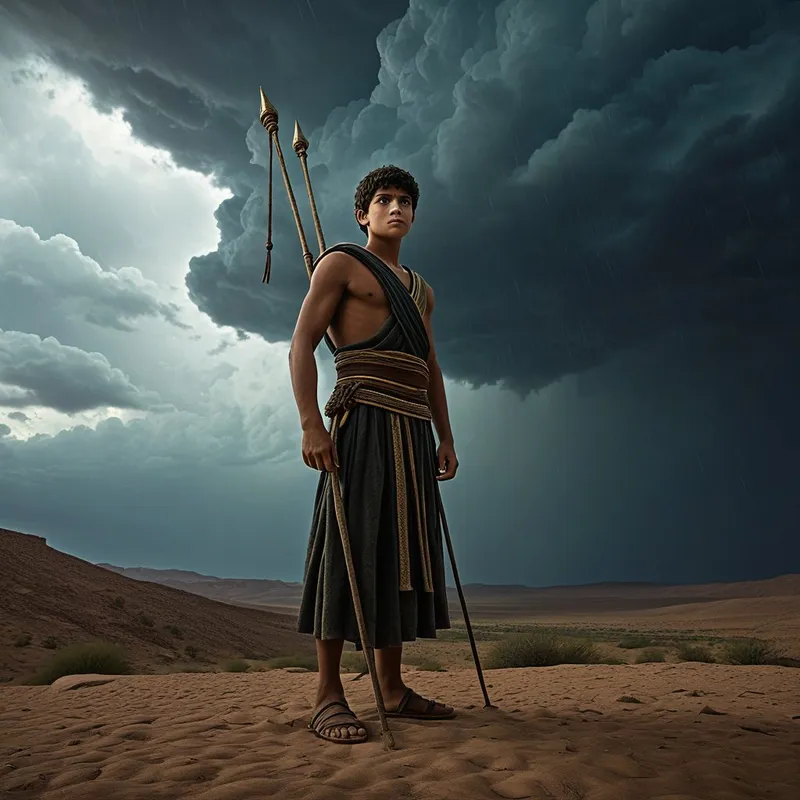
David's Sling Myth Meaning & Symbolism
A shepherd boy, armed with faith and a sling, faces a giant warrior, embodying the archetypal triumph of the small, the true, and the divinely guided over brute force.
The Tale of David's Sling
Listen. The air in the Valley of Elah is thick, not with mist, but with a silence so profound it has weight. For forty days, this silence has been broken only by a voice like grinding stones, a voice that rolls across the scrubland and rattles the shields of an entire army. It is the voice of Goliath, a mountain of bronze and rage, who stands between two hills, between two peoples, and dares any man of Israel to face him. The king’s finest soldiers, men of renown, feel their blood turn to water in their veins. Their god, they whisper, has abandoned them to this terror.
But a sound, soft and persistent as a heartbeat, cuts through the dread. It is the sound of a sling whirring. Not on the battlefield, but on the sun-baked hills behind the camp, where a boy tends to his father’s sheep. His name is David. He has been sent with bread and cheese for his brothers, but he finds them paralyzed, their faces etched with a fear he does not share. He hears the giant’s curse, the challenge against the living God, and something in him, something older than fear, stirs.
He goes before King Saul, who is clad in the despair of his station. The boy speaks not of strategy, but of testimony: of the lion and the bear he slew with his own hands while guarding the flock. “The Lord who delivered me from the paw of the lion and the bear will deliver me from the hand of this Philistine.” Saul, with nowhere else to turn, offers his own armor—a king’s heavy shell. David tries it on, the bronze a foreign weight, and stumbles. He sheds it. He will go as he is.
He walks toward the brook, the giant’s laughter booming behind him, a storm of mockery. He does not look at the towering spectacle of polished death. His eyes are on the earth. He bends and chooses five smooth stones from the water. Their coolness is a comfort. He places one in the pouch of his shepherd’s sling, a simple tool of leather and focus. He begins to walk, then run, not away, but into the valley, into the very mouth of the roaring threat.
The whirring begins again, a humble song against the clank of armor. Goliath sees only a stick-wielding boy and scorns him, cursing him by his gods. David’s reply is a clear, carrying truth: “You come to me with a sword and a spear and a javelin, but I come to you in the name of the Lord of hosts.” The sling becomes an extension of his will, a circle of potential energy spun from a lifetime of unseen practice. He releases. The stone, an unremarkable piece of the earth, flies true. It finds the one place not sheathed in bronze, the space between helmet and brow, and the mountain of fury crashes to the ground. The silence that follows is different now. It is the silence of a world remade by a single, faithful action.

Cultural Origins & Context
This story is preserved in the First Book of Samuel, a text that sits at the crossroads of tribal epic and royal chronicle. It was crafted not merely as history, but as foundational theology and political narrative for the kingdom of Israel. Passed down through oral tradition before being codified by scribal schools, it served multiple vital functions. For a people often outmatched by the military powers of Canaanites, Philistines, and others, it was a potent myth of divine reversal—a reassurance that their God favored the faithful underdog, not merely the strong. It also legitimized the dramatic, divinely-ordained shift in power from the failed dynasty of Saul to the new, enduring line of David. The tale was told to instill a specific identity: a people whose true strength lay not in armaments, but in covenant faithfulness and the unexpected choices of their God.
Symbolic Architecture
At its heart, the myth is a masterclass in symbolic inversion. Every element is a pair of opposites where the seemingly weaker contains the latent, transformative power.
The Sling versus the Armor. Saul’s armor represents the borrowed identity, the heavy, ill-fitting persona society (or the super-ego) insists we wear for battle. David’s sling is the authentic tool, honed in solitude, representing skill, focus, and a power that is integrated, not imposed. It is the weapon of the periphery, of the shepherd, not the center-stage warrior.
The Smooth Stone versus the Sword. The sword is the symbol of conventional, sanctioned violence and metallic, forged power. The smooth stone is natural, chosen, and humble. It is not manufactured; it is found and recognized as fit for purpose. It represents the core, unadorned truth that, when aimed with precision, can topple colossal falsehoods.
The Shepherd versus the Champion. Goliath is the ultimate Shadow figure: oversized, loud, encased in an impenetrable shell of threat and reputation. He is the overwhelming problem, the internal critic, the external oppressor, all given terrifying form. David, the shepherd, is the ego that does not fight the Shadow on its own terms. He does not meet metal with metal. He represents the conscious self that operates from its own ground, using its practiced, authentic faculties.
The giant is not felled by a greater giant, but by the focused application of a small, true thing. This is the alchemy of the myth: the transmutation of insignificance into the pivotal instrument of fate.

The Dreamer's Resonance
When this myth stirs in the modern psyche, it often manifests in dreams of confronting an overwhelming, perhaps faceless, adversary. The dreamer may feel small, ill-equipped, and terrified, facing a looming figure of authority, a monstrous problem, or an insurmountable obstacle. The somatic feeling is one of paralysis and dread—the “water in the veins” of Saul’s army.
The psychological process at work is the initial confrontation with a dominant complex or a swollen aspect of the personal Shadow. This “Goliath” might be an internalized critical parent, a societal expectation that feels like a prison, or a lifelong pattern of anxiety that towers over one’s life. The dream is staging the conflict. The crucial detail to attend to is the “sling”—the simple, often overlooked tool or resource the dream-ego discovers. It might be a forgotten talent, a piece of quiet knowledge, a moment of unexpected calm, or a sudden, clear thought. This is the psyche hinting at the authentic strength available, the skill honed in the “shepherd’s fields” of one’s own experience, which the conscious self has neglected in favor of feeling defenseless.

Alchemical Translation
The journey of David models the individuation process—the becoming of one’s true, undivided self—with stunning clarity. It begins with rejection of the borrowed persona (Saul’s armor). The ego must have the courage to be “un-armored,” vulnerable, and authentic, even if it seems foolish. Next is the gathering of one’s own resources (the five smooth stones). This is the conscious collection of one’s innate, natural strengths—insights, values, and truths polished by life’s stream. They are not flashy, but they are yours.
The core alchemical operation is the precision aim of the focused will. The sling must be spun, the energy directed. This is the moment of conscious commitment, where faith (in the Self, in the process) is translated into decisive action. The stone—the chosen, focused truth—is released toward the weak point in the Shadow’s armor. This is not a battle of attrition, but a targeted intervention: speaking the precise truth to the inner critic, setting the clear boundary with the oppressor, applying the specific insight that unravels the complex.
The triumph is not the death of the giant, but the integration of its energy. David takes Goliath’s own sword to cut off his head, symbolizing the ego using the power of the conquered complex for its own new purposes. The shadow is dis-armed and its strength assimilated.
For the modern individual, “David’s Sling” is an eternal reminder that our greatest battles are not won by becoming a larger version of what oppresses us, but by returning to the simple, potent tools of our essential nature and wielding them with unwavering focus. The valley we must walk into is within, and the giant waiting there can only be felled by the smooth stone of our own realized truth.
Associated Symbols
Explore related symbols from the CaleaDream lexicon: