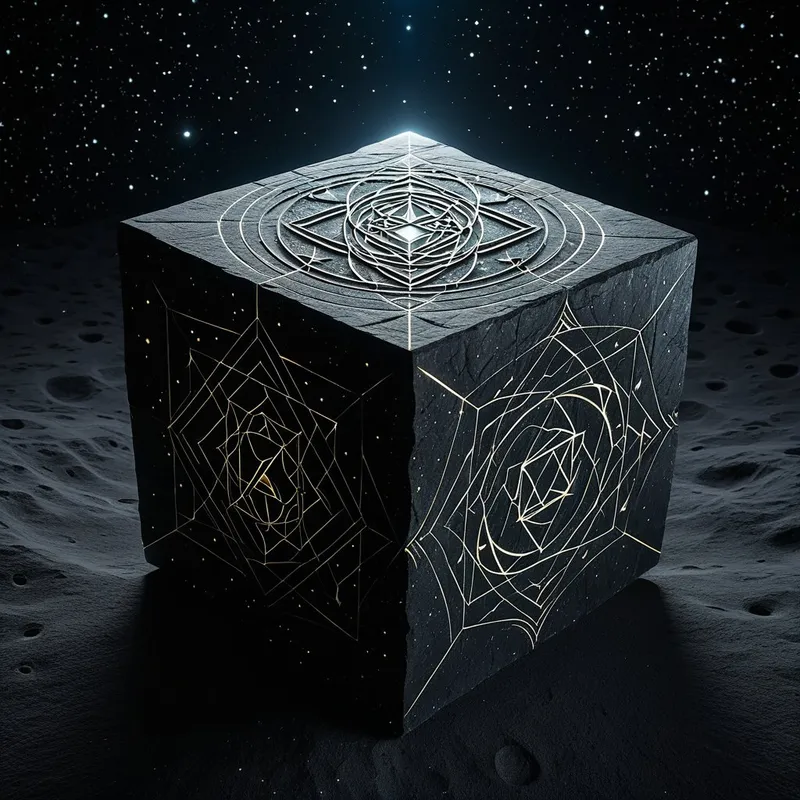
Cube of Earth Myth Meaning & Symbolism
A myth of a primordial architect who sacrifices their perfect form to become the stable, foundational geometry of the manifest world.
The Tale of Cube of Earth
Listen. Before the rivers carved their paths and the mountains dreamed of their peaks, there was only the Hum. A vibration of pure potential, a luminous fog of unshaped thought. Within this Hum moved the Architects, beings of geometry and intent. They were not gods of thunder or love, but of angle and line, of ratio and form.
Greatest among them was The Proposer. Where others spun spirals of possibility or wove nets of light, The Proposer contemplated stability. It witnessed the beautiful chaos of the Hum and perceived a lack: a place for things to be. A stage upon which the drama of form could unfold.
And so, from the substance of its own contemplation, The Proposer drew forth the First Idea. Not a sphere, for a sphere rolls away into eternity. Not a pyramid, for a pyramid points ever upward, away from itself. It drew the Cube. Six faces of perfect equality. Eight points of absolute decision. Twelve edges defining irrevocable boundary.
The Cube hung in the Hum, a silent, dark paradox. It was the shape of “Here.” It was the answer to the question no other had thought to ask: “Where?”
But the Cube was only an idea, a ghost of geometry. It had presence, but no substance. It defined space but could not fill it. The Hum flowed around it, unable to interact, for the Idea was too perfect, too abstract. The world remained potential, aching for foundation.
The Proposer understood. To give the Idea to the world, it could not merely propose. It had to become.
There was no battle with a monster, no theft from a tyrant. The conflict was interior, a silent crisis of identity. To remain an Architect was to retain perfect, free form within the Hum. To act was to sacrifice that form forever.
The Proposer moved to the center of the silent Cube. Placing its essence—a being of fluid light and boundless intent—against the immutable angles, it began to speak. Not with words, but with the language of being. It spoke the words “Solidity,” “Gravity,” “Horizontal,” and “Vertical.” With each utterance, a part of The Proposer’s luminous form crystallized. It felt its boundless nature compress, its infinite directions collapse into the six of the Cube’s faces.
It was not a destruction, but a profound translation. The Proposer’s consciousness did not vanish; it infused. Its sacrifice was its embodiment. The abstract Cube of Idea drank in the living essence of The Proposer and became the Cube of Earth.
A deep, resonant thud echoed through the Hum, a sound that was also a feeling—the feeling of down. The Cube, now heavy with meaning and sacrifice, descended. It did not fall, for there was no below. It established below. Where it came to rest, the first plane was defined: the horizontal. Around it, stability propagated like a crystallizing wave. The chaotic potential of the Hum now had a reference point, a foundation upon which all subsequent forms—the spiral of shell, the branch of tree, the chamber of heart—could securely grow.
The Proposer was gone as it was. In its place was the world’s first certainty: the ground beneath all feet, the cornerstone of all reality, the silent, enduring promise of place.

Cultural Origins & Context
This myth originates from the philosophical and ritual traditions now termed “Platonic,” not as a single tribe, but as a scattered culture of geometer-priests, astronomer-poets, and city-founders. They saw the cosmos as a manifestation of perfect, eternal Forms. The myth of the Cube of Earth was their foundational narrative, recited not in public theaters but in the inner chambers of academies and during the ceremonial laying of a city’s first cornerstone.
It was an esoteric teaching, passed from master to initiate. Its tellers were the Harmonists, who believed physical reality was a “shadow” of ideal mathematical truth. The story’s function was dual. Societally, it sanctified the act of foundation—every temple, every city wall, every law was seen as a small, human-scale echo of The Proposer’s primordial act. Psychologically, it taught the necessity of sacrificing perfect, abstract ideation for the sake of manifest, if imperfect, reality. It was a myth against the paralysis of pure philosophy.
Symbolic Architecture
The Cube is the supreme symbol of manifestation. The sphere represents infinite potential, but the cube is potential realized, bounded, and given a specific, stable relationship to itself and the world.
The sacrifice of the perfect for the real is the first and holiest law of creation.
The Proposer represents the creative mind itself—the part of consciousness that can conceive of perfect, abstract systems. Its crisis is the crisis of every artist, engineer, or parent: the terrifying leap from the blueprint to the ground-breaking, from the ideal to the actual. The Cube of Earth is the body of the idea. It is no longer a thought, but a thing with weight, resistance, and limitation. It symbolizes the necessary constraints that make existence possible: time, space, law, and physicality.
Psychologically, the Cube is the structure of the ego—not the ego as arrogance, but as the essential, foundational complex that provides a stable “I” from which to experience the world. It is the container of consciousness.
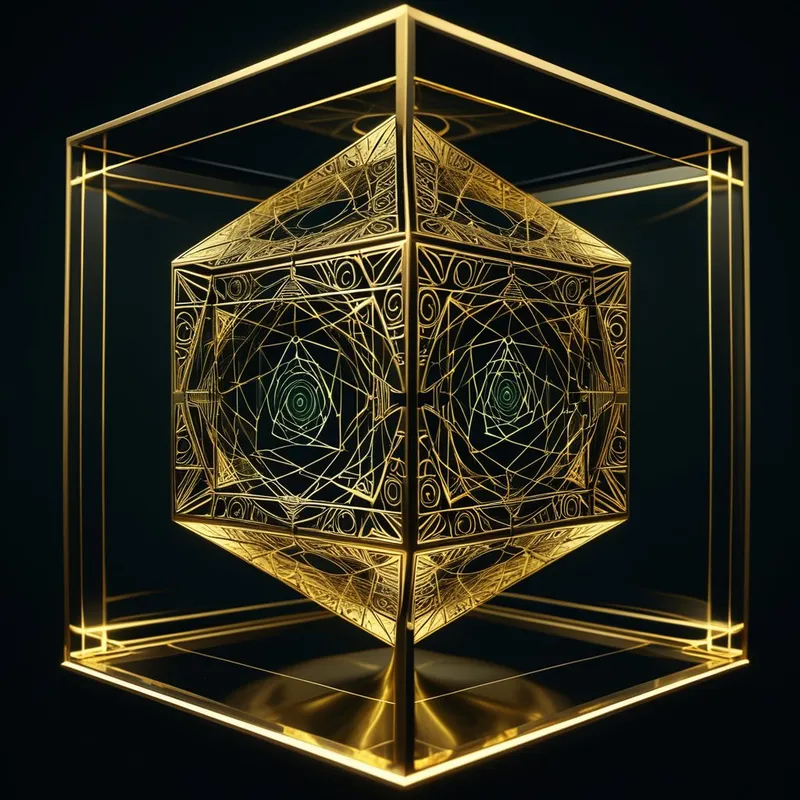
The Dreamer's Resonance
When the Cube of Earth appears in modern dreams, it rarely appears as a story. It appears as a sensation and an image. The dreamer may find themselves in a landscape of terrifying fluidity—shifting floors, melting walls, endless corridors. The anxiety is somatic: a loss of psychological footing.
Then, the Cube is discovered. It is often heavy, immovable, and made of a dense material like iron, stone, or dark glass. The dreamer might lean against it, sit upon it, or simply gaze at it. The profound relief felt is the relief of The Proposer’s sacrifice completing itself within the dreamer’s own psyche. It signals a process of “coming down to earth,” of consolidating a scattered identity, of making a firm decision, or of finally giving tangible form to a long-held idea. The Cube in a dream is the self-anchoring in the midst of inner chaos.
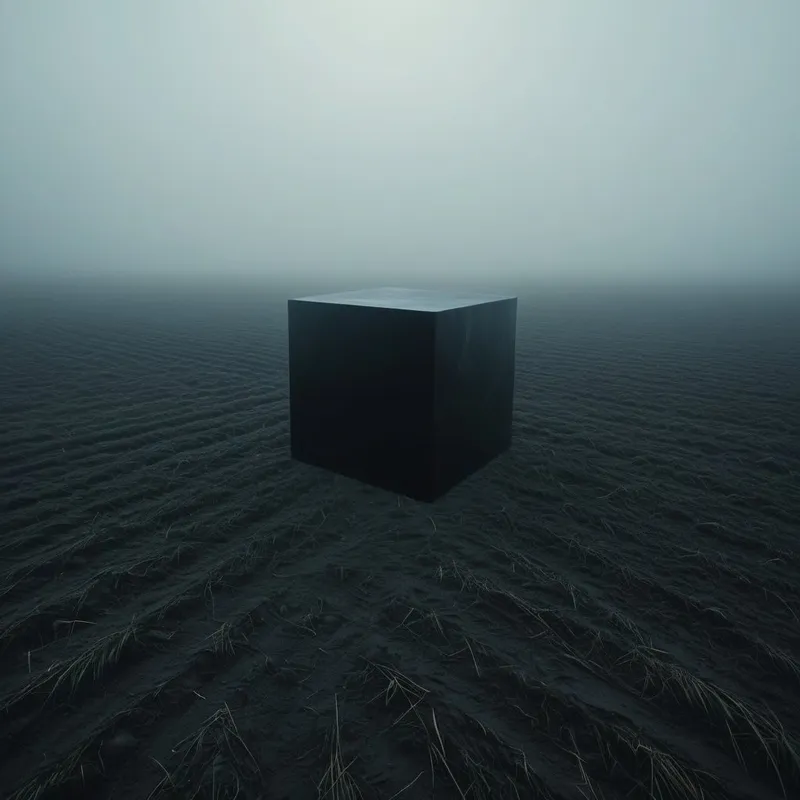
Alchemical Translation
The myth models the alchemical stage of Coagulatio—the making solid. In the journey of individuation, we all begin in the “Hum” of the unconscious: fluid, boundless, filled with every potential self. To become an individual is to perform The Proposer’s sacrifice.
Individuation is not about becoming infinite, but about becoming definite.
We must choose which potentials to bring into the stable light of day and which to leave in the realm of dreams. This requires sacrificing the god-like fantasy of being everything, everywhere, at once. We must become a specific person, with a specific shape, in a specific place and time. This is the “cube” of our individual life: our commitments, our responsibilities, our physical body, our moral code. These are the faces that define us and the edges that limit us, and they are forged through conscious choice and often painful embodiment.
The triumph of the myth is not that The Proposer escapes the Cube, but that it becomes the foundation for all that is beautiful and complex. So too, the modern individual finds that their true Self is not discovered by fleeing limitation, but by fully incarnating within it, thereby becoming the stable ground from which a unique and authentic life can authentically grow. We do not transcend the Cube; we animate it with our living spirit.
Associated Symbols
Explore related symbols from the CaleaDream lexicon: