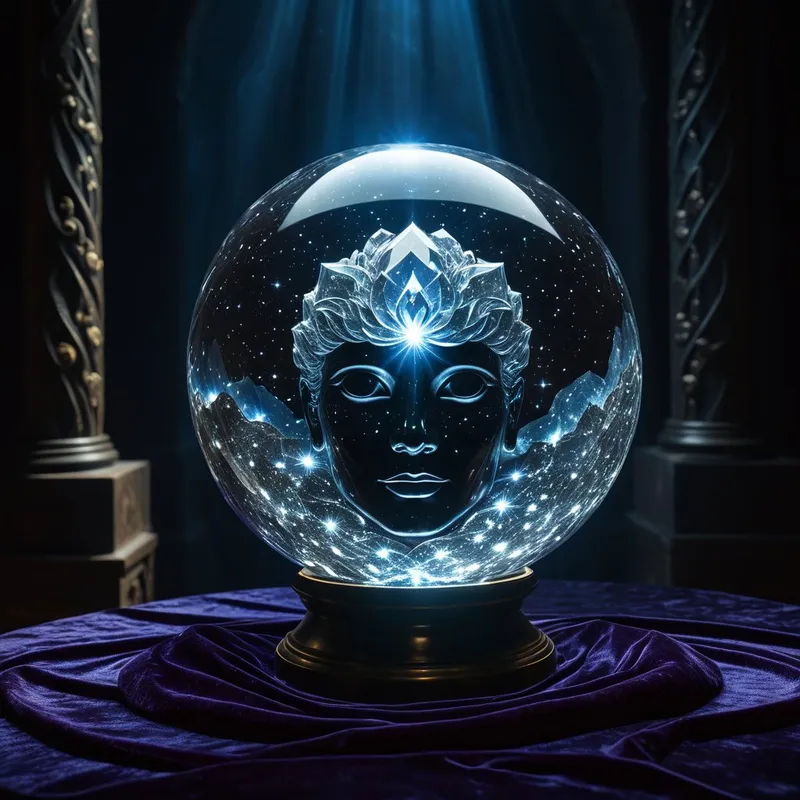
Crystal balls Myth Meaning & Symbolism
A myth of a perfect sphere of seeing, born from chaos and sacrifice, offering a reflection of the world and the soul that gazes into it.
The Tale of Crystal balls
Before the world knew its own name, when light and shadow were still wrestling in the womb of chaos, there was a great fracture. It was not a sound of breaking, but a silence so profound it split the firmament. From this silent cataclysm fell a rain of tears—not of water, but of potential, solidified into a million fragments of earth’s hidden heart.
Among these fragments was one unlike the others. It was not a shard, but a perfect, closed fist of the earth, a geode. It lay forgotten in a riverbed, tumbling for eons, smoothed by the patient waters until it resembled nothing more than a common, grey river stone.
It was found by a figure known in no single tongue, but whose essence is remembered: the Seeker of Patterns. This was no king or warrior, but a quiet soul who listened to the hum of the world. In their hands, the ordinary stone felt strangely heavy, not with weight, but with withheld light. A conviction, deeper than knowledge, settled in their spirit. Inside this plainness lies a captured sky.
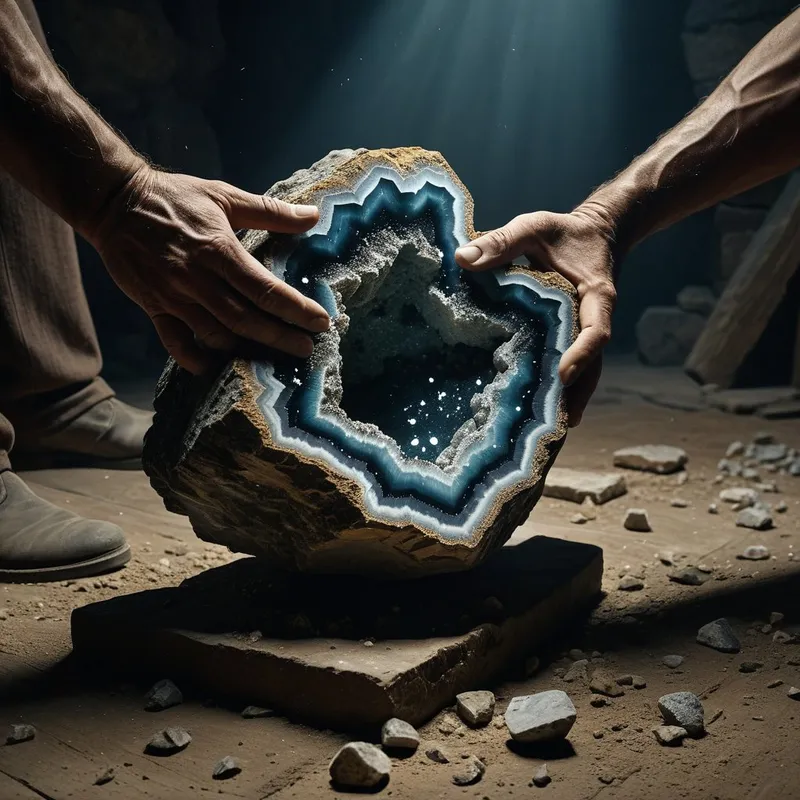
With a toolsmith’s hammer, a tool of decisive force, they struck. The blow was not one of violence, but of invitation. The grey shell shattered, falling away like a discarded cocoon. And there, cradled in the palm of the world, was a sphere of pure, crystalline clarity. But it was not empty. Within its perfect boundaries swirled the memory of the primordial fracture—a silent storm of all that was, is, and could be. It did not emit light; it was light given form, and darkness given depth.
The Seeker gazed into it, and the sphere gazed back. They did not see the future. They saw the river’s course in the pattern of inclusions, heard the mountain’s age in the layering of hue. They saw the hidden grief in a neighbor’s smile, the unspoken courage in a child’s eyes. The sphere showed the world not as a collection of separate things, but as a single, interconnected tapestry. The vision was overwhelming, a flood of truth where before there had been only the comfort of surfaces.
The Seeker learned to still their own mind, to become a calm pool so the sphere’s reflections could grow clear. They became a bridge between the hidden pattern and the visible world. The sphere asked for no worship, only clarity of intent and the courage to see without flinching. Its gift was not prophecy, but profound reflection—a chance to meet the universe, and one’s own soul, in the silent, luminous space between question and answer.
Cultural Origins & Context
The crystal ball, as a mythological and symbolic object, has no single point of origin. It is a polycultural emergence, appearing in various forms across Celtic seership, Achaemenid royal symbolism, East Asian folklore, and the Renaissance alchemical traditions of Europe. This very "variousness" is its primary cultural context. It did not spread from one culture to another so much as it was independently conceived by the human psyche confronting universal questions.
Its custodians were typically liminal figures—the Druid in the sacred grove, the Sibyl at her tripod, the village wise-woman, the hermetic alchemist in his laboratory. These were individuals who operated at the edge of the known community, translating the unseen into guidance for the seen. The myth was passed down not as a single, codified story, but as a practice and an understanding embedded in ritual. Its societal function was dual: it was a tool for navigating uncertainty (offering "readings" for kings and commoners alike), and, more profoundly, a concrete symbol of humanity's belief that the apparent chaos of the world conceals a deeper, intelligible order waiting to be perceived.
Symbolic Architecture
At its core, the crystal ball is an icon of the speculum mundi—the mirror of the world. Its symbolism is a perfect architecture of paradox.
The Sphere: The most perfect of forms, representing wholeness, completion, and the cosmos itself. It has no beginning and no end. It symbolizes the totality of the psyche, the Self in its potential wholeness.
The Crystal: Formed under immense pressure and time, it represents clarity, structure emerging from chaos, and the freezing of light into a tangible medium. It is the principle of consciousness itself—the organ of perception that must be clear to receive an accurate impression.
The Interior Vision: The swirling mists or scenes within represent the pleroma of the unconscious, the unformed potential of the future, and the hidden connections of the present. It is not a television screen showing a predetermined movie, but a dynamic, responsive pool of symbolic information.
The crystal ball does not show the future; it shows the present in its fullest, most interconnected dimension. The future is merely one thread visible within that tapestry.
The Seeker who uses it represents the ego attempting to relate to the Self. The hammer blow is the necessary act of consciousness, the decisive effort to break through the hardened shell of literal reality (the ordinary geode) to access the numinous, symbolic reality within. The act of gazing is one of receptive attention, where the ego’s chatter must subside to allow the deeper patterns of the psyche to constellate into meaning.
The Dreamer's Resonance
When the crystal ball appears in a modern dream, it rarely functions as a simple fortune-telling device. Its emergence signals a critical moment in the dreamer’s psychological process.
As an Unattainable Object: If the dreamer sees the ball but cannot reach it, or it is clouded and unclear, it often reflects a sense of confusion about life’s direction or an inability to access one’s own intuition. The dream ego feels cut off from its inner compass.
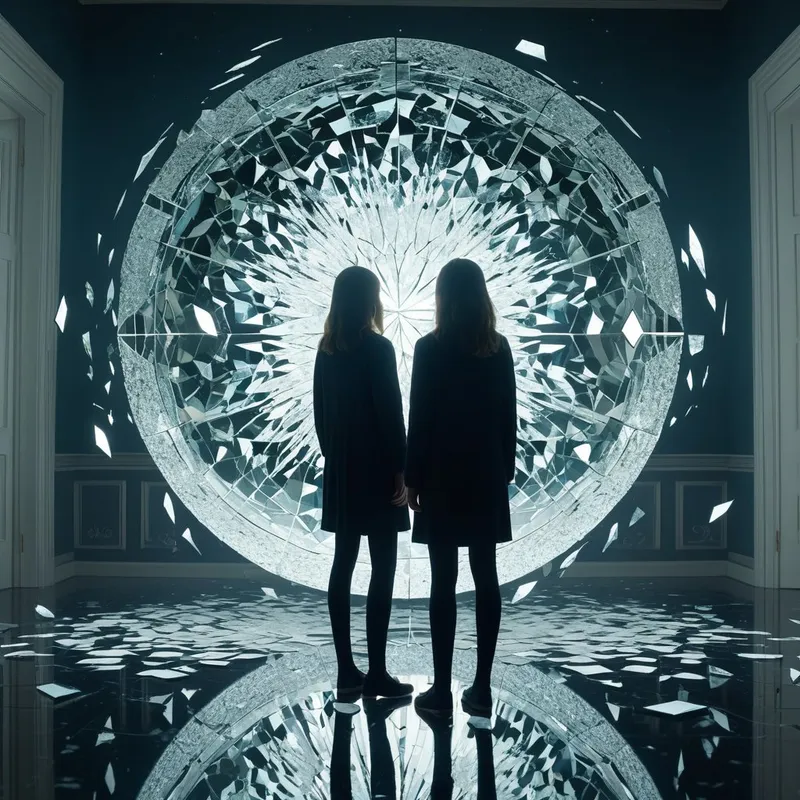
As a Shattered Sphere: A broken or cracking crystal ball is a powerful image of a shattered worldview, a broken promise about how life "should" be, or a crisis of faith in one’s own judgment. It can feel catastrophic, but psychologically, it may represent the necessary breaking of an old, rigid structure of perception to make way for something new.
As a Overwhelming Vision: To gaze into the ball and be flooded with terrifying or incomprehensible imagery points to a confrontation with the contents of the personal or collective unconscious that the ego is not yet prepared to integrate. The somatic experience is often one of vertigo or awe.
The dream is essentially asking: Where in your life are you seeking clarity? What hardened, "ordinary" surface (a job, a relationship, a self-concept) needs to be struck to reveal the hidden pattern within? Are you afraid of what you might see?
Alchemical Translation
The myth of the crystal ball is a precise map for the alchemical process of individuation. Its stages mirror the opus alchymicum.
The Geode (Nigredo): This is the initial state—the massa confusa, the leaden, opaque life situation or depressive state. The dreamer feels trapped in the "common stone" of mundane suffering, unaware of the latent potential within. This is the dark night of the soul.
The Hammer Blow (Separatio): This is the conscious crisis, the painful but necessary act of differentiation. It is the decision to go to therapy, to end a toxic relationship, to question a deep-seated belief. It is the ego’s forceful act to separate the valuable (the crystal) from the worthless (the rocky shell). It is often experienced as a rupture.
The Revealed Sphere (Albedo): The crystal, once revealed, represents the emergence of clarity—the albedo or whitening. This is not yet the final gold, but the cleansing light of awareness. The dreamer gains insight, sees patterns in their behavior, understands their history. The sphere is the symbol of this new, fragile consciousness.
The Sustained Gaze (Coniunctio): The final and ongoing stage is the sacred marriage between the ego (the Seeker) and the Self (the sphere’s vision). This is the coniunctio oppositorum. It is not about passively receiving answers, but about engaging in a dynamic relationship with the inner truth. The ego must learn to still its demands and fears to become a clear vessel. The goal is not to possess the ball, but to develop the capacity to see with it.
The alchemical gold is not a prediction of external events, but the attainment of an unshakeable inner perspective—the ability to hold the tension of opposites, to see the pattern in the chaos, and to reflect the world with the clarity of a consciousness that has met its own depths.
Thus, the crystal ball myth ultimately guides us away from seeking fate outside ourselves. It turns us inward, teaching that the most profound oracle is the psyche in dialogue with its own totality. The future we seek to read is, in truth, the wholeness we are called to become.
Associated Symbols
Explore related symbols from the CaleaDream lexicon: