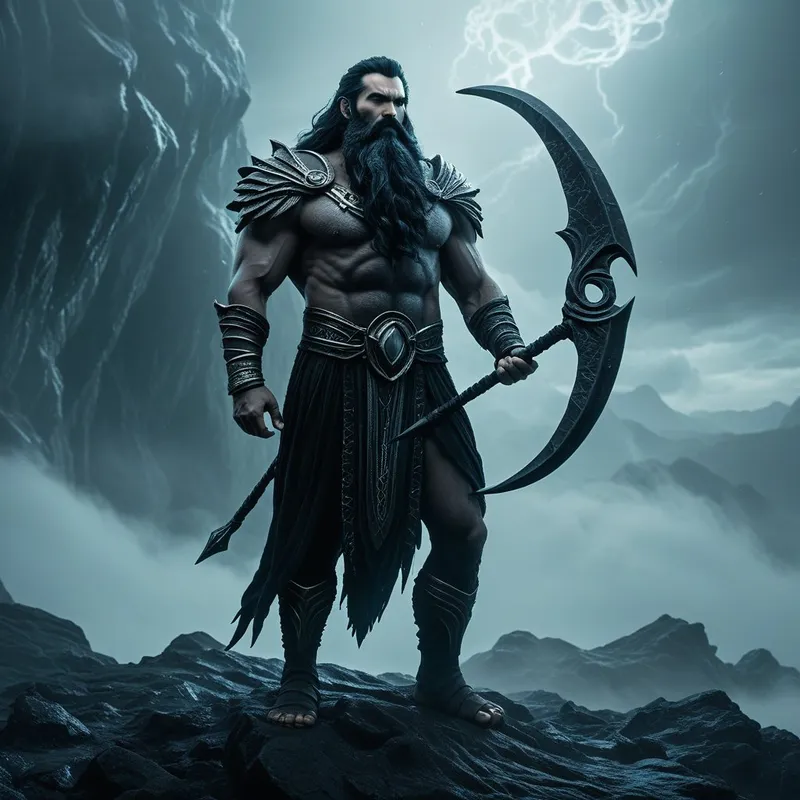
Cronus/Saturn Myth Meaning & Symbolism
The Titan who devours his children to preserve his reign, only to be overthrown by the son he could not consume, embodying the cycles of time and power.
The Tale of Cronus/Saturn
Before the gods of Olympus, there was a raw and terrible age. The universe was a churning womb of potential, where Uranus lay heavy upon Gaia, his weight smothering her children in the dark. From this agony, a plot was forged in the deep earth. Gaia fashioned a great, jagged sickle of grey adamant and called for a champion. It was her youngest, Cronus, who answered, his heart filled with a cold and ambitious fire.
When Uranus next descended to embrace the earth, Cronus struck from the shadows. With one savage sweep of the sickle, he severed his father’s generative power and cast it into the foaming sea. From that act, power and vengeance were born together. Cronus claimed the throne of the cosmos, and with his sister Rhea as his queen, he ushered in the Golden Age of the Titans. But the cosmos remembers. A prophecy, whispered by the wounded Uranus and echoed by Gaia herself, haunted the new king: "You too shall be overthrown by your own child."
This prophecy became the dark seed in Cronus’s soul. It grew into a terrible resolution. When Rhea bore their first glorious child—Hestia—Cronus did not rejoice. He asked to hold the infant, his eyes like pits of obsidian. And then, he opened his maw and swallowed her whole. So it went with Demeter, Hera, Hades, and Poseidon. Each divine child vanished into the fathomless, churning darkness of their father’s belly, where time itself seemed to stand still.
Rhea’s grief became a mountain. When she grew heavy with her sixth child, she could bear the cycle no longer. She fled to the wild, high mountains of Crete. In a sacred cave, attended by dancing Curetes whose clashing spears drowned the infant’s cries, she gave birth to Zeus. With a mother’s fierce cunning, she wrapped a large stone in swaddling clothes, imbuing it with the scent and weight of a newborn. Returning to Cronus, her face a mask of weary submission, she presented the bundle. Without a glance, the Titan King took it and consumed it, believing his dominion secure.
But Zeus grew strong in secret, nourished by the goat Amalthea. When he came of age, he confronted his destiny. With the help of the Titaness Metis, he prepared a draught—a potion of honey and powerful emetic. Disguised as a cupbearer, he served it to his father. Cronus drank, and a great convulsion seized him. One by one, from the depths of time within him, he disgorged his children: first the stone, then Hades, Poseidon, Hera, Demeter, and Hestia, whole and unharmed, now grown and blazing with divine power.
The war that followed—the Titanomachy—shook the pillars of the world. Zeus and his freed siblings, with the aid of the freed Cyclopes and Hecatoncheires, waged a decade-long battle against Cronus and the old order. In the end, the Titans were cast down, imprisoned in the lightless pit of Tartarus. Cronus, the devouring king, was dethroned. Some say he sleeps in a distant, blessed isle; others, that he is bound forever in the dark. The Age of the Olympians had begun, forged in the belly of the father and born from his violent undoing.
Cultural Origins & Context
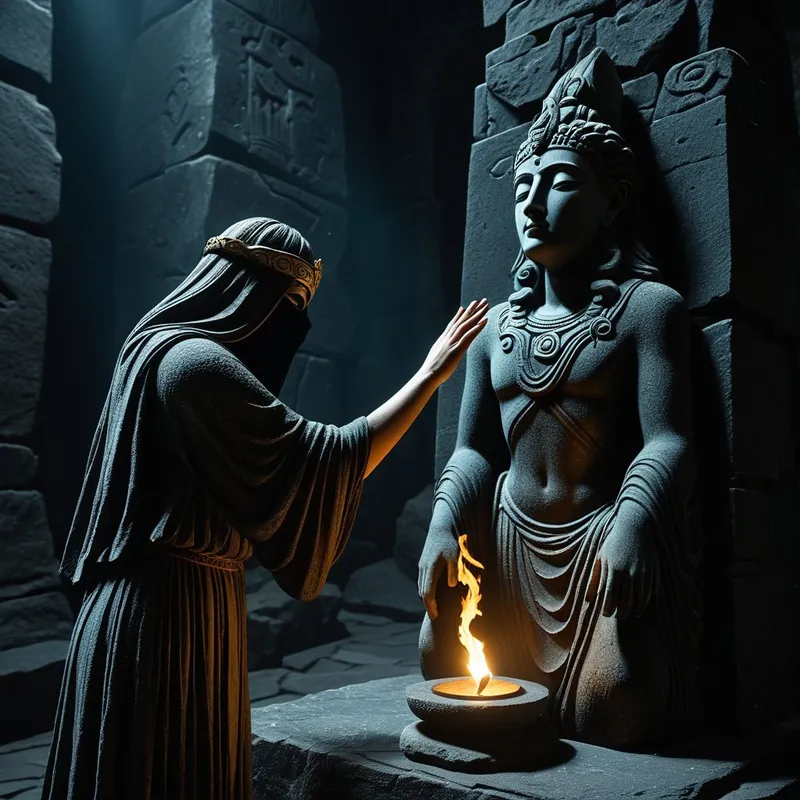
This foundational myth comes to us primarily from the epic poetry of Hesiod’s Theogony (c. 700 BCE), a work that systematized the chaotic genealogy of the Greek gods into a narrative of cosmic succession. It is a myth of origins, explaining not only the lineage of the Olympian gods but also the very structure of reality: how the world moved from a primordial, often brutal state to a more ordered, though no less passionate, divine regime.
The story of Cronus was not merely entertainment; it was a sacred narrative that addressed deep cultural anxieties about power, legitimacy, and time. It was told in the context of a patriarchal society deeply concerned with patrilineal succession and the potential for a son to usurp a father’s authority. The myth provided a divine precedent for this terrifying yet inevitable cycle. Furthermore, the figure of Cronus was syncretized with the Roman Saturn, whose festival, the Saturnalia, was a time of role reversal, feasting, and temporary social upheaval—a ritualized, controlled echo of the cosmic overthrow the myth describes.
Symbolic Architecture
At its core, the myth of Cronus is an archetypal drama of time, tyranny, and the necessary violence of transformation. Cronus is not merely a cruel father; he is the personification of Chronos—time itself, specifically time as a devouring, all-consuming force. His act of swallowing his children symbolizes the way the present moment consumes the future, how the status quo seeks to neutralize all potential for change.
The sickle that castrates Uranus is the same instrument that harvests; it represents the decisive, cutting moment that ends one cycle to begin another, a necessary violence for creation.
The stone Rhea gives him is a profound symbol. It is the omphalos, the navel of the world, a placeholder for the true self. Cronus, obsessed with literal, biological succession, swallows an illusion, while the true heir grows elsewhere. This speaks to the psychological truth that the identity forced upon us by family or tradition is often a hollow substitute; the authentic self must develop in secret, away from the devouring expectations of the parental complex.
The regurgitation of the children is not a birth, but an unbirthing—a traumatic, violent retrieval of what was lost to the unconscious. It represents the psychological process of reclaiming swallowed parts of the self: talents, instincts, and potentials that were sacrificed to appease an internalized, tyrannical authority.
The Dreamer's Resonance
When this myth pattern stirs in the modern unconscious, it often manifests in dreams of being consumed, trapped in darkness, or of a powerful, oppressive figure who prohibits growth. One might dream of eating something that then grows inside them uncontrollably, or of being forced to hide a precious, vulnerable part of themselves.
Somatically, this can feel like a deep, chronic tension in the gut—a literal holding in of one’s voice, power, or creativity. Psychologically, the dreamer is likely grappling with a powerful internal "Cronus complex": a tyrannical inner critic or a set of inherited beliefs that devour any new initiative, any step toward independence, labeling it a threat to the established order of the psyche. The dream is a signal that a long-swallowed potential is now stirring, demanding to be disgorged and integrated, no matter how messy or violent that process may be.
Alchemical Translation
The alchemical journey modeled by this myth is the nigredo—the blackening, the dissolution of the old king. For the individual, Cronus represents the dominant, conscious attitude that has ruled the psyche, often a rigid persona or identification (the "ruler" archetype in its shadow aspect). This complex maintains control by "eating" any emerging contrary impulse, any feeling or thought that challenges its supremacy.
The work of individuation requires one to become Rhea and Zeus simultaneously: to feel the grief of what has been lost, to cunningly nurture the hidden spark of the true self in secret, and finally, to administer the purgative potion of conscious truth.
The potion Zeus gives Cronus is the insight that forces a confrontation with what has been repressed. The ensuing convulsion is the psychic crisis—the depression, anxiety, or life upheaval—that feels like coming apart. But it is in this disgorging that the lost siblings—the feeling function (Hera), the connection to the depths (Hades), the nourishing capacity (Demeter)—are retrieved. They return not as helpless infants, but as powerful allies, ready to wage the necessary inner war against the stagnant tyranny.
The final stage is not the destruction of Cronus, but his dethronement. In psychological terms, the chronos-principle of compulsive, devouring time is integrated. It becomes Saturn, the wise elder who sets boundaries, imposes necessary limits, and brings structure—a vital force that is no longer a tyrant, but a sober part of a reconciled self. The individual moves from being consumed by time to understanding their place within it, having reclaimed their swallowed future from the belly of the past.
Associated Symbols
Explore related symbols from the CaleaDream lexicon: