Cronus Myth Meaning & Symbolism
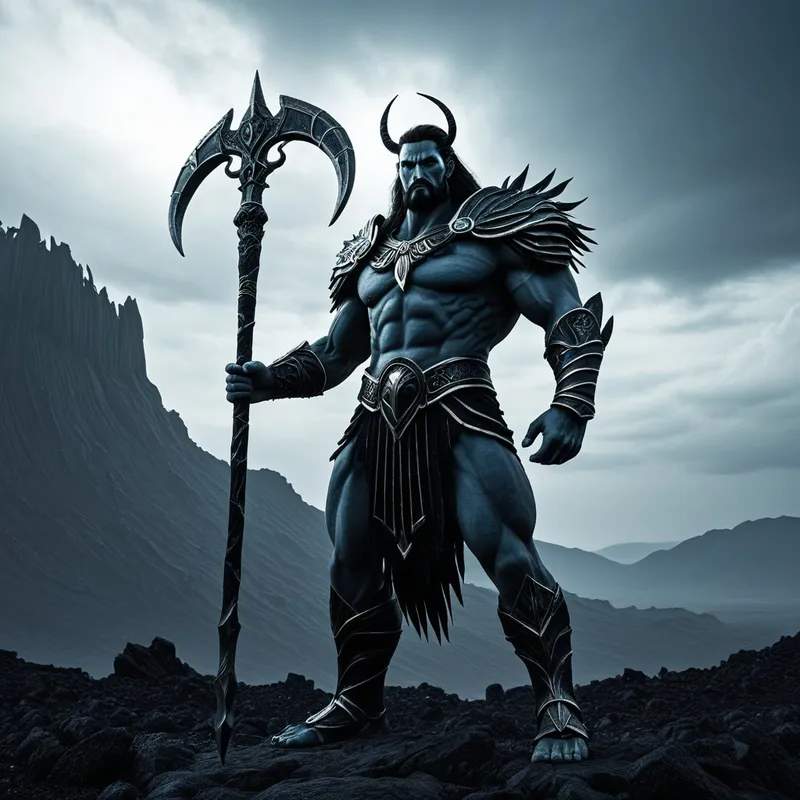
A Titan of time and harvest, Cronus castrates his father Ouranos, then swallows his own children, fearing their prophesied rebellion, until he is overthrown by his son Zeus.
The Tale of Cronus
Listen, and I will tell you of the Age of Titans, when the world was raw and the sky pressed close upon the earth. It was a time of primal groans and fertile darkness, ruled by Ouranos, who in his jealous fear imprisoned his own monstrous children, the Cyclopes and the Hecatoncheires, deep in the belly of the earth, Gaia. Her soil grew heavy with sorrow, her roots twisted in pain. From her anguish sprang a plot, and from her stony flesh she forged a weapon: a great, jagged sickle of grey adamant.
She gave it to her youngest and most cunning son, Cronus, whose soul was as sharp as the blade he now held. "Avenge your siblings," Gaia whispered, her voice the rumble of continents. That night, when star-cloaked Ouranos descended to embrace the earth, Cronus struck from the shadows. The sickle flashed—a silver arc against the velvet dark—and a terrible, world-splitting scream echoed through the void. Ouranos was cast down, his reign severed. From the blood that fell upon the earth sprang the Erinyes and the fierce Gigantes. From the foam where his flesh met the sea rose Aphrodite. Thus began the rule of Cronus, the Harvester.
He took his sister Rhea as his queen, and the Golden Age dawned. But the victory was poisoned. A prophecy, uttered by the wounded Ouranos and echoed by Gaia, haunted Cronus: "You too shall be overthrown by your own child." The words coiled around his heart like a serpent. So, when Rhea bore their first glorious child—Hestia—Cronus did not lift her to the light. His jaw unhinged, vast and dark as a chasm, and he swallowed the infant whole. The same fate befell Demeter, Hera, Hades, and Poseidon. Each was consumed, imprisoned in the timeless dark of their father's gut.
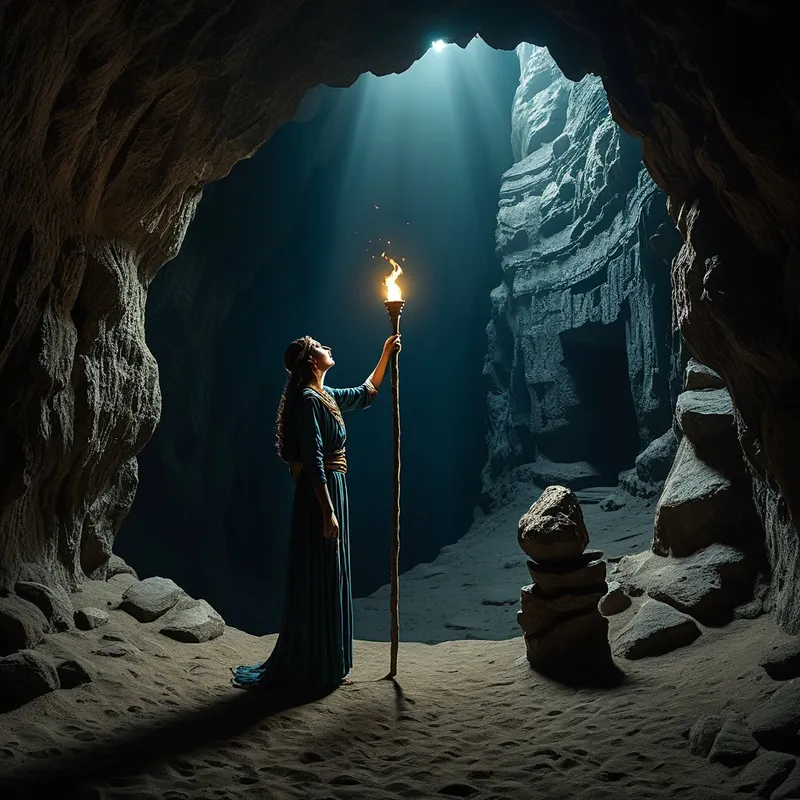
Rhea’s grief became a mountain. When she grew heavy with her sixth child, she could bear the devouring no longer. She fled to the wild, craggy slopes of Crete, to a hidden cave where the Curetes danced and clashed their spears to mask an infant's cry. There, she gave birth to Zeus. To Cronus, she presented not a child, but a stone wrapped in swaddling clothes—the Omphalos Stone. The Titan, deceived, gulped it down, and the thunder-god was saved.
Zeus grew in secret, nourished by the goat Amalthea. When his strength was full, he returned. With the aid of the Titaness Metis, he concocted a potion—a draught of honey and powerful emetic. He presented himself to Cronus as a humble cupbearer. The unsuspecting Titan drank, and a great convulsion seized him. One by one, from the depths of time within him, he disgorged his children: the stone first, then Poseidon, Hades, Hera, Demeter, and Hestia, whole and grown, their eyes blazing with the fire of rebellion.
The war that followed—the Titanomachy—shook the pillars of the cosmos. Zeus freed the Cyclopes and Hecatoncheires from Tartarus, and with their gifts of thunder, lightning, and immense strength, the Olympians prevailed. Cronus and his Titan allies were cast down, imprisoned forever in the gloomy pit of Tartarus. Time, the devourer, was itself bound by the new order. The Age of Gods began.
Cultural Origins & Context
The myth of Cronus is not a singular story but a foundational layer of Greek cosmology, preserved primarily in the epic poetry of Hesiod’s Theogony (c. 700 BCE). It functioned as a divine charter, explaining the violent, necessary transitions of cosmic power from Chaos to the stable reign of the Olympians. This was not mere entertainment; it was sacred history, recited to explain the world's origin, the nature of sovereignty, and the price of order.
The tale was passed down by bards and poets, serving a crucial societal function: it legitimized the Olympian pantheon worshipped in the city-states and provided a mythic template for understanding generational conflict, succession, and the inescapable cycles of time and harvest (Cronus was also associated with the agrarian cycle). The act of deposing a father-king, while shocking, was framed as a necessary, even fated, step toward a more just and structured cosmos. It answered profound questions: Why do rulers fear their heirs? Why must the old order make way for the new? The myth provided a narrative container for these universal anxieties.
Symbolic Architecture
Cronus is a figure of profound paradox. He is both the agent of necessary revolution (castrating the oppressive Ouranos) and the embodiment of a terrible, stagnant tyranny (devouring his future). His primary symbol, the sickle, connects him to both the harvest—the cutting down of the ripe crop—and to castration, a severing of creative potential. He is not merely a cruel father; he is the archetypal force of Chronos (Time), which consumes all things.
The fear of being succeeded is the shadow of creation itself. To hold power is to live with the ghost of your own obsolescence.
His act of swallowing his children symbolizes a desperate attempt to stop time, to prevent the future from arriving. Psychologically, this represents the ego's tyrannical attempt to assimilate all emerging potentials, insights, or new aspects of the self that threaten its established rule. The children represent the nascent, vital psychic forces—the future consciousness—that the ruling complex (Cronus) cannot integrate and so tries to negate. The stone given to him is the ultimate symbol of this failure: he consumes the inert, the lifeless, the symbol of mere matter, while the living spirit (Zeus) grows elsewhere.
The resolution—the forced regurgitation—is a violent rebirth. What was swallowed and trapped in darkness is brought back into the light, transformed and ready for conflict. This is the inevitable return of the repressed, not as helpless infants, but as powerful, differentiated gods.
The Dreamer's Resonance
When the pattern of Cronus manifests in modern dreams, it speaks to a profound psychological process of containment and the fear of emergence. The dreamer may experience scenarios of being swallowed, trapped in a dark, enclosed space, or of hiding a vulnerable, creative part of themselves from a powerful, consuming authority figure (a parent, a boss, an internal critic).
Somatically, this can feel like a tightness in the gut, a literal holding-in. The dream is signaling that a vital new development in the psyche—a talent, an emotion, a life transition—is being "eaten" by an old, fearful pattern of control. The Cronus-complex is active, attempting to maintain a status quo by negating growth. The dream may also present the figure of Rhea—the cunning, protective, resourceful aspect that knows how to save the nascent self by deception, by finding a safe, wild space (Crete) for it to develop.
To dream of being Cronus is to confront one's own tyrannical impulse, the part that would rather destroy potential than risk being changed or replaced by it. It is the shadow of the ruler archetype, terrified of its own succession.

Alchemical Translation
The myth of Cronus models the critical, often painful, stage of psychic transmutation where the old, ruling consciousness must be overthrown. In the alchemy of individuation, this is the nigredo—the blackening, the dissolution of the old king.
The ego, having once performed the necessary task of dethroning the chaotic, unconscious rule of the "Ouranos" state (perhaps a life dominated by primal impulses or parental complexes), often installs itself as a new tyrant. It becomes Cronus, a rigid, time-bound structure that views any new psychic content as a threat. The work of the seeker, then, is to become both Rhea and Zeus. One must have the maternal cunning to hide and nurture the emerging Self (the divine child) in the secret cave of the unconscious, protecting it from the devouring logic of the old mindset.
The stone swallowed is the rejected foundation; the god saved is the spirit that will build upon it.
The final, crucial step is the administration of the emetic—the potion of truth offered by Metis (wisdom, cunning intelligence). This represents the conscious insight, often bitter, that forces the ego to disgorge what it has swallowed. The individual must voluntarily undergo a crisis, a psychological "vomiting," to release the trapped potentials, talents, and energies they have denied. What returns is not the infantile content, but a host of powerful, differentiated capacities (the Olympians), ready to engage in the inner Titanomachy—the fierce battle to establish a new, more capacious psychic order.
This is not a one-time event but a cyclical process. Every time we cling to an outworn identity, every time we fear the new life growing within us, we re-enact the drama of Cronus. The myth teaches that sovereignty is not about eternal rule, but about the courage to participate in one's own necessary succession.
Associated Symbols
Explore related symbols from the CaleaDream lexicon: