Coyolxauhqui Moon Goddess Myth Meaning & Symbolism
A myth of celestial rebellion where the Moon Goddess Coyolxauhqui is dismembered by her brother, modeling the painful process of psychic integration.
The Tale of Coyolxauhqui Moon Goddess
Listen. The story begins not in light, but in shadow, on the slopes of the sacred mountain, Coatepec. Here dwelled Coatlicue, the Serpent Skirt, a goddess of earth and life. One day, as she swept the temple atop the mountain, a ball of brilliant hummingbird feathers descended from the sky and touched her. From this divine contact, she conceived a child.
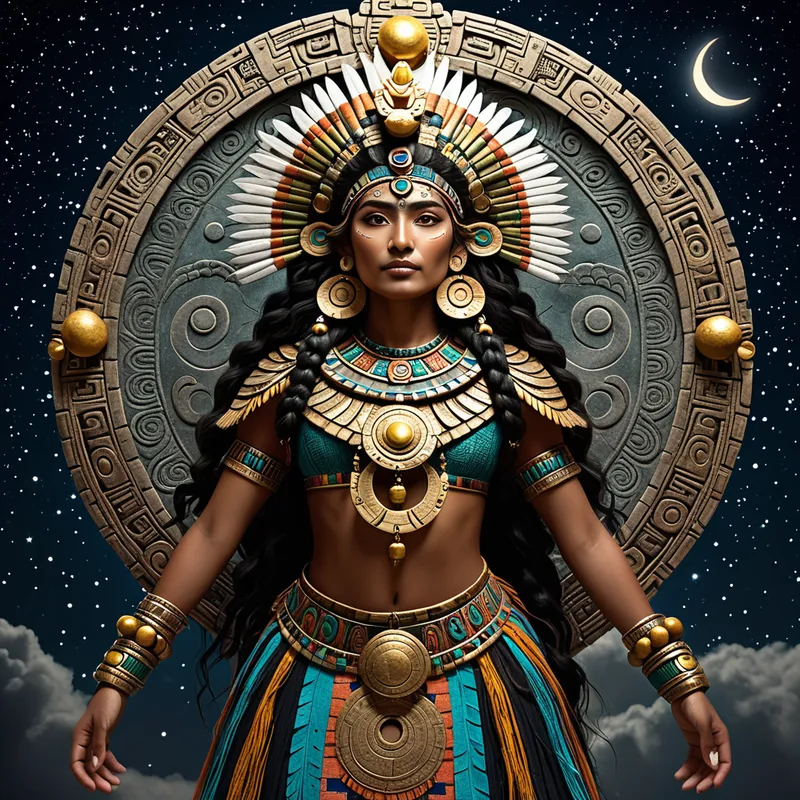
This miraculous pregnancy was a scandal to the heavens. Her daughter, Coyolxauhqui, whose face shone with golden bells and whose power was that of the night sky, was consumed by a righteous fury. How could her mother be so dishonored? She rallied her four hundred brothers, the Centzon Huitznahua, who glittered with the cold fire of the southern stars. "We must cleanse this shame!" she declared. "We will ascend Coatepec and slay our mother."
And so, a celestial rebellion began. Coyolxauhqui, magnificent and terrible, led her starry brothers up the mountainside. Their weapons glinted like distant constellations, their rage a silent, growing thunder. Coatlicue, heavy with child, felt the mountain tremble with their approach. Fear clutched her heart, for she was alone.
But the child within her heard. From the womb, the unborn god Huitzilopochtli spoke to his mother. "Do not fear. I am here. I will defend you." As Coyolxauhqui and the four hundred reached the summit, their war cries shattering the mountain's silence, the moment of birth and death converged.
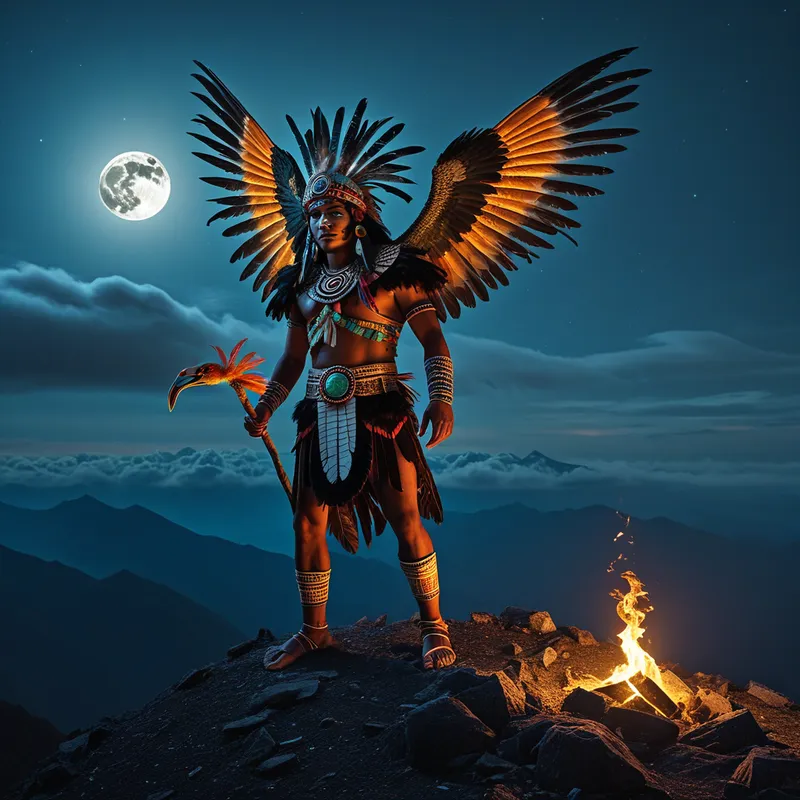
In a flash of blue light and the sound of a hummingbird's furious wing, Huitzilopochtli sprang forth, fully armed. He was not an infant, but a warrior, clad in hummingbird feathers, his left leg adorned with feathers, his face striped with blue. In one hand he held the Xiuhcoatl, the Turquoise Serpent, a weapon of pure, destructive fire.
The battle was not a battle; it was an execution of cosmic order. Huitzilopochtli turned the Xiuhcoatl upon his sister. He struck her down. He cut off her head. And then, with relentless, divine force, he dismembered her body, hurling the pieces down the steep slopes of Coatepec. Her limbs came to rest, broken and scattered. He then turned upon the four hundred brothers, the stars, and chased them from the sky, scattering them into helpless flight.
Coyolxauhqui's head was thrown into the sky, where it became the moon, a cold, watchful, and fragmented light, forever circling the mountain but never again whole. The rebellion was over. Order, a brutal, solar order, was imposed from the chaos of familial betrayal.
Cultural Origins & Context
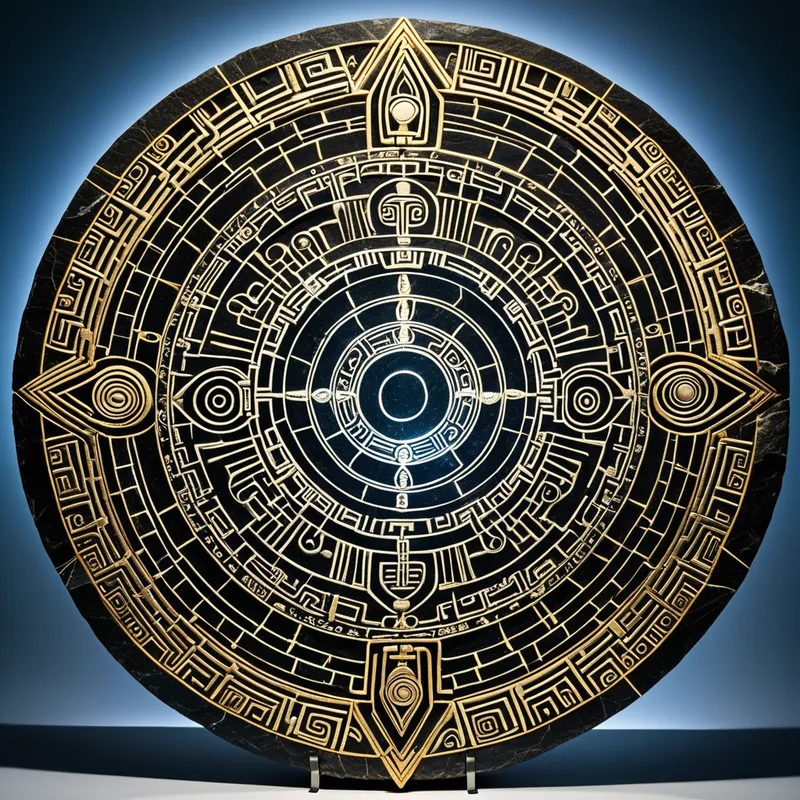
This myth was not merely a story; it was a foundational charter for the Mexica people. It was recited by priests and remembered in the very stones of their world. Its most powerful physical manifestation was the great Coyolxauhqui Stone, a massive carved disc discovered at the base of the Templo Mayor in the heart of Tenochtitlan.
The stone, depicting the goddess in her dismembered state, was strategically placed. Every enemy warrior sacrificed atop the temple, his heart offered to the sun god Huitzilopochtli, would be hurled down the steps to land upon this stone, re-enacting the fate of the moon goddess. The myth thus served a dual societal function: it justified the relentless, expansionist warfare of the Mexica state as a sacred duty to feed the sun and stave off cosmic darkness, and it reinforced the absolute authority of the state and its patron god over all challengers, even familial ones. It was a narrative of power, legitimacy, and the necessary violence of cosmic maintenance.
Symbolic Architecture
At its core, the myth of Coyolxauhqui is a profound drama of psychic forces. Coyolxauhqui represents the complex, often rebellious aspect of the psyche that reacts with outrage to a new, emerging consciousness (the unborn Huitzilopochtli). She is the established order of the personal cosmos—the familiar patterns, the familial loyalties, the ego's sense of control—that perceives profound change as a threat that must be violently eliminated.
The moon does not hate the sun for its light; it fears the dawn that renders it invisible. The rebellion is not against the mother, but against the new self being born within her.
Huitzilopochtli symbolizes the eruptive, conscious will—the heroic impulse of the emerging Self that cannot be stopped. His weapon, the Xiuhcoatl, is the transformative fire of insight and decisive action. The dismemberment is not merely punishment; it is a brutal form of differentiation. The previously unified, monolithic identity (the sister-led clan) is shattered into distinct parts. This is the necessary, painful prelude to a new, more complex integration—one where the moon (the emotional, reflective body) is separated from its controlling will and cast into a cyclical, orbiting relationship with the central solar consciousness.
The Dreamer's Resonance
When this mythic pattern stirs in the modern unconscious, it often manifests in dreams of shocking violence, betrayal by family or close allies, or most tellingly, dreams of bodily fragmentation. To dream of one's own limbs being severed, or to see a loved one dismembered, can be a terrifying somatic echo of Coyolxauhqui's fate.
Psychologically, this is not a prophecy of literal harm, but a symbolic representation of a psyche undergoing a radical deconstruction. The dreamer is likely experiencing a life transition so profound it feels like the "self" they have known is being torn apart. An old identity (a career, a relationship, a long-held belief) that once felt cohesive and powerful is being challenged by an emerging new potential (the Huitzilopochtli within). The dream captures the inner civil war, the feeling of being betrayed by one's own history and patterns (the star-brothers), and the visceral fear of coming undone. The process, while terrifying, is one of necessary disintegration, making space for a consciousness that can hold greater complexity.

Alchemical Translation
The individuation process modeled here is stark and uncompromising. It begins with the coniunctio, the divine impregnation—a moment of inspiration, a calling, a seed of destiny that feels both sacred and disruptive. The ego-complex (Coyolxauhqui) reacts with fierce resistance, mobilizing all allied aspects of the personality (the star-brothers) to destroy this nascent Self before it can be born.
The alchemical fire, the Xiuhcoatl, is the fierce, purifying light of consciousness that must be wielded. This is the difficult, often painful work of self-confrontation and shadow integration. The dismemberment is the separatio and mortificatio—the breaking down of outmoded psychic structures. The old, monolithic self-image must be shattered.
Wholeness is not the absence of fragments, but the conscious relationship between them. The moon is not rebuilt; it learns to shine, beautifully broken, in orbit around a greater center.
The final stage is not a reassembly of the old form, but a new cosmic ordering. The fragmented aspects (the moon, the scattered stars) are not destroyed but repositioned. They become part of a larger, dynamic system. The heart of the process is the realization that the Self (Huitzilopochtli) is not the same as the ego (Coyolxauhqui). The ego must be relativized, its tyrannical unity broken, so that it can take its rightful place as a reflective, orbiting satellite to the central, guiding consciousness of the Self. The triumph is not the victory of one side over the other, but the establishment of a new, more truthful hierarchy within the soul.
Associated Symbols
Explore related symbols from the CaleaDream lexicon:
- Moon — The fragmented, reflective light of Coyolxauhqui, representing the emotional body and cyclical nature of the psyche after its unifying ego-structure is broken.
- Goddess — Coyolxauhqui as the divine feminine principle in its aspect of powerful rebellion against imposed change and the defense of a perceived sacred order.
- Sacrifice — The myth's core dynamic, where the old self must be ritually dismembered and offered up to make way for the new, conscious solar principle.
- Mother — Coatlicue as the fertile, containing vessel of the unconscious from which both rebellion (the daughter) and transformative consciousness (the son) are born.
- Mountain — Coatepec, the Serpent Mountain, as the axis mundi where the inner drama between the established order and emerging consciousness is violently played out.
- Serpent — Represented in Coatlicue's skirt and Huitzilopochtli's weapon, symbolizing both the chthonic, creative life force and the transformative, destructive fire of insight.
- Warrior — Huitzilopochtli as the archetypal force of decisive, conscious action that defends the nascent Self against the attacking forces of the entrenched psyche.
- Star — The Centzon Huitznahua, the star-brothers, as the myriad supporting complexes and beliefs that align with the ego's rebellion and are subsequently scattered.
- Circle — Echoed in the form of the Coyolxauhqui Stone, representing both the shattered wholeness of the goddess and the cyclical, orbital relationship of moon to sun.
- Shadow — Coyolxauhqui embodies the shadow of the solar hero—the rightful fury and tragic beauty of what must be overcome for consciousness to dawn.
- Rebirth — The violent birth of Huitzilopochtli, which is simultaneously the death of the old psychic order, modeling the painful necessity of true psychological renewal.
- Moonlit Night — The eternal domain of Coyolxauhqui, a time of reflection, mystery, and the haunting beauty of a consciousness that knows its own fragmentation.