Corybantes Myth Meaning & Symbolism
The myth of the Corybantes, ecstatic dancers who protected the infant Zeus with their clashing shields and drums, symbolizing the primal defense of nascent consciousness.
The Tale of Corybantes
Listen, and hear the tale that begins not with a cry, but with a drumbeat. In the time when the world was young and raw, when the Titan Kronos devoured his own children, a desperate mother fled. Her name was Rhea, and her heart was a cavern of grief and cunning. She could not bear to lose another babe to her husband’s insatiable fear. So, when her time came again on the slopes of Mount Ida in Crete, she did not call for a midwife. She called upon the earth itself.
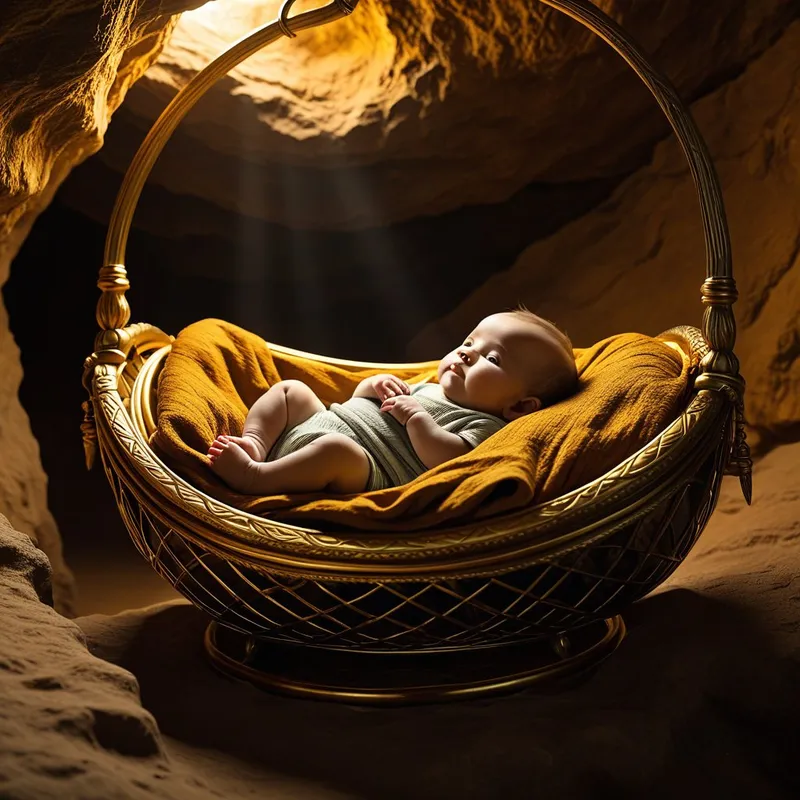
She gave birth in a hidden, echoing cave, its walls slick with the breath of the deep. The child was Zeus, and his first lullaby was not a song, but the distant, frantic rhythm of approaching feet. Rhea wrapped a stone in swaddling clothes, a decoy for Kronos’s dread feast. But for her true son, she summoned guardians born of a different order.
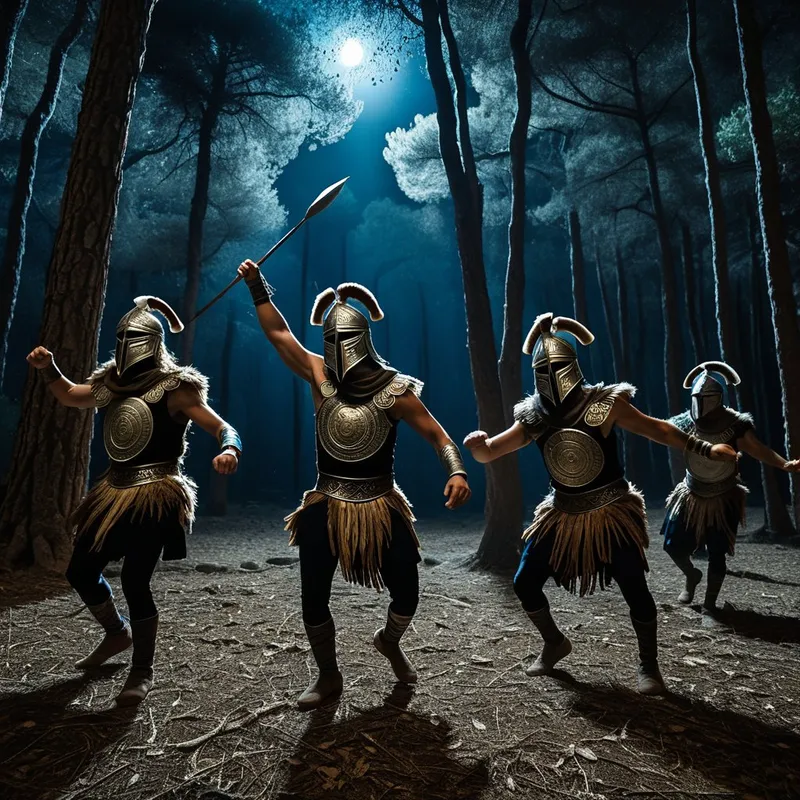
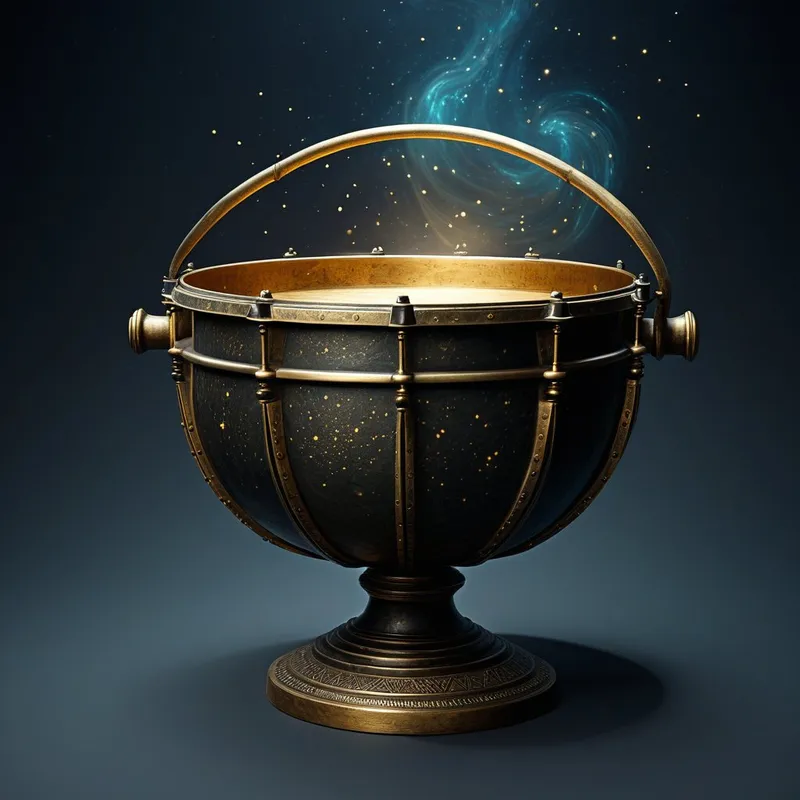
They came from the mountains and the wild places, the Corybantes. They were not gods, not quite mortals, but spirits of ecstatic fury. Their hair was wild, their eyes shone with a frenzied light, and they wore helmets crested like the waves of a stormy sea. In their hands were drums of stretched hide and shields of gleaming bronze.
Their task was not gentle watch. It was a roaring, clanging camouflage of life itself. As the infant god slept in his golden cradle, the Corybantes began their dance. They stamped the earth until it trembled. They beat their drums in a rhythm that mimicked the thunder that would one day be Zeus’s own. And with a terrifying, beautiful cacophony, they clashed their shields together—crash! crash! crash!—a wall of bronze sound meant to drown out the infant’s cries, to hide the scent of divinity, to shout down the very attention of the heavens.
Night and day, the ritual continued. The cave became a womb of deafening celebration. The Corybantes danced themselves into trances, their movements a blur of devotion and madness. They were the living sound-barrier, the furious heartbeat protecting the vulnerable spark of a new world order. They danced until their feet bled, until the cave walls absorbed the rhythm, until the infant Zeus grew strong, nourished by the honey of bees and the milk of the goat Amaltheia, all to the relentless, protective din of their rite. They danced for the future, and in their ecstatic noise, the king of gods was saved.
Cultural Origins & Context
The myth of the Corybantes is a thread woven from two distinct cultural tapestries: the indigenous, pre-Greek traditions of Crete and Anatolia, and the later Olympian framework of classical Greece. Their story is a palimpsest, where older, chthonic rites are repurposed to serve a new divine narrative.
Primarily, the Corybantes were inseparable from the worship of the Great Mother Goddess, Cybele. In her Phrygian and later Greek cults, they were her male attendants, performing wild, orgiastic dances accompanied by flutes, drums, and cymbals. Their rites, known as Corybantism, were initiatory and cathartic, designed to induce a state of sacred madness (enthousiasmos) that could both heal psychological distress and forge a direct connection to the divine.
The Greeks, in their systematizing of mythology, adopted these powerful figures and grafted them onto the foundational story of Zeus. This served a dual purpose. It explained the existence of these ecstatic, non-Olympian cults by giving them a primordial, heroic purpose. More importantly, it positioned the raw, ecstatic, and embodied power they represented as being in service to the nascent principle of cosmic order (Zeus). The myth thus acts as a cultural digestion of a more chaotic, earth-based spirituality, containing it within the "official" story of the patriarchy's rise. The tale was passed down not as a simple bedtime story, but as an etiological myth for ritual practice, performed and recounted in the context of the very mysteries it described.
Symbolic Architecture
At its core, the myth of the Corybantes is a profound allegory for the protection of nascent consciousness. The infant Zeus symbolizes the fragile, emerging Self—a new psychic structure, a novel idea, a spark of authentic being that is threatened by the devouring patterns of the old order (Kronos, representing chronos, literal time, or the repetitive, unconscious status quo).
The Corybantes represent the primal, pre-rational, and somatic defenses of the psyche. They are not strategic thinkers but embodied reactors. Their tools are rhythm, noise, and ecstatic movement—the language of the body and the unconscious.
The defense of the new Self is not an argument, but a rhythm; not a wall, but a dance.
Their clashing shields create a temenos, a sacred space of sound. This is the psychological container, often forged in crisis or intense emotional experience, that allows a vulnerable new aspect of personality to develop without being immediately crushed by internalized criticism ("the devouring father") or overwhelming external reality. The dance itself is symbolic of the necessary, often chaotic, expenditure of energy required to maintain this protective boundary. It is the frenzy of creative obsession, the manic defense against depression, the compulsive activity that shields a deepening inner process.
Furthermore, their androgynous nature (often described as male followers of a female deity performing a "nursing" function) points to a wholeness beyond gender. They embody a protective, nourishing principle that is fierce, active, and non-maternal in the conventional sense, challenging simple archetypal assignments.
The Dreamer's Resonance
When the pattern of the Corybantes erupts into modern dreams, it signals a period of intense psychic defense around something newly born within. The dreamer may not see dancers, but will feel the quality of the myth.
Somatically, this can manifest as dreams of loud, repetitive, or overwhelming sounds—incessant drumming, industrial noise, the clang of machinery, or a heartbeat that fills the entire dream space. There may be imagery of frantic activity or dancing, not for joy, but from a compulsive, urgent necessity. The dream landscape itself might feel charged, vibrating, or electrically alive, a direct correlate to the energized temenos.
Psychologically, the dreamer is likely in a state where a fresh insight, a recovering vulnerability, or a newly acknowledged talent or feeling is experiencing acute threat. This threat is often internal: the "Kronos complex" of old, self-sabotaging habits or a harsh inner critic that seeks to consume any growth. The Corybantian dream is evidence of the psyche's autonomous, instinctive mobilization of its own resources to create noise and motion—perhaps through anxiety, sudden bursts of creative work, or social activity—to camouflage and protect this tender new growth until it is strong enough to face the world on its own terms.
Alchemical Translation
The alchemical journey modeled here is the opus of guarding the prima materia—the initial, chaotic, and precious substance of transformation—during its most vulnerable phase. In the individuation process, this is the moment when a content from the unconscious has emerged but is not yet integrated into the conscious personality. It is dazzlingly new and frighteningly fragile.
The Corybantian rite is the nigredo—the blackening, the chaotic, passionate, and often distressing initial stage of the work. The initiate (the psyche) must engage in a fierce, embodied practice to create the vessel. This is not passive waiting, but active, rhythmic guarding.
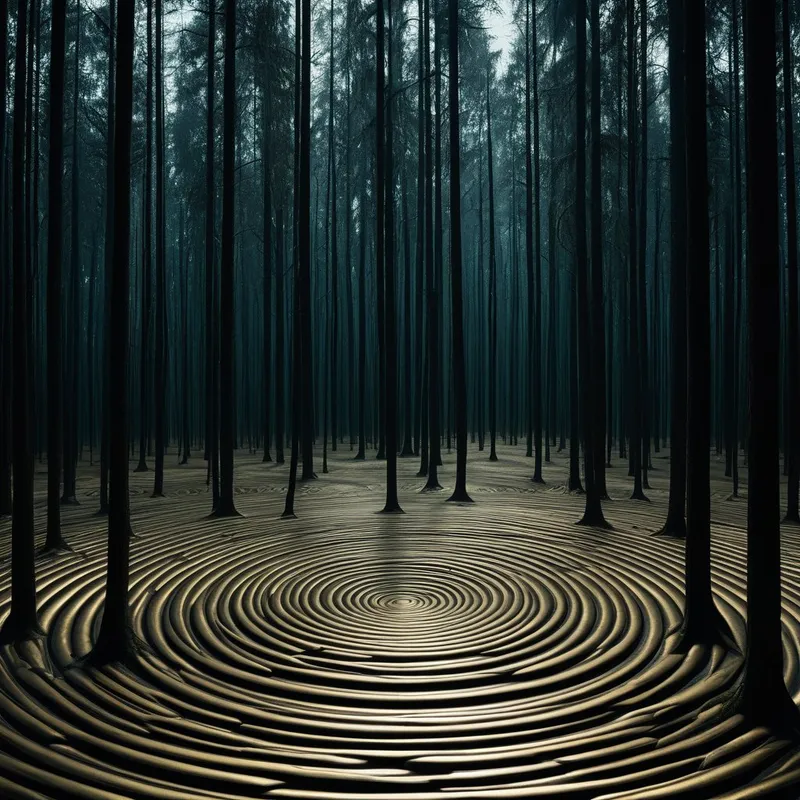
The transmutation begins not when the gold appears, but when we learn the dance that keeps the crucible from shattering.
For the modern individual, this translates to recognizing and honoring those periods of "frantic defense." It might be the obsessive research at the start of a new project, the protective solitude after a emotional opening, or the seemingly disordered creative outburst that shields a nascent identity from external judgment. The goal is not to live in the Corybantian frenzy forever, but to understand its sacred purpose: to buy time. The dance continues until the infant Zeus—the nascent consciousness, the integrated complex, the new attitude—is strong enough to wield its own thunder. Then, the cacophony can cease, the dancers can rest, and their ecstatic, protective energy is transmuted into the steady, ruling power of a consciousness that has successfully defended its own becoming. The wild guardians are absorbed, their function complete, their rhythm now the steady pulse of a sovereign self.
Associated Symbols
Explore related symbols from the CaleaDream lexicon: