Coniraya and Cavillaca Myth Meaning & Symbolism
A myth of a trickster moon god's unrequited love for a pristine goddess, leading to a cosmic pregnancy, a shaming revelation, and a transformation into stone.
The Tale of Coniraya and Cavillaca
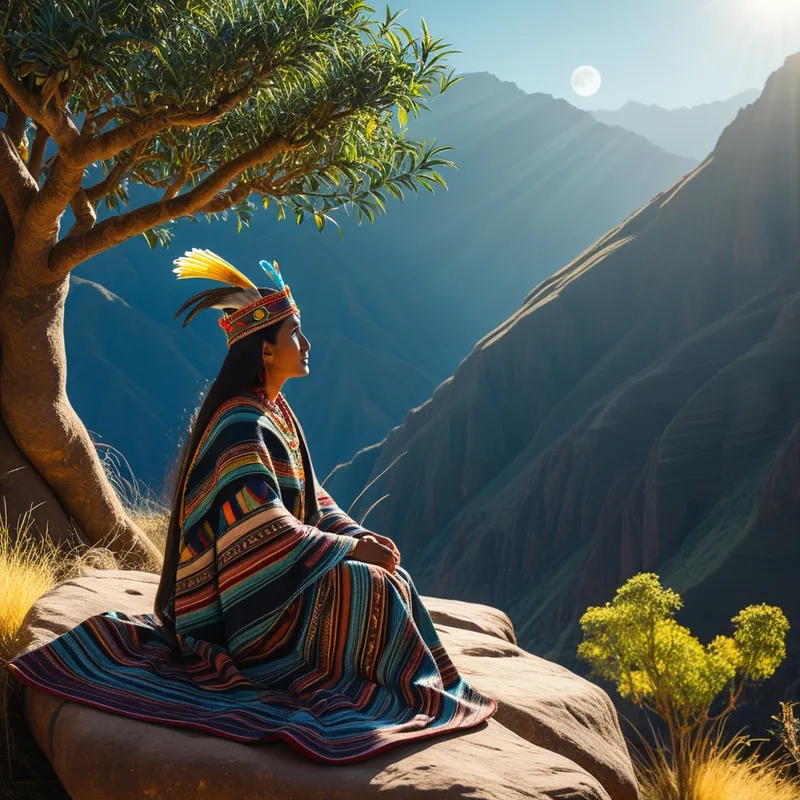
Listen. In the time when the world was still soft clay, when the Viracocha had set the mountains in their places but the valleys still whispered with new life, there lived a goddess named Cavillaca. She was not born of woman, but of the earth's own longing for perfection. She was untouched, pristine, a being of such luminous beauty that flowers turned their faces to her as she passed, and the very air seemed to polish itself in her presence. She spent her days in a secluded garden, weaving the threads of sunlight and tending to blossoms that knew no wilting, a sovereign in her own silent, perfect kingdom.
And there was Coniraya. He was the Moon, but not as you know him. He was a deity of cunning and shape, a master of the unseen paths and the humble crafts. To the eyes of the high gods, he appeared lowly, often taking the form of a ragged beggar or a simple bird. But his power was in transformation and subtlety. He saw Cavillaca, this paragon of solitary beauty, and a fire was kindled in his celestial heart—a fire not of pure light, but of clever, desperate desire.
Knowing she would never regard a seeming pauper, Coniraya wove a plan of profound intimacy. He transformed his essence into a ripe, luscious lúcuma fruit. Or, some say, he became a glistening, perfect bead of his own silvery light. He waited, a patient potential nestled in the grass of her garden. When Cavillaca walked by, drawn by the fruit's impossible perfection, she plucked it and ate. In that moment, the seed of Coniraya was planted within her.
Time passed in the sun-drenched garden, but a new time grew within Cavillaca. She felt the quickening, the undeniable swell of life. Confusion turned to awe—for she had known no man. This, she believed, was a miracle, a sign of her own divine and immaculate nature. When her time came, she bore a son, a healthy, beautiful child. She loved him fiercely, this proof of her own sacredness.
Years later, when all the gods and huacas of the land gathered in a great festival at Pachacamac, Cavillaca came, proud and radiant, her son by her side. She stood before the assembly and declared, “Let the father of my child, who is surely a god as magnificent as this boy, now stand forth and claim us!”
A silence fell. The wind stilled. No one stepped forward. Then, from the edges of the crowd, from among the lowly and the overlooked, a murmur arose. It was Coniraya, in his humble guise. “He is my son,” he said, his voice clear. “To prove it, let the child crawl to me. He will know his own blood.”
Cavillaca stared, her world cracking. Humiliation, hot and corrosive, flooded her veins. But she set the child down. On tiny hands and knees, the boy crawled unerringly across the dusty ground, past the glittering robes of sun gods and earth mothers, straight into the arms of the ragged Coniraya.
The revelation was a cataclysm. The perfect narrative of her life shattered. This was no divine immaculate conception, but a trick, a ingestion, a cosmic deception by a god she deemed beneath her. A shame so profound it turned her heart to ice. Without a word, without a glance back at the child or the father, she turned and fled west, towards the edge of the world, towards the vast, swallowing Mamacocha.
Coniraya, his triumph instantly curdling into despair, gave chase, calling out her name. “Cavillaca! My love!” But she was a bolt of pure, wounded light. Reaching the coast at Pachacamac, she did not stop. She waded into the foaming surf with her son, and there, in that moment of ultimate refusal, they were transformed. Goddess and child became stone—twin islands, or a mother rock clutching her child, eternal sentinels gazing forever away from the land, forever turned to sea and setting sun.
Coniraya, arriving too late, found only stone where his love had been. In his grief, he laid a curse upon the creatures of that coast, and forever after, he follows her, a lonely, chasing light in the night sky, never to hold what he created through cunning and claimed through truth.
Cultural Origins & Context
This myth was recorded by the Spanish chronicler Bernabé Cobo in the 17th century, sourced from the oral traditions of the Andean peoples. It is a pre-Incan, likely coastal myth that was absorbed and retold within the expansive Inca cosmology. Unlike the official, state-sanctioned myths of the Sapa Inca and Inti, this tale feels folkloric, earthy, and psychologically complex.
It was likely a story told not in grand state ceremonies, but in local communities, serving as an etiological myth explaining coastal rock formations and the nature of the moon’s path. More profoundly, it functioned as a deep cultural narrative about the consequences of deception, the volcanic nature of shame, and the unpredictable, often messy, origins of life and lineage. It presents a cosmology where divinity is not monolithic perfection, but a spectrum containing cleverness, desire, humiliation, and irreversible change.
Symbolic Architecture
At its core, this is a myth about the collision of two profound psychic principles: the Trickster and the Self in its pristine, undifferentiated form. Cavillaca represents the psyche’s initial state of imagined self-containment and perfection. She is the ego that believes it is self-created, untouched by the messy, unconscious, or “lowly” parts of the psyche (Coniraya).
Coniraya’s act—transforming into a fruit and being consumed—is the ultimate symbol of unconscious content entering consciousness not through battle or quest, but through seduction and ingestion. It is an insemination by idea, by a truth too palatable to refuse until it manifests in undeniable reality (the child).
The child is the living symbol born from the union of hidden cunning and apparent purity—it is the new consciousness, the undeniable fact that bridges two separate worlds.
The public revelation is the shattering of the persona. Cavillaca’s flight is not just geographical; it is a psychic retreat of such totality that it becomes a petrification. She would rather become static, eternal stone (a fixed complex) than integrate the humiliating truth of her connection to the trickster. Coniraya’s eternal chase is the fate of the unconscious content once it is glimpsed but rejected—it forever follows the psyche, a haunting, unintegrated potential.

The Dreamer's Resonance
When this myth patterns a modern dream, it speaks to a profound psychological crisis of identity and origin. To dream of discovering a pregnancy from an unknown or despised source mirrors the shock of realizing a core aspect of one’s identity or creativity is tied to something one has rejected or judged within oneself—a hidden talent, a repressed trauma, a “shameful” desire.
The somatic experience is one of sudden, gut-wrenching shame and the impulse to flee. The dreamer may feel exposed, their perfect self-narrative collapsing. The figure of Cavillaca turning to stone translates somatically as freezing, dissociation, a feeling of being trapped and immobilized by the revelation. The dream is signaling that a truth, perhaps delivered in a tricksterish or unexpected way (a lost object found, a slip of the tongue, a sudden insight), is demanding integration. The refusal to do so risks a kind of psychic petrification, where growth stops, and one becomes fixed in a stance of wounded pride, forever facing away from the source of one’s own becoming.
Alchemical Translation
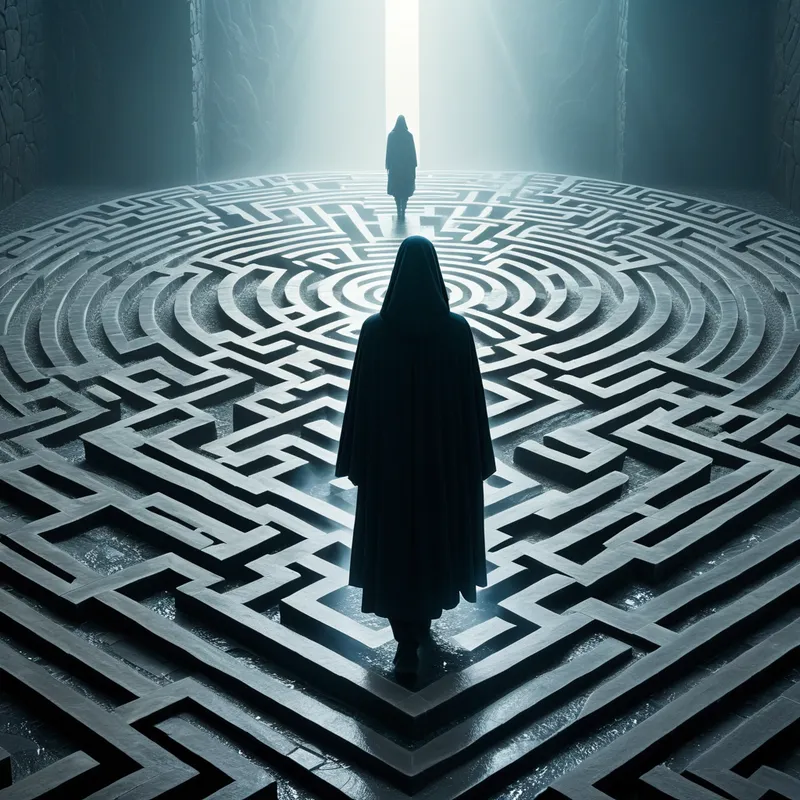
The alchemical process modeled here is the nigredo—the blackening, the putrefaction, the stage of utter despair and shame that follows the coniunctio (the union, symbolized by the ingestion and pregnancy). For individuation to proceed, the pristine, idealized self-image (Cavillaca) must die. It is not a heroic death in battle, but a death by humiliation, by the unveiling of a “lowly” origin.
The myth shows the catastrophic result of failing this stage. Instead of enduring the nigredo—sitting with the shame, acknowledging the trickster within as a creative force, and embracing the “bastard” child of this union (the new, more complex self)—the psyche flees. It chooses the salt of the sea (tears) and the permanence of stone over the fluidity of transformation.
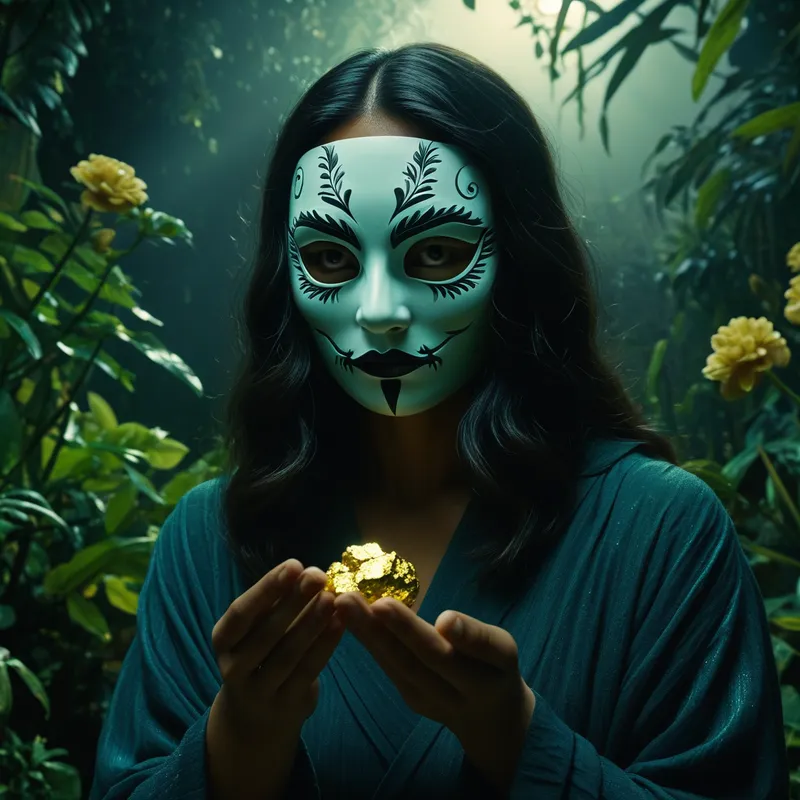
The alchemical gold in this myth is not found, because the process is aborted. The gold is the potential integrated self—Cavillaca as mother, Coniraya as acknowledged father, the child as their living bond. This potential is forever lost, crystallized as a monument to failure.
For the modern individual, the instruction is clear: when a hidden, perhaps tricksterish, part of yourself creates something new in your life (a project, a relationship, a perspective), you must claim it publicly, even if its origins shame your old self-image. The alternative is not peace, but a lonely, eternal petrification, with the creative source forever chasing you, just out of reach, in the night sky of your own unconscious.
Associated Symbols
Explore related symbols from the CaleaDream lexicon:
- Moon — The celestial body representing Coniraya, symbolizing cyclical change, reflection, the unconscious, and the cunning, transformative power that works in shadows.
- Stone — The final state of Cavillaca and her child, symbolizing petrification, eternal fixation, the complex that forms when profound shame halts all psychic movement and growth.
- Child — The living proof and product of the union, representing new consciousness, potential, and the undeniable fact that bridges disparate parts of the psyche.
- Shame — The catalytic emotion of the myth, the searing heat that transforms identity, forcing either integration or a retreat into stony, permanent defense.
- Fruit — The vessel of Coniraya's essence, symbolizing seductive knowledge, the unconscious content made palatable and irresistible, which once ingested, irrevocably alters the self from within.
- Ocean — Mamacocha, the vast mother-sea into which Cavillaca flees, representing the dissolution of the individual back into the unconscious, the primal waters from which new forms are born (or into which they retreat).
- Journey — Cavillaca's desperate flight west, representing the psychic movement away from integration, a journey not of discovery but of refusal, ending in stasis.
- Trickster — The archetype embodied by Coniraya, the boundary-crosser who instigates crisis and change through deception, challenging rigid notions of purity and order.
- Goddess — Cavillaca as the archetypal pristine feminine, representing wholeness, self-containment, and the idealized image that must be shattered for deeper growth to occur.
- Gold — The potential symbolized by the child and the union, the alchemical "gold" of integrated consciousness that is lost when the process is aborted out of shame.