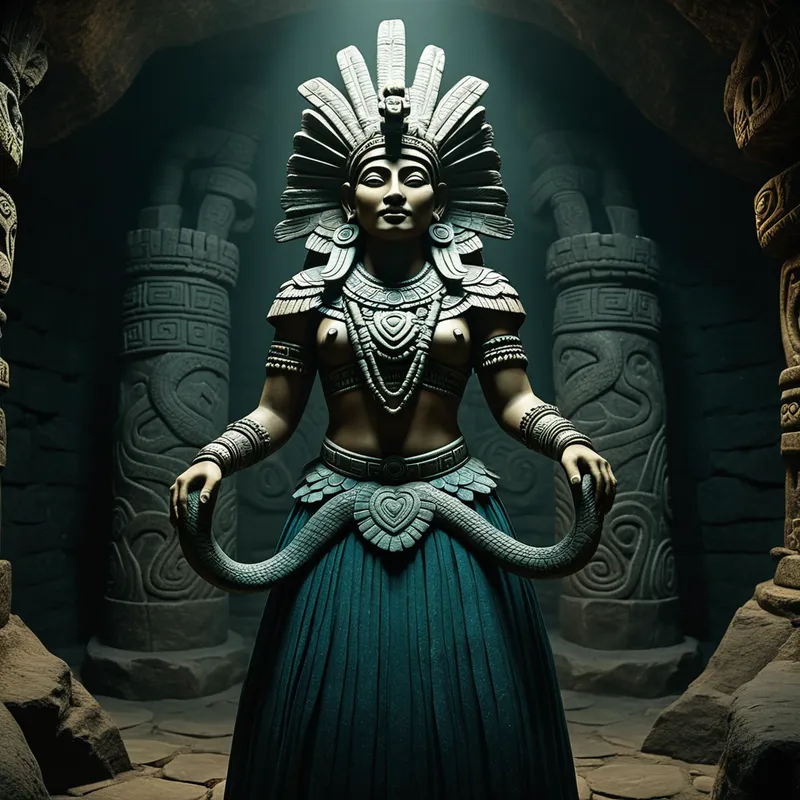
Coatlicue Earth Mother Myth Meaning & Symbolism
The story of the goddess who gives life and receives death, embodying the terrifying, fertile, and transformative power of the earth itself.
The Tale of Coatlicue Earth Mother
Listen. Before the Fifth Sun found its place in the sky, when the world was a place of potent silence and humming potential, there lived a goddess on the mountain. Not a goddess of glittering palaces, but of the living rock itself. Her name was Coatlicue, and she was the keeper of the mountain Coatepec. She was a mother of multitudes, her children the stars of the southern sky, the Centzon Huitznahua.
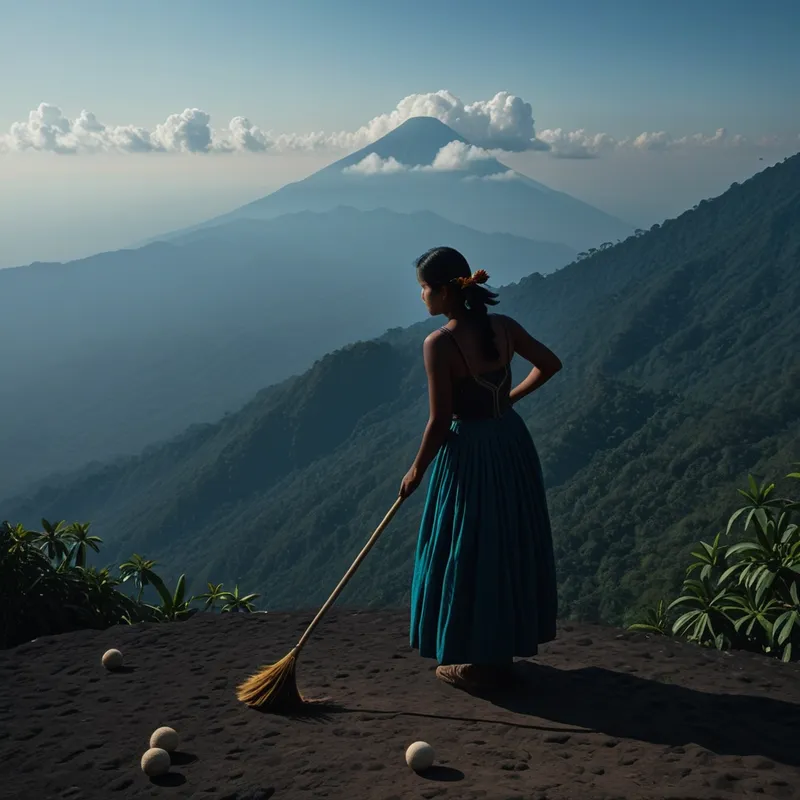
Her days were a humble ritual. She swept the sacred slopes, her broom whispering against the stone, keeping the holy place clean. She was the earth, performing its endless, quiet work of maintenance and decay. One day, as she swept, a miracle as soft as a sigh occurred. A single, perfect ball of brilliant down feathers, plucked from the breast of the sky, drifted down and settled upon her. It was not an eagle's feather, nor a macaw's, but something purer—a plume of light. In that moment of contact, without union or passion, she was impregnated.
The life within her grew, a new sun waiting to be born. But this divine conception was a scandal to the established order. Her children, the four hundred southern stars, were consumed by a rage as cold and sharp as starlight. Their mother, the humble sweeper, had been touched by a mystery they could not own or understand. Their shame curdled into murderous intent. Led by their sister, the fierce goddess Coyolxauhqui, they resolved to climb Coatepec and slay their own mother, to cut the new life from her womb and restore their tainted honor.
They armed themselves with spears and shields, their faces set in grim masks of righteous fury. The mountain trembled under the march of four hundred avenging sons. Coatlicue, sensing the approach of death from the children she had birthed, was filled with a terrible fear. Her heart, the heart of the earth, quaked.
But the child in her womb heard. From the dark, warm sanctuary, a voice spoke to her, a voice that was both unborn and ancient. "Do not fear, Mother. I am here. I will protect you." As Coyolxauhqui, beautiful and terrible, led the charge to the summit, the moment of violence erupted.
In a single, explosive instant, the child within Coatlicue was born. Not as a babe, but as a fully armed and radiant warrior, painted for battle, clutching a fiery serpent as his weapon. This was Huitzilopochtli, the Left-Handed Hummingbird, the Fifth Sun himself. With the fury of the dawn, he sprang forth. His first act was not of birth, but of defense. He beheaded his sister Coyolxauhqui with a single blow. Her body tumbled down the slopes of Coatepec, breaking apart as it fell, coming to rest dismembered at the mountain's base. Then, turning his blazing gaze upon his four hundred brothers, he drove them from the sky, scattering them into the distant darkness where they remain as faint stars, forever defeated.
Coatlicue witnessed this. She witnessed the birth that was a battle, the child who was a savior and a destroyer. She saw her daughter slain, her sons vanquished. She remained, the mountain, the silent, enduring earth, now stained with the blood of her children, now cradling the new sun that had saved her. She was the stage, the cause, and the survivor of the cataclysm. The sweeping was done. A new age had dawned in a baptism of familial blood.
Cultural Origins & Context
This myth was the sacred history of the Mexica people, the foundational narrative enshrined at the heart of their capital, Tenochtitlan. It was not merely a story but a cosmological blueprint, recited by priests and embodied in monumental architecture. The Great Temple, the Templo Mayor, was itself a representation of Coatepec. At its base was a massive, carved stone disk depicting the dismembered body of Coyolxauhqui, over which priests would ascend to perform sacrifices at the twin shrines above—a ritual re-enactment of Huitzilopochtli's victory.
The myth served multiple vital functions. It legitimized Huitzilopochtli's supreme position in the Aztec pantheon as a patron god of war and the sun. It explained the cyclical, violent nature of the cosmos, where new life (the sun) must be defended and nourished by constant struggle and sacrifice. Most profoundly, it presented a terrifyingly honest image of the earth: not a passive, nurturing mother, but a dynamic, consuming, and regenerative force that gives life and receives the dead in equal measure. The myth was a constant reminder that the stability of their world—the sun's journey—depended on confronting and integrating this fundamental, bloody truth.
Symbolic Architecture
Coatlicue is the ultimate symbol of the Mater Terrifica. She is not the gentle, bountiful earth, but the earth that quakes, swallows, and transforms all things in the dark humus of her being. Her skirt of writhing serpents and necklace of severed hands and hearts are not mere adornments; they are her essence. She wears the symbols of life (the phallic, shedding serpent) and death (the severed extremities) as inseparable parts of her whole.
To face Coatlicue is to face the reality that the source of all life is also the destination of all death. There is no creation without destruction, no nurture without dissolution.
The myth's central drama is a psychic civil war within the Mother archetype itself. The established, ordered children (the stars, the moon) revolt against the emergence of a new, potent, and disruptive consciousness (the sun, Huitzilopochtli). Coyolxauhqui represents a beautiful but rigid order—a purity that cannot tolerate the messy, miraculous, and violent process of new birth. Her dismemberment is not a mere defeat but a necessary fragmentation, a breaking apart of an old, static identity to make way for a new, more dynamic one. Huitzilopochtli's birth in medias res, fully armed, signifies that transformative consciousness often erupts into being precisely when the old self is under lethal attack.

The Dreamer's Resonance
When this myth stirs in the modern psyche, it often manifests in dreams of profound, unsettling fertility and equally profound threat. One might dream of a garden that grows both exquisite flowers and grasping thorns from the same soil, or of a beloved maternal figure whose face suddenly becomes a void or transforms into a serpent. These are Coatlicue dreams.
Somatically, they may be accompanied by feelings of deep, grounding heaviness mixed with panic—the sensation of being both held and swallowed. Psychologically, the dreamer is encountering what Carl Jung called the negative mother complex or the shadow of the Great Mother. This is the process where the inner image of nurture, safety, and source is revealed to have a counterpart: the devouring, smothering, chaotic force that demands a sacrifice of one's old, comfortable self. The dreamer is at the base of their own Coatepec, feeling the approach of a transformative insight so powerful it feels like it will destroy their existing world—and it must, in order for a new, more authentic consciousness to be born.
Alchemical Translation
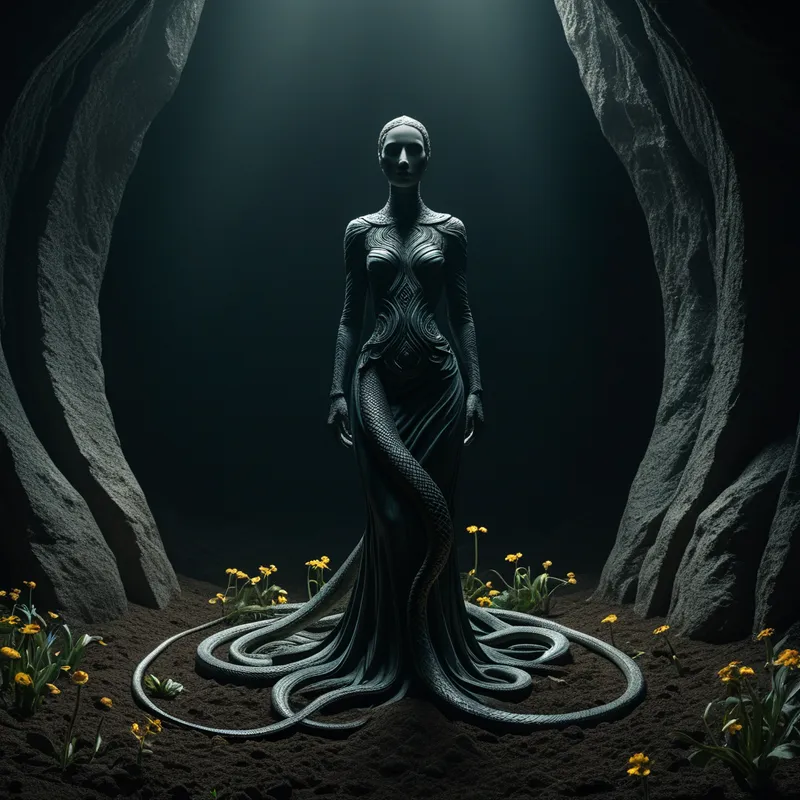
The alchemical journey modeled by Coatlicue's myth is the Nigredo, the descent into the black, fecund earth of the soul. It is the stage of confrontatio with the most primal, paradoxical layer of existence. For an individual, this is the process of acknowledging that within one's own foundation—the personal history, the body, the unconscious—lies not just nurturing memory but also coiled trauma, repressed rage, and the inevitability of personal decay.
Individuation requires a sacrifice on the mountain of the self. One must allow the "Coyolxauhqui" within—the proud, orderly, but ultimately sterile self-image—to be shattered by the erupting "Huitzilopochtli," the authentic, assertive, and often disruptive core of the personality.
The "sweeping" is the humble, daily work of attending to the psyche. The "feather" is the grace of an unexpected insight, a divine intrusion that impregnates the soul with a new potential. The fury of the "star-children" is the resistance of the ego, which sees this new growth as a threat to its sovereignty. The psychic transmutation occurs in the defense of that nascent self. One must become both Coatlicue, who endures the terror of transformation, and Huitzilopochtli, who acts with decisive force to protect the nascent life. The outcome is not a peaceful resolution, but a hard-won new order, where the dismembered parts of the old self lie at the base of one's being, integrated not as whole, but as acknowledged fragments that fertilize the new dawn.
Associated Symbols
Explore related symbols from the CaleaDream lexicon:
- Mother — The primal source and container of all life, who in this myth embodies the terrifying paradox of being both giver and receiver of death.
- Earth — The physical and symbolic ground of being, represented by Coatlicue as a dynamic, consuming, and regenerative entity, not a passive resource.
- Snake — The quintessential symbol of transformation, fertility, and cyclical life-death-rebirth, woven into the very skirt of the goddess as her defining attribute.
- Sacrifice — The core cosmological principle enacted in the myth, where the death of the old (Coyolxauhqui) is the necessary nourishment for the birth of the new (Huitzilopochtli).
- Blood — The sacred liquid of life and the currency of sacrifice, which flows in this myth from familial conflict to cement a new solar order.
- Mountain — The sacred axis mundi, Coatepec, representing the point where heaven and earth meet and where world-changing psychic battles are fought.
- Sun — The triumphant, born-fully-formed consciousness of Huitzilopochtli, representing the luminous, assertive self that emerges from the dark earth of the unconscious.
- Moon — The beautiful but rigid order of Coyolxauhqui, symbolizing a pristine, static identity that must be broken apart for true transformation to occur.
- Heart — The central organ of life and emotion, depicted in the goddess's necklace of severed hearts, signifying the price of creation and the essence of sacrifice.
- Death — Not an end, but a transformative phase within Coatlicue's domain, a necessary return to the source that fuels the next cycle of creation.
- Rebirth — The violent dawn of Huitzilopochtli, illustrating that psychological rebirth is often a defensive, explosive act against the forces of stagnation.
- Shadow — The dark, devouring, and chaotic aspect of the Mother archetype that must be confronted and integrated to achieve psychic wholeness.