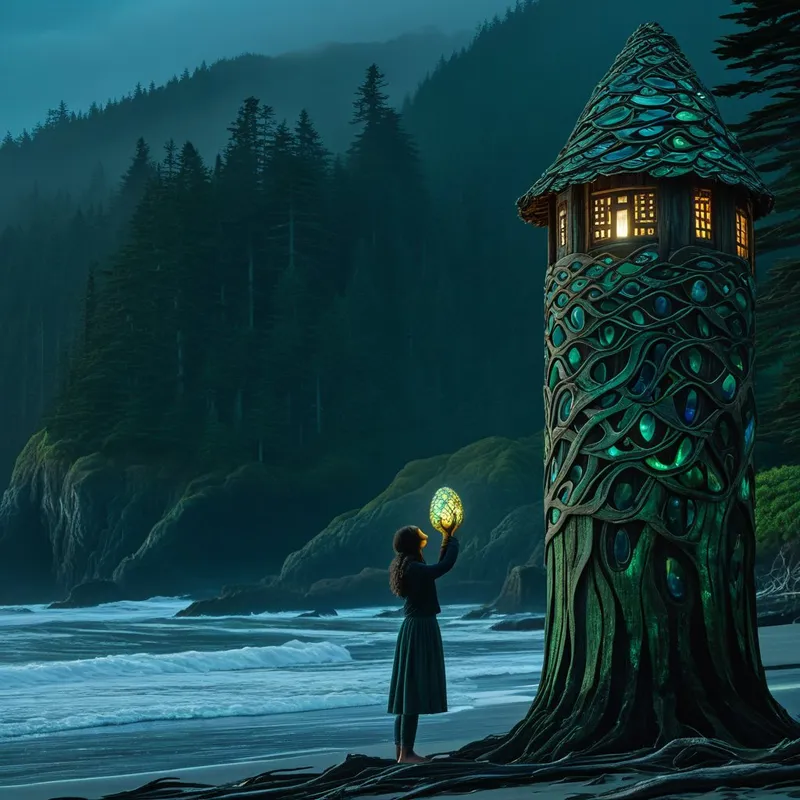
Coastal tribes Myth Meaning & Symbolism
A myth of a people born from the meeting of sea and forest, learning to live in sacred reciprocity with the tides, the salmon, and the cedar.
The Tale of the Coastal Tribes
Listen. The world was not always as it is.
In the time before memory, the great Raven flew over a land of endless, whispering forests and a sea that roared with a voice of its own. The forest was the domain of the Mountain Spirit, a being of rooted strength and silent growth. The sea belonged to the Ocean Mother, a being of fathomless emotion and relentless change. Between them lay a narrow strip of stone and sand, a tense border where their powers met and clashed. Waves would crash and gnaw at the roots of the towering cedars; roots would stretch and clutch at the retreating tides. It was a place of constant negotiation, neither one nor the other.
Raven, ever the trickster and the arranger, saw not conflict, but potential. He dove into the cold, green heart of the Ocean Mother and gathered a handful of her essence—not water, but the promise of water, the pattern of the tide, the shape of the salmon’s leap. He carried this glistening potential to the highest branch of the oldest cedar in the forest, where the Mountain Spirit slept. There, Raven placed the sea-promise into a knothole, a wound in the tree’s side.
From this union, from the cedar’s sacrifice and the ocean’s gift, the first people emerged. They were born not from the earth alone, nor the sea alone, but from the sacred seam between them. Their skin held the hue of wet sand at dusk; their hair flowed like kelp in the current; their bones held the strength of seasoned wood. They opened their eyes to a world of profound duality. They felt the Mountain Spirit’s call to stay, to build, to be steadfast. They felt the Ocean Mother’s pull to journey, to flow, to adapt.
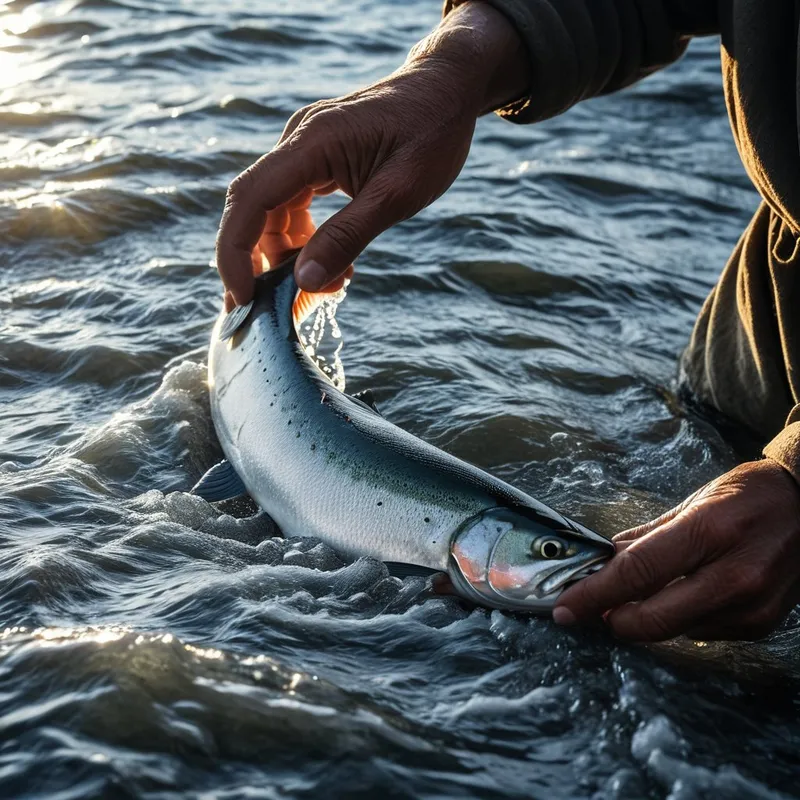
Their first days were a struggle. They were strangers in both realms. The forest shadows were too deep, the sea’s cold too biting. They huddled on the shore, hungry and uncertain. Raven returned, not with a gift of food, but with a lesson. He showed them how to watch the Silver People—the salmon—who themselves lived between fresh and salt water. He showed them how the cedar, when asked with respect, would give its body for shelter and canoe. He taught them the language of the tides, the signs of the herring spawn, the paths of the whales.
The people learned. They became translators. They built longhouses from the cedar, facing the sea. They carved canoes to ride the Ocean Mother’s moods. They developed rituals—the First Salmon Ceremony, the welcoming of the herring, the pollatching—not as demands, but as conversations. They spoke to the Mountain Spirit through the smoke of their fires and the carvings on their poles. They spoke to the Ocean Mother through their offerings and their songs carried on the wind. They became the living covenant, the embodied treaty between forest and sea. They were the Coastal Tribes, the people of the threshold, whose purpose was not to conquer either world, but to honor the relationship that created them.
Cultural Origins & Context
This foundational narrative, in its myriad local forms, belongs to the many distinct nations inhabiting the Pacific Northwest coast—from the Tlingit and Haida in the north to the Coast Salish, Kwakwaka’wakw, and Nuu-chah-nulth peoples further south. It is not a single, monolithic myth but a core cosmological understanding expressed through diverse stories, art forms, and social structures.
The myth was not merely entertainment; it was the operating system for reality. It was passed down orally by elders and shamans, woven into the intricate patterns of woven blankets, carved into the towering totem poles, and enacted in elaborate ceremonial dances with masks embodying the spirits of animals and ancestors. Its societal function was paramount: it encoded the laws of ecological and social reciprocity. It explained why one must never waste a salmon, why a chief must redistribute wealth in a potlatch, and why every clan traced its origins to a specific encounter with a spiritual being from the land or sea. The myth established identity, law, and ethics as inseparable from place and relationship.
Symbolic Architecture
At its heart, the myth is a blueprint for consciousness situated at a boundary. The coastal strip is the liminal zone, the psychical space where opposites meet and generate something new. The people themselves symbolize the emergent ego-consciousness that arises not from rejecting nature (forest) or emotion (sea), but from consciously holding the tension between them.
The true self is not born in purity, but in the creative tension between enduring structure and fluid change.
The Mountain Spirit represents the psychic principle of stasis, structure, tradition, and the rooted unconscious—the enduring patterns of family, culture, and the body. The Ocean Mother represents the principle of dynamics, emotion, intuition, the unknown, and the flowing unconscious—the tides of feeling, innovation, and the collective psyche. Human life, as depicted in the myth, is the constant, sacred work of mediating these two vast, often opposing, inner forces. Raven, the catalyst, is the archetypal trickster spirit that disrupts stagnant balances and forces new integrations, representing the unexpected insight or crisis that initiates psychological growth.
The Dreamer's Resonance
When this mythic pattern stirs in the modern dreamer, it often manifests as dreams of shorelines, of being caught between two powerful forces, or of negotiating a relationship between a dense forest and a vast body of water. One might dream of building a house that is also a boat, or of trying to translate between two groups that speak different languages.
Somatically, this can feel like a pull in two directions—a desire for security and routine (the forest) conflicting with a longing for freedom and emotional release (the sea). Psychologically, the dreamer is likely navigating a life transition that requires integrating a part of themselves they have kept separate. Perhaps a deeply emotional, intuitive side (Ocean Mother) is demanding recognition from a life overly structured by duty and logic (Mountain Spirit). The dream is an invitation from the psyche to stop choosing one over the other and to begin the difficult, creative work of building a "coastal" consciousness—a self that can honor both its foundations and its fluidity.
Alchemical Translation
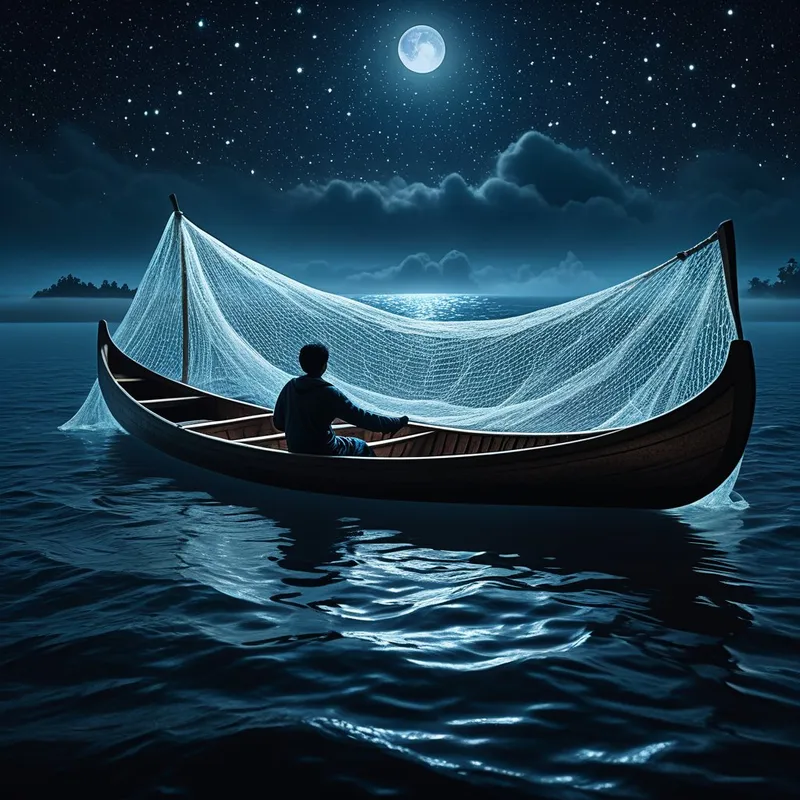
The individuation process modeled here is not a heroic journey to a distant goal, but a deepening commitment to one’s native terrain—the inner landscape where our deepest structures meet our wildest depths. The modern seeker often tries to "find themselves" by escaping to the forest (isolation, asceticism) or losing themselves in the sea (fusion, emotional chaos). The alchemy of the Coastal Tribes myth proposes a third way: conscious inhabitation of the boundary.
Individuation is the craft of building a self at the intersection of what you are made of and what moves through you.
The first step, catalyzed by a "Raven" event (a loss, an insight, a crisis), is the acknowledgment of the inner conflict. The second is the respectful "gathering of essences"—learning the languages of both inner forces. This might involve therapy to understand one’s rooted patterns (Mountain Spirit) and artistic practice to channel one’s emotions (Ocean Mother). The final, ongoing stage is the ritualized practice of reciprocity: building a life structure (the longhouse) that faces the unconscious, crafting a vessel (the canoe of the personality) capable of navigating emotional depths, and developing personal "ceremonies"—habits of gratitude, reflection, and creative expression—that maintain the sacred dialogue. One becomes the caregiver of one’s own soul, tending the covenant between the enduring self and the ever-changing self, finding wholeness not in resolution, but in sacred, sustained relationship.
Associated Symbols
Explore related symbols from the CaleaDream lexicon: