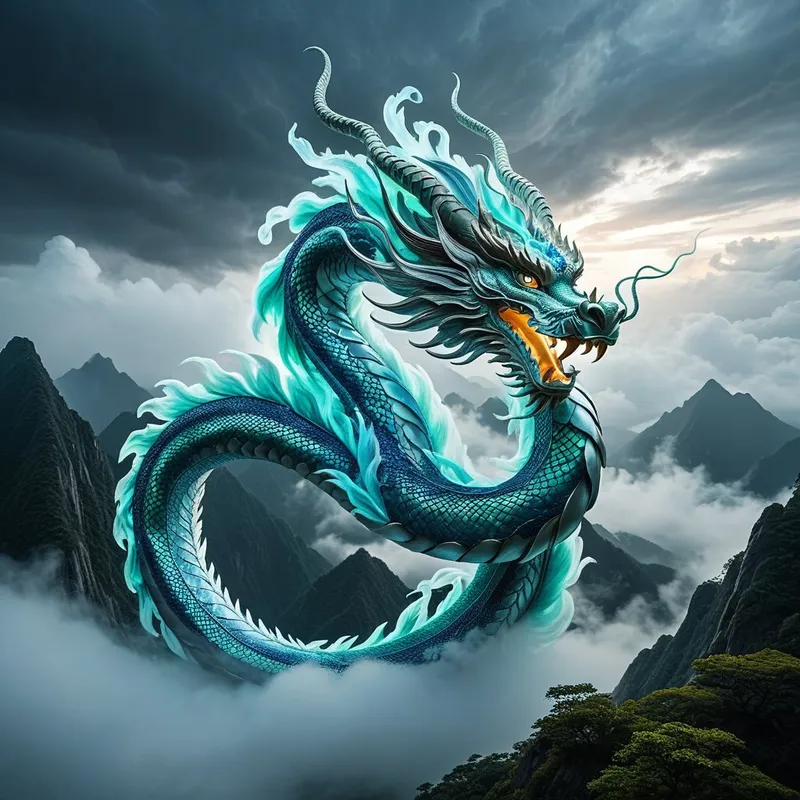
Cloud Dragons Myth Meaning & Symbolism
Celestial dragons weave rain from mist and thunder, embodying the creative tension between chaos and order, and the soul's journey through the unconscious.
The Tale of Cloud Dragons
Listen, and let your spirit drift to the time when the world was young and the sky was a blank scroll of pale silk. In those days, the heavens were silent. The sun beat down, the earth grew parched, and the rivers ran thin. Life waited, hushed and thirsty, beneath a dome of relentless blue.
But in the secret chambers of the air, where the breath of the mountains met the sigh of the seas, something stirred. They were the Long, but not the scaled, river-dwelling kind. These were the Yun Long, the Cloud Dragons. They were born not of earth or water, but of the in-between. Their bodies were woven from the first morning mist, their bones the structure of gathering fog, their blood the potential of a storm yet to break. They were creatures of pure becoming, formless yet yearning for form, silent yet humming with the song of thunder to come.
They slept in the high, cold places, in the womb of the void. But a whisper traveled up from the cracked earth, a plea carried on the dry wind. It was the world’s longing. This longing seeped into their dreamless sleep and became a restlessness. One by one, they awoke. Not with a roar, but with a slow, deliberate uncoiling, like a thought taking shape.
Where a dragon’s thought trailed, cloud gathered. A flick of a tail of vapor painted cirrus across the azure. A deep, silent breath drawn in pulled the humid air from forests and lakes into great, grey banks. They began to dance—a slow, cosmic, and utterly silent ballet. They wove through each other, their misty forms merging and parting. In their passing, the air grew heavy, charged. The light changed, turning the world a strange, luminous grey.
This was the conflict: not a battle, but a profound tension. The tension between the formless potential of the cloud and the need to release it as formed rain. The dragons carried the chaos of the storm within their serene bodies. Their dance was the rising action, a gathering of will. They coiled tighter, drawing the moisture from ten thousand li, compressing the promise of life into dense, dark thunderheads. The world below held its breath. The air crackled with unshed energy.
Then, the moment of resolution. A great Cloud Dragon, its form now a towering anvil of shadow and silver, would turn its gaze—a flash of imagined lightning in the mist—earthward. With a gesture that was both surrender and command, it would release its hold. Not with violence, but with a sigh that became the wind, and a trembling that became the first, fat drop of rain. The dragon did not cease to be; it transformed. Its body became the falling rain, the rolling thunder, the life-giving river. It sacrificed its singular, majestic form to become the myriad forms of water, returning to the earth only to be drawn up again, to dream once more in the high air, and to dance again when the world grew thirsty.
Cultural Origins & Context
The concept of Cloud Dragons is woven deeply into the fabric of Chinese natural philosophy and cosmology. They are not the subject of a single, canonical myth like the Greek tales of Olympus, but rather a pervasive and evolving archetype within a vast ecosystem of dragon lore. Their origins are diffuse, emerging from ancient animist beliefs that saw spirit (shen) in all natural phenomena—especially those as powerful and life-giving as weather.
These beings were chronicled in early texts like the Shan Hai Jing, and their behavior was meticulously observed and poetically documented by scholars, farmers, and court astronomers alike. The Cloud Dragon’s primary societal function was explanatory and relational. It gave a face and an intention to the terrifying and vital processes of meteorology. A drought was not mere chance; it was the Cloud Dragons sleeping too deeply. A benevolent growing season was their diligent dance.
They served as a crucial bridge in the Chinese cosmological view, which emphasized harmony between Heaven (Tian), Earth (Di), and Humanity (Ren). The Cloud Dragon existed in the middle realm of the sky, mediating between the celestial will and terrestrial need. Emperors, as the Tianzi, were intimately linked to this symbolism. Their ability to rule justly and perform correct rituals was believed to influence the behavior of these celestial dragons, ensuring timely rains and national prosperity. Thus, the myth was passed down not just in stories, but in agricultural practices, imperial iconography, and the very language used to describe the weather.
Symbolic Architecture
At its core, the Cloud Dragon is a supreme symbol of potential in motion. It represents the state of being that exists after conception but before manifestation. It is the creative idea not yet articulated, the emotion not yet expressed, the psychic energy not yet directed.
The cloud is the unspoken word; the dragon is the will to speak it. The rain is the word made flesh, watering the world.
Psychologically, the Cloud Dragon embodies the fertile chaos of the unconscious. Its misty, formless body is the swirling content of our inner world—dreams, impulses, intuitions, and fears—that lacks coherent structure. The dragon’s "dance" is the ego’s initial, often awkward, engagement with this material: observing it, circling it, feeling its charge. The gathering storm represents the increasing pressure for this unconscious content to become conscious, to take a definite form and enter the world of reality.
The transformation into rain is the critical act of symbolic realization. It is the process by which raw, amorphous psychic energy is transformed into a specific thought, a work of art, a conscious feeling, or a concrete action. The dragon does not die; it changes state. This symbolizes that integrating unconscious content does not destroy it, but rather translates it into a nourishing force that feeds the psyche’s growth.
The Dreamer's Resonance
When a modern dreamer encounters the imagery of Cloud Dragons—be it through swirling fog that feels alive, a sense of a vast presence in the clouds, or a direct visionary encounter—they are likely navigating a profound somatic and psychological process of incubation.
Somatically, this may feel like a gathering pressure, a fullness, or a humming tension in the body that has no clear outlet. It’s the feeling before a creative breakthrough or a necessary emotional release. Psychologically, the dream signals a period where significant unconscious material is coalescing but has not yet found its form or voice. The dreamer may be in a "fertile void," a time of apparent stagnation that is actually rich with potential.
The mood of the dream is key. A serene, weaving Cloud Dragon suggests a healthy, patient process of inner synthesis. A turbulent, chaotic, or trapped dragon may indicate that the dreamer is resisting this inner pressure, perhaps out of fear of the "storm" it may bring (i.e., the changes that conscious realization will demand). The dream is an invitation to engage in the dragon’s dance—to consciously attend to the formless feelings and intuitions, to give them space to gather, and ultimately, to courageously allow the rain to fall.
Alchemical Translation
The myth of the Cloud Dragons provides a majestic blueprint for the alchemical process of individuation—the journey toward psychic wholeness. The entire narrative mirrors the Solve et Coagula (dissolve and coagulate) of the soul.
The sleeping dragon in the void is the initial state of unconsciousness, where the Self is latent. The awakening by the "world’s longing" is the first stirring of the individuation impulse, often triggered by a life crisis or a deep sense of lack. The gathering of mist is the Nigredo, where one collects the shadowy, unintegrated aspects of the psyche.
The silent, weaving dance is the heart of the work—the Albedo. This is the reflective, meditative process of holding tension without prematurely resolving it. It is allowing contradictory thoughts and feelings to coexist, to swirl and interact, without forcing a conclusion. This stage requires immense tolerance for ambiguity and uncertainty.
Individuation is not about becoming a fixed, perfect form. It is about gaining the fluidity to transform—to be cloud, dragon, and rain as the soul's season demands.
Finally, the release of the rain is the Rubedo. It is the conscious integration and expression of what was once formless. The energy that was tied up in inner conflict is now released as creative power, emotional maturity, or compassionate action. The individual, like the dragon transforming into rain, sacrifices a simpler, more contained identity for a more complex and connected state of being. They realize they are both the singular dancer (the ego) and the life-giving water that connects all things (the Self). The cycle then continues, at a higher level of awareness, forever weaving new forms from the endless mist of experience.
Associated Symbols
Explore related symbols from the CaleaDream lexicon: