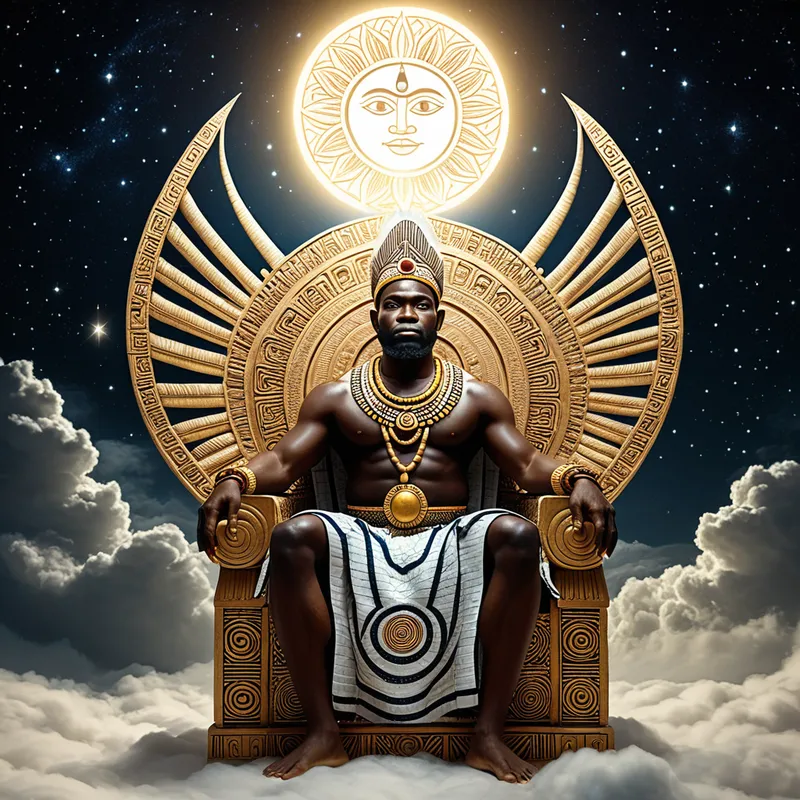
Chukwu Creator God Igbo Myth Meaning & Symbolism
The story of Chukwu, the Supreme God who created the cosmos through sacrifice, establishing the sacred order of the visible and invisible worlds.
The Tale of Chukwu Creator God Igbo
In the beginning, there was no earth beneath, no sky above. There was only the Great Void, a deep and silent potential, and within it, the presence of Chukwu. He was not a being of form as we know it, but of pure consciousness, the original thought that thinks itself. The silence was complete, and within that silence, a longing stirred—a desire for expression, for relationship, for a world to behold.
From the core of his boundless essence, Chukwu summoned his first children, the forces that would become his hands and his breath. Anyanwu, the spirit of the Sun, blazed forth—a being of fierce light, heat, and the power to make things manifest, solid, and clear. Then came Ala, the spirit of the Earth and Moon—a being of cool reflection, fertile darkness, and the deep wisdom of all that is hidden, growing, and cyclical. They were not separate from him, but expressions of his own nature, the first great division within the One.
Chukwu spoke to them, and his voice was the first sound, a vibration that became the fabric of space. “The Void is too still,” he intoned. “It dreams of form and story. We shall give it a dream to inhabit.” To Anyanwu, he gave a portion of his own fiery, active principle. “You shall carve the day. You shall bring forth the mountains, the rivers, the bodies of animals and humans. You shall be the father of all that is seen and known.” Anyanwu took this charge, and from his radiance, the solid world began to crystallize—stone, leaf, and limb emerging from the formless potential.
To Ala, Chukwu gave a portion of his own cool, receptive principle. “You shall hold the night. You shall receive the seeds of life into your dark soil, nurture them in secret, and govern the cycles of birth, death, and return. You shall be the mother of all that is felt, remembered, and ancestral.” Ala received this charge, and her presence became the vast, welcoming body of the earth itself, and the reflective glow of the moon that rules the unseen tides.
But a world of only light and only matter was a corpse. A world of only darkness and only spirit was a ghost. They needed to be married, to breathe together. So Chukwu performed the first and greatest sacrifice. He did not slay a beast or offer a libation of grain. He divided his own wholeness. From his supreme state of undivided being, he allowed a part of himself to become fully immersed in the creation—to become its life force, its Chi. This was the descent of spirit into matter.
With this sacrifice, the cosmos breathed its first breath. Anyanwu’s light danced upon Ala’s body, creating day. Ala’s shadow embraced Anyanwu’s absence, creating night. The Mmụọ—the spirits of the ancestors, of the forests, and of the rivers—arose from this marriage, inhabiting the spaces between the visible and the invisible. Chukwu, now both transcendent and immanent, watched from the realm of pure potential, Ọnwụ, connected to his creation through the Chi in every being and the sacred laws woven into the fabric of Ala, the Earth. The universe was no longer a void, but a living, breathing conversation between the seen and the unseen, forever held in the mind and sacrifice of the Creator.
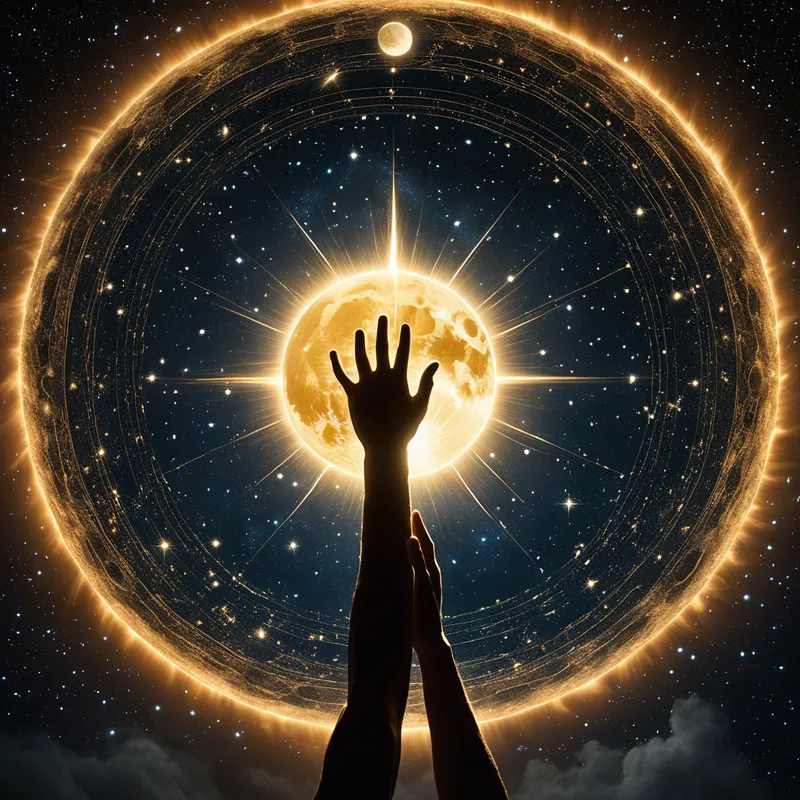
Cultural Origins & Context
This narrative of Chukwu is central to the cosmology of the Igbo people of southeastern Nigeria. It was not preserved in a single, canonical text, but in the living oral tradition—spoken by elders (Ndị Ichie) and priests during rituals, festivals, and the vital storytelling sessions around the evening fire. The myth served as the foundational metaphysical framework, explaining not how the world was built like a machine, but how it came to be alive with sacred relationship.
Its primary societal function was integrative. It established the fundamental order (Omenala) of the universe, a moral and natural law that governed human conduct. By rooting the origin in sacrifice and the balance of complementary opposites (Anyanwu and Ala), it taught that life is sustained through reciprocal exchange—between humanity and the earth, the visible community and the invisible ancestors, the individual and their personal Chi. The myth was the ultimate reference point for justice, ethics, and the understanding that every action reverberates in both the material and spiritual worlds.
Symbolic Architecture
At its heart, the myth of Chukwu is a profound map of cosmic and psychic wholeness. It begins not with an act of domination, but of interiority—a thought within the Great Void. This represents the primordial state of the unconscious Self, undifferentiated and full of potential.
Creation is not an act of making something from nothing, but of allowing the One to experience itself through the Many.
The primary symbolic action is division as creation. Chukwu’s separation into the complementary pair of Anyanwu and Ala symbolizes the necessary differentiation of the psyche. Anyanwu represents the conscious ego—the principle of light, clarity, action, and outward manifestation. Ala represents the unconscious—the principle of darkness, fertility, mystery, reception, and the hidden ground of being. A healthy psyche, like a healthy cosmos, requires both in dynamic balance.
The core of the drama is Chukwu’s sacrifice—the immersion of part of his essence as Chi. This is the archetypal pattern of incarnation: spirit voluntarily entering the limitations of form to give it life and purpose. Psychologically, this mirrors the ego’s daunting but sacred task: to embody the boundless potential of the Self within the specific, limited vessel of a single human life.
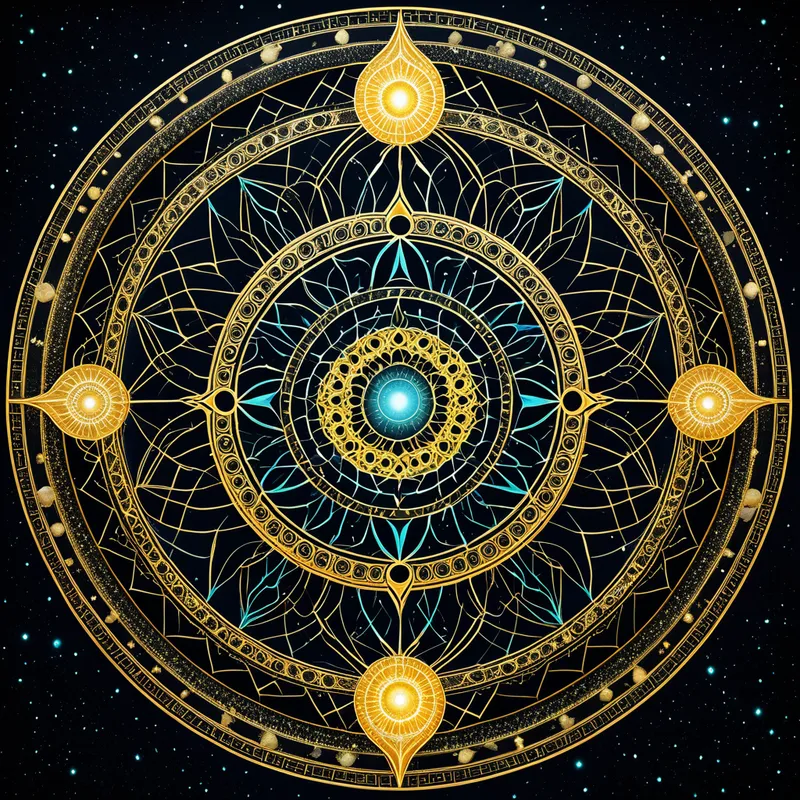
The Dreamer's Resonance
When this myth stirs in the modern dreamer, it often manifests as dreams of profound duality or a call to sacred wholeness. One might dream of standing between two worlds—a bustling city and a deep, silent forest; or of meeting a luminous double or a shadowy twin. These are echoes of the Anyanwu and Ala dynamic within.
Somatically, this process can feel like a tearing or a stretching—a sense of being pulled between the demands of outer achievement (the sun world) and inner truth (the moon world). It is the tension of the incarnated Chi, the divine spark feeling the friction of earthly life. Dreams of receiving a sacred charge or a mysterious object from an ancient, authoritative figure point to the awakening of one’s personal destiny, the recognition of the Chukwu-given purpose within. The psychological process is one of recognition and reconciliation—acknowledging that the conflicting parts of oneself are not enemies, but necessary partners in the creation of a complete life.
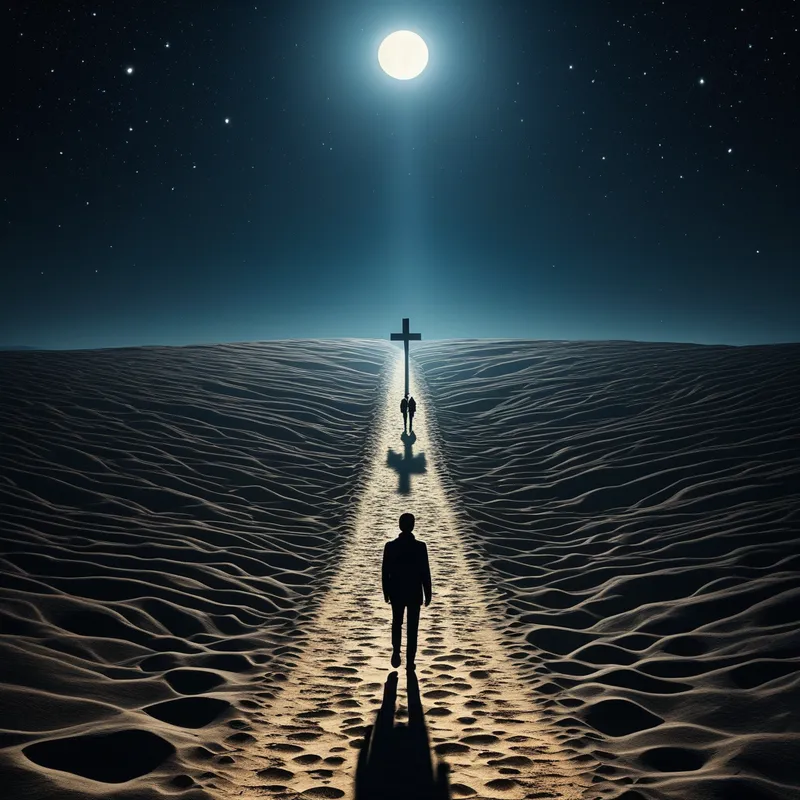
Alchemical Translation
The individuation journey modeled by this myth is not a linear conquest, but a sacred circular process of sacrifice and reintegration. The modern seeker begins, like Chukwu, in a state of potential—perhaps a feeling of inner void or undirected longing. The first alchemical step is the divisio, the courageous differentiation of one’s own inner Anyanwu and Ala. This means consciously developing the ego’s strengths while respectfully engaging the unconscious—through dream work, creative expression, or confronting repressed material.
The ultimate sacrifice is the inflation of the ego, surrendering the illusion of total control to make room for the guidance of the greater Self.
The critical transmutation is the “Chukwu sacrifice.” This is the voluntary descent of consciousness into the depths of one’s own being. It is the sacrifice of the ego’s claim to totality, allowing a part of one’s identity to be dissolved and reborn in service of a larger pattern—the Chi, or destiny. Practically, this looks like giving up a rigid life plan to follow a deeper calling, or surrendering a cherished self-image to embrace a more authentic, complex truth.
The resolution is not a return to undifferentiated oneness, but the establishment of a living, breathing system. The conscious and unconscious, like sun and earth, enter a sustainable cycle of exchange. The individual becomes a vessel where the transcendent (Chukwu in Ọnwụ) and the immanent (the Chi in action) are in constant dialogue. One becomes a microcosm of the myth itself: a creator, sustaining one’s own world through the sacred balance of visible action and invisible reflection.
Associated Symbols
Explore related symbols from the CaleaDream lexicon:
- Creator — The central archetype of Chukwu, representing the primal source that brings forth existence not from nothing, but from the fullness of its own being through thought and sacrifice.
- Sun — Symbolizes Anyanwu, the principle of consciousness, clarity, masculine energy, active creation, and the visible, manifest world.
- Moon — Symbolizes Ala, the principle of the unconscious, reflection, feminine energy, receptive fertility, and the hidden, cyclical world of spirit and mystery.
- Earth — Represents Ala as the physical embodiment of the divine feminine, the sacred vessel that receives, nurtures, and governs the laws of nature and morality (Omenala).
- Sacrifice — The core divine act where Chukwu gives part of his wholeness to become the Chi in all things, modeling the necessary surrender of totality for the sake of incarnated life.
- Spirit — Represents the Mmụọ, the myriad life forces and ancestral spirits that populate the cosmos, born from the marriage of sun and earth, inhabiting the liminal spaces.
- Chi — The personal divine spark, a fragment of Chukwu’s sacrificed essence, representing individual destiny, life force, and the god-within that guides the journey of incarnation.
- Duality — The fundamental structure of creation, embodied by Anyanwu and Ala, representing the complementary opposites (light/dark, conscious/unconscious, male/female) whose dynamic tension generates life.
- Order — Symbolizes Omenala, the sacred law and natural order established by Chukwu and upheld by Ala, providing the ethical and cosmic framework for a harmonious existence.
- Sky — The domain of Anyanwu and the realm of transcendent potential (Ọnwụ), representing boundless possibility, authority, and the source of divine breath and light.