Choice of Paths Myth Meaning & Symbolism
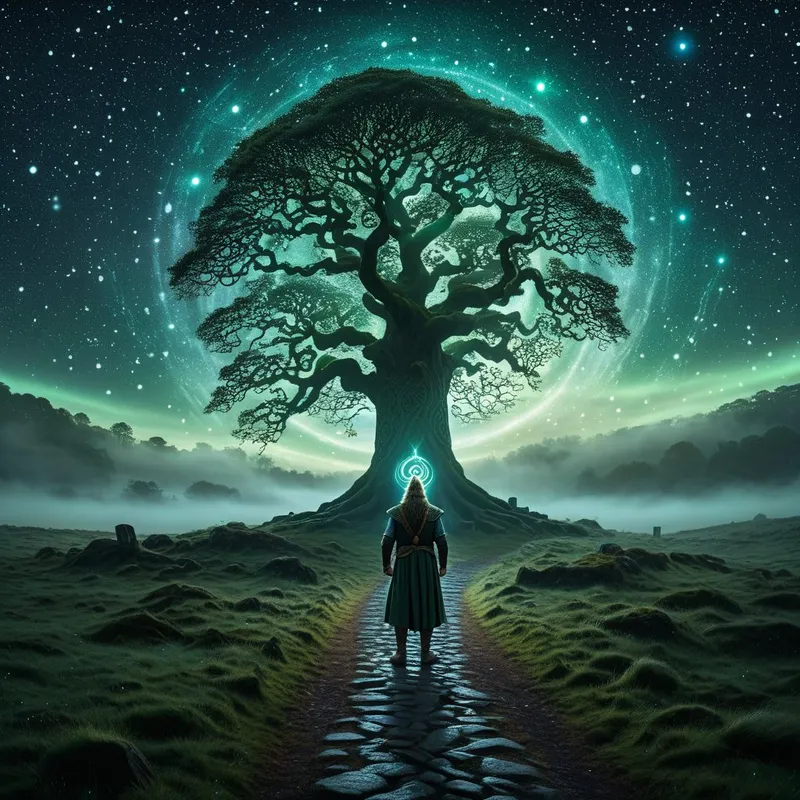
A hero stands at a sacred crossroads, where three paths demand a choice that will define their fate and the fate of their people.
The Tale of Choice of Paths
Listen now, and let the hearth-fire dim. Let the world outside the hall fade to a murmur of wind in the yew trees. I will tell you of a time when the veil was thin, and a man’s fate was not written in stone, but laid before him on a road of earth and choice.
His name was Conall, and a geis, a sacred binding, lay upon him. A druid’s prophecy had whispered that on the day the blackbird sang at dusk, he must journey to the Crossroads of the Three Realms. He went, not as a king in finery, but as a soul stripped bare, with only his spear, his cloak, and the weight of his people’s silent hope upon his shoulders.
The crossroads was not marked by signpost, but by feeling. The air hummed, thick with the scent of damp earth, blooming hawthorn, and distant lightning. Before him, the land split. One path wound sunward, paved with bright, white stones that led to a hill crowned with a fortress of gold. It promised sovereignty, the roar of acclaim, a throne. The second path dove into a deep, green-gladed forest, shadowed and cool, where the sound of laughter and the scent of feasting mead wafted from a hall with a door forever open. It promised kinship, pleasure, the heart’s ease. The third path was a mere track, rocky and steep, vanishing into a high, mist-clad mountain pass where eagles cried. It promised nothing but the wind and the climb.
As Conall stood, the very space before him shimmered. Not one, but three figures coalesced at the mouth of each path. From the sunward road emerged a woman clad in cloth of gold, holding a circlet of kingship. From the forest path stepped a man with a welcoming smile and a overflowing horn of ale. From the mountain track came a figure hooded in grey, face unseen, one hand empty, the other pointing upward along the difficult ascent.
No voice spoke aloud, yet the choice echoed in his bones. To take the circlet was to choose the Realm of Land. To take the horn was to choose the Realm of Sea. To follow the silent guide was to choose the Realm of Sky. His hand did not reach for the glittering prize, nor the comforting draft. He felt the geis not as a chain, but as a pull in his chest, a tuning of his spirit to a note only the mountain wind could carry. He turned his back on the sovereign and the reveler, and began to climb the stony track. He did not look back, though he heard, or perhaps dreamed he heard, the sigh of the land and the sea behind him. The hooded figure walked ahead, a silent witness, until the mists swallowed them both, and the choice was made.
Cultural Origins & Context
The motif of the "Choice of Paths" is not a single, codified myth from a specific text, but a profound archetypal pattern woven through the fabric of Celtic heroic literature and oral tradition. We find its echoes in the early Irish Ulster Cycle, where heroes like Cú Chulainn face prophetic dreams and geasa that force fateful decisions. It resonates in the Welsh Mabinogion, where characters like Pwyll enter the Annwn and must navigate its unearthly rules.
This story was the domain of the filid, the poet-seers. They were not mere entertainers but custodians of imbas, the illuminating knowledge. Told at the fireside or before a battle, the tale served a crucial societal function: it modeled the existential posture of the Celtic worldview. Life was not a linear progression but a series of encounters with sovereignty, shaped by personal honor (enech), sacred obligation (geis), and the ever-present tension between the human community and the demands of the Otherworld. The crossroads itself was a liminal space, a physical manifestation of a critical juncture in the soul's journey, where destiny (fír flathemon, the ruler's truth) was not received, but chosen.
Symbolic Architecture
The myth’s power lies in its stark, tripartite symbolism, a map of the psyche’s fundamental orientations. The three paths are not merely options; they are entire worlds, entire ways of being.
The Path of Land (Sovereignty) symbolizes the archetype of the Ruler. It is the call to external power, order, legacy, and social identity. The Path of Sea (Kinship) symbolizes the archetype of the Lover. It is the call to emotion, connection, sensory pleasure, and tribal belonging. The Path of Sky (Ascent) symbolizes the archetype of the Sage or the transcendent aspect of the Hero. It is the call to spirit, solitude, wisdom, and alignment with a transpersonal purpose.
The true choice is never between good and evil, but between one good and another, between a known world and an unknown calling. The sacrifice is not of something bad, but of something profoundly good for the sake of what the soul intuits is essential.
The hero’s choice of the difficult, non-guaranteeing path represents the pivotal moment of individuation: the conscious decision to privilege the soul’s unique destiny (daimon) over the compelling, and often noble, lures of collective life. The silent, hooded guide is the psychopomp, the inner Self, which does not command but simply indicates the direction of wholeness, often away from the crowd’s applause.
The Dreamer's Resonance
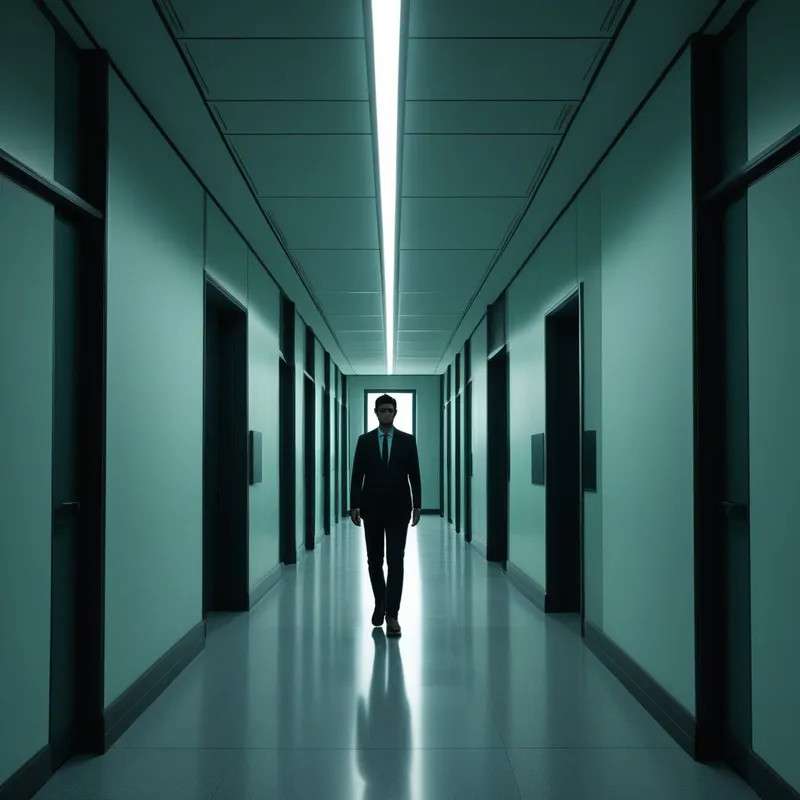
When this myth stirs in the modern unconscious, it rarely appears as a Celtic warrior at a literal fork in a forest. Its language is the symbolic language of the dreamer’s life. You may dream of standing in a hallway with three identical doors, paralyzed by which to open. You may be offered three jobs, three relationships, or feel torn between the demands of career (Land), family (Sea), and a lonely creative or spiritual calling (Sky).
The somatic experience is one of profound tension, a feeling of being "stretched" in three directions. There is often anxiety, but beneath it, a deep, resonant hum of significance—the feeling of the geis, the soul’s imperative. This dream pattern signals a critical threshold in the dreamer’s psychological development. The psyche is presenting the constituent parts of the personality—the Persona (Land), the Anima/Animus (Sea), and the calling of the Self (Sky)—and demanding a conscious integration. The paralysis is not pathology; it is the necessary pause before a fateful reorientation of one’s entire life-energy.
Alchemical Translation
The alchemical process mirrored here is the nigredo leading to the solutio—the darkening and dissolution of the old, composite self. In choosing the Path of Sky, the hero does not destroy the Land or the Sea within him. He sacrifices his exclusive identification with them. This is the alchemical mortificatio: a symbolic death of a former way of being.
The mountain path is the athanor, the alchemical furnace. Its hardship is not punishment, but the necessary heat that separates the essential from the incidental, the gold of the true self from the alloy of social compliance and instinctual attachment.
The modern individual undergoing this "Choice of Paths" is engaged in a psychic transmutation. The lure of Land becomes the disciplined cultivation of inner authority, rather than the pursuit of external validation. The lure of Sea becomes the deep, contained well of self-compassion and authentic relationship, rather than needy enmeshment. By turning toward the Sky—the often lonely, difficult path of inner truth—one does not abandon the world, but begins to relate to it from a centered Self. The three paths, once external alternatives, are integrated internally. The ruler, the lover, and the sage within cease their war and become a council, governed by the sovereignty of a spirit that chose the ascent. The myth teaches that our deepest destiny is not found, but forged in the moment of conscious, sacrificial choice at the soul’s crossroads.
Associated Symbols
Explore related symbols from the CaleaDream lexicon: