Chod Ritual Myth Meaning & Symbolism
A practitioner journeys to a haunted place, offering their own body as a feast to demons and fears, transforming terror into liberating wisdom.
The Tale of Chod Ritual
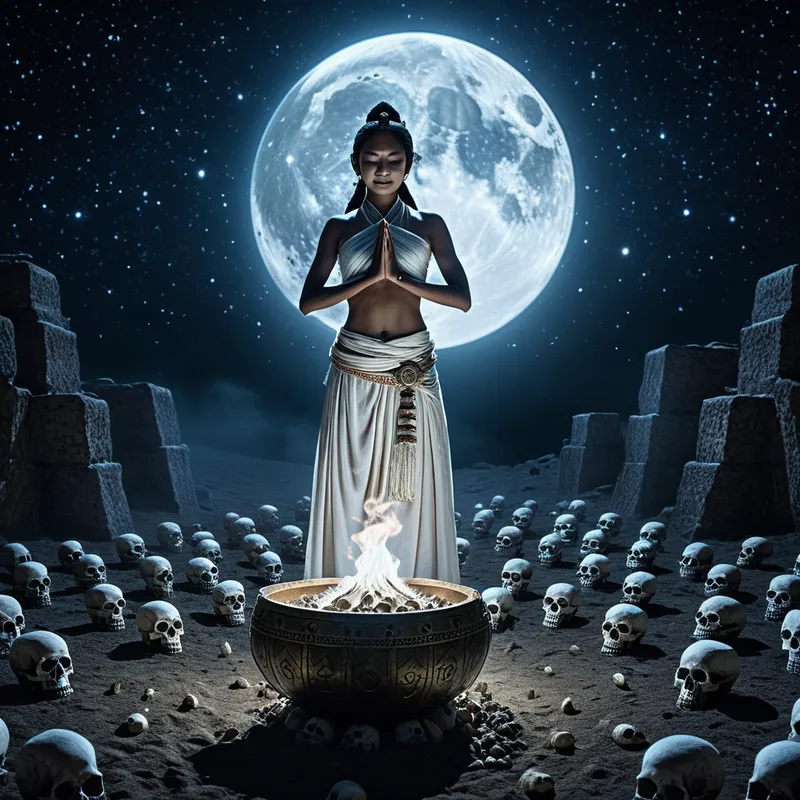
The wind howls across the high plateau, carrying the scent of frost and decay. Here, in a place where the bones of the forgotten lie scattered among the rocks, a solitary figure walks. She is a yogini, her robes the color of bleached bone. In her heart, there is no prayer for protection, but an invitation. She has come not to conquer this haunted ground, but to offer herself to it.
She finds her place where the fear is thickest. The air grows cold, and the whispers of the unseen become a clamor. From the shadows of the mind and the cracks in the world, they emerge: the pretas with needle-throats and swollen bellies, the dregs pa of jealousy and rage, the spectral forms of every terror she has ever harbored. They are the demons of the eight worldly concerns, the ghosts of past shames, the lurking dread of mortality itself. They circle, hungry, their forms shifting like smoke.
The yogini does not flee. She sits. From her bag, she draws a damaru, its rhythmic beat the pulse of the universe, and a drilbu, its clear tone cutting through illusion. She begins to sing, not a song of banishment, but of invitation. She calls upon the wisdom of the Prajnaparamita, the Great Mother of all Buddhas, and visualizes her own consciousness leaping from the crown of her head, transforming into the wrathful, compassionate form of Vajrayogini.
Then, with the blade of wisdom, this visualized form of Vajrayogini performs the ultimate act. She flays the yogini’s earthly body. The flesh is cut, the bones are smashed upon the rock of absolute reality. The physical form is transformed into a vast, oceanic offering. The blood becomes amrita, the nectar of immortality. The bones become a majestic mountain. The flesh becomes a boundless feast. The senses become brilliant lights. She invites all guests: the high gods, the lowly spirits, the demons of fear, the ghosts of attachment. “Come,” her song echoes. “Eat. Drink. Take your fill. There is nothing here that is not yours.”
The demons surge forward. They devour the offering with terrifying gusto. They consume the flesh of pride, gnaw the bones of identity, drink the blood of separation. The yogini feels it all—the terror of dissolution, the visceral pull of clinging. Yet, she holds the view: this body was never truly mine. This self was always a phantom. As the feast reaches its crescendo, a great emptiness dawns. The demons, their hunger finally satiated by the truth of emptiness, are transformed. Their monstrous forms soften. Their raging eyes clear. They bow, not in defeat, but in gratitude. They become protectors, allies, aspects of her own liberated mind. The haunted ground is now a pure land. The howling wind carries only the whisper of shunyata. The ritual ends. The yogini rises, lighter than air, having given everything away and in doing so, found the only thing that is real.
Cultural Origins & Context
The myth and practice of Chod (gcod) trace their lineage to the 11th-century Tibetan Machig Labdrön. While rooted in the Indian Prajnaparamita philosophy of emptiness and compassion, Machig synthesized these with native Tibetan Bön shamanic elements, particularly journeys to potent, fearful places. Chod was not a monastic practice confined to temples; it was the path of the wandering ngakpa, performed in the wilds—charnel grounds, mountain passes, and lonely forests—places where the veil between worlds is thin. It was transmitted orally and through terma, its power lying in direct, experiential realization. Societally, Chod practitioners often acted as healers and exorcists, but their primary function was radical psycho-spiritual surgery. They modeled a path that confronted the deepest cultural and personal fears—of demons, illness, death, and loss of self—transforming them from objects of terror into sources of liberating wisdom.
Symbolic Architecture
At its core, Chod is not a literal battle but a profound allegory for the deconstruction of the ego. The haunted ground is the psyche itself, populated by the “demons” of our unresolved emotions, traumas, and fixations.
The ultimate offering is the illusion of a separate self. To feed your demons is to starve your ignorance.
The ritualized dismemberment symbolizes the systematic dismantling of identification with the physical body and the constructed personality. The damaru, made of human skulls, is a memento mori, its beat the rhythm of impermanence. The drilbu represents wisdom, its sound cutting through discursive thought. The visualization of Vajrayogini represents the activation of one’s own innate, fierce wisdom-consciousness, which alone can perform this inner work. The demons, once fed the nectar of emptiness, transform into protectors. This is the alchemical key: what we resist and fear gains power; what we acknowledge and offer compassion to becomes integrated, transforming from a block into a source of energy and insight.

The Dreamer's Resonance
When the pattern of Chod arises in modern dreams, it signals a profound somatic and psychological process of shadow integration. One may dream of being pursued by monstrous figures, of their body changing or dissolving, or of preparing a strange feast in a tense, liminal space. These are not nightmares to be escaped, but rituals awaiting completion.
The somatic sensation is often one of acute vulnerability—a chilling dread, a tightening in the gut, a sense of being consumed. Psychologically, the dreamer is at a point where old structures of identity (career, relationship, self-image) are breaking down, and repressed aspects of the self—the “demons” of rage, grief, shame, or unexpressed power—are clamoring at the gates of consciousness. The dream is the psyche’s innate Chod practice, presenting the raw material of transformation. The critical movement, upon waking, is not to analyze the monsters away, but to ask: “What part of me have I starved? What fear am I refusing to feed with awareness?” The dream invites a courageous hospitality toward the inner exile.

Alchemical Translation
For the modern individual navigating a world of curated identities and partitioned emotions, Chod provides a radical model for psychic transmutation, or individuation. The journey to the charnel ground is the conscious decision to enter therapy, engage in deep introspection, or face a life crisis without spiritual bypass. The demons are our complexes: the inner critic, the needy child, the repressed rebel.
Individuation is not about building a better, shinier self. It is the graceful dissolution of the self-concept into the wider field of being.
The “offering of the body” translates to the relinquishment of our most cherished identifications: “I am my job,” “I am my trauma,” “I am my achievements.” We learn to offer these constructs to the fire of awareness. The ritual music is the disciplined practice of mindfulness and self-inquiry that holds the space for this dissolution. The transformation of demons into protectors is the realized outcome: our anxiety, when listened to, becomes a guide to unmet needs; our anger, when honored, becomes a force for healthy boundaries; our grief, when fully felt, becomes a well of compassion. The triumph is not victory, but integration. The practitioner—the modern individuating soul—achieves sovereignty not by walling off the darkness, but by discovering that they are the spaciousness that can contain it all.
Associated Symbols
Explore related symbols from the CaleaDream lexicon:
- Ritual — The structured, sacred framework that contains the chaos of transformation, turning raw fear into a deliberate process of offering and liberation.
- Bone — Symbolizes the essential, indestructible core of wisdom (the "bone" of reality) that remains after all transient flesh of identity is stripped away.
- Shadow — The internal "demons" of Chod—repressed fears, shames, and desires—that must be invited to the feast of awareness to be integrated.
- Sacrifice — The voluntary offering of the ego's attachments and the illusion of a separate self, which is the central, transformative act of the Chod practice.
- Dance — The dynamic, rhythmic movement of the ritual, representing the active engagement with one's own psyche and the flowing, non-resistant approach to inner demons.
- Mountain — The stable, unwavering awareness (often visualized from the bones) upon which the ritual feast is laid, representing grounded presence amidst psychic dissolution.
- Cave — The isolated, inward-turned space of practice, akin to the haunted ground, where one confronts the depths of the unconscious in solitude.
- Dream — The liminal state in which the Chod process often unfolds psychically, where the boundaries between self and other, real and symbolic, become permeable.
- Fear — The primary "demon" and fuel for the ritual; the raw material that, when faced and offered, is transmuted into wisdom and courage.
- Healing — The ultimate outcome of Chod, achieved not through suppression or cure, but through the radical integration and transformation of psychic wounds.
- Spirit — The unseen guests at the feast, representing both externalized projections and internal archetypal forces that inhabit the liminal spaces of the mind.
- Ritual Drum — The damaru, whose heartbeat rhythm anchors the practitioner in impermanence and calls the contents of the unconscious to the surface.