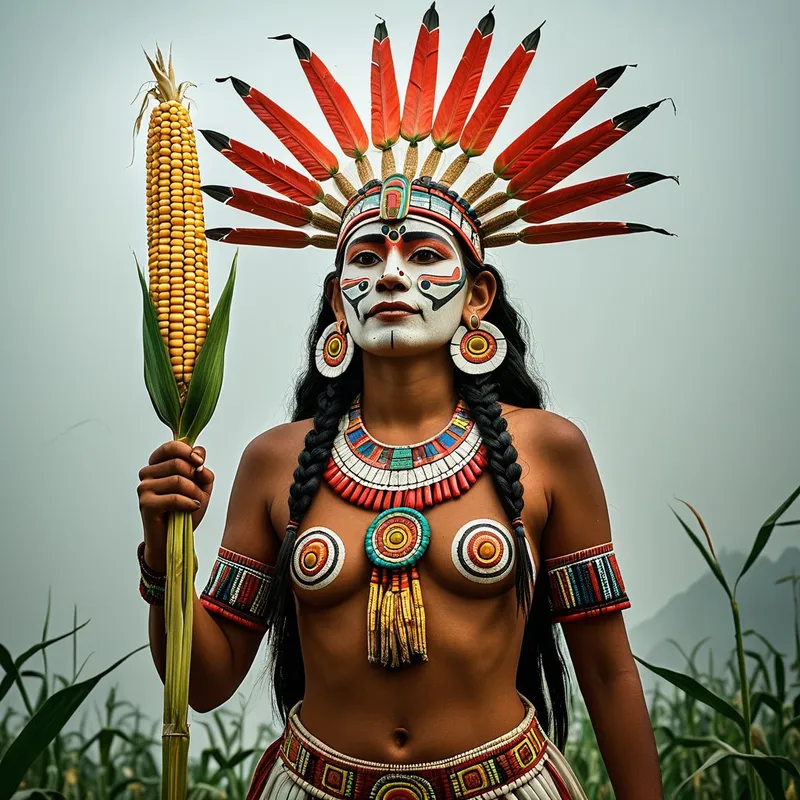
Chicomecoatl Myth Meaning & Symbolism
The myth of Chicomecoatl, the Seven Serpent, reveals the sacred cycle where life's sustenance is born from profound sacrifice and transformation.
The Tale of Chicomecoatl
Hear now the rustling tale, whispered by the wind through the endless fields. It begins not with a birth, but with a hunger—a deep, echoing emptiness in the belly of the world. The sun, Tonatiuh, was a fierce and demanding lord. His journey across the sky was a battle, and he grew weak. The people below, the children of corn, felt his waning strength in their own thinning bodies. The earth was hard, the stalks were brittle, and a great silence of want settled over the land.
In the silent places between the stars, where the gods convene, a decision was made. It was not a decision of war, but of profound offering. Chicomecoatl stepped forward. She was not clad in jade or quetzal feathers, but in the very substance of life itself. Her skin was the color of fertile earth, her hair the silk of the ripening ear. In her hands, she did not hold weapons, but bounty: seven ears of maize, each a different color, each holding the promise of a people.
“The sun must be fed,” her voice was the sound of dry husks rubbing together, a soft, necessary friction. “The people must be sustained. I will be the bridge.”
And so she descended. Not with thunder, but with the gentle, inevitable pressure of a seed breaking open underground. She walked into the great city, and the people saw not a goddess, but the embodiment of their deepest need. They clothed her in the finest paper vestments, they painted her face the red of life-blood, they crowned her with the plumes of green growth. For seven days, she was paraded, celebrated, adored—the perfect, living idol of abundance.
But the celebration had a sacred, terrible rhythm. The drums beat not for joy alone, but as a countdown. On the seventh day, the procession turned toward the temple. The air grew thick with copal smoke, sweet and suffocating. The cheers of the crowd became a unified, chanting breath. Chicomecoatl, the Sustainer, climbed the steep pyramid steps, each one a beat in the heart of the world.
At the summit, under the blinding eye of the hungry sun, she did not resist. She offered herself—the seven ears of maize in her hands, the body that wore them. The obsidian blade flashed, a quick, dark tear in the fabric of the day. Her blood, which was not blood but a stream of luminous, golden kernels, spilled upon the stone. It did not pool and stagnate; it poured down the temple sides, soaking into the earth below.
Where each drop fell, the hard ground softened. Green shoots, tender and fierce, pierced the surface. They grew with a speed that was not magic, but necessity fulfilled. They thickened into stalks, they unfurled leaves like banners, and they bore fruit—ears of white corn, yellow corn, red corn, blue corn. The hunger broke. The people gathered the first fruits, and their teeth sank into the sweet, starchy flesh. They were not eating food; they were consuming a sacred promise. The sun, tasting the essence of the offering, blazed with renewed strength. Chicomecoatl was gone. And yet, in every kernel, in every meal, she was endlessly present.
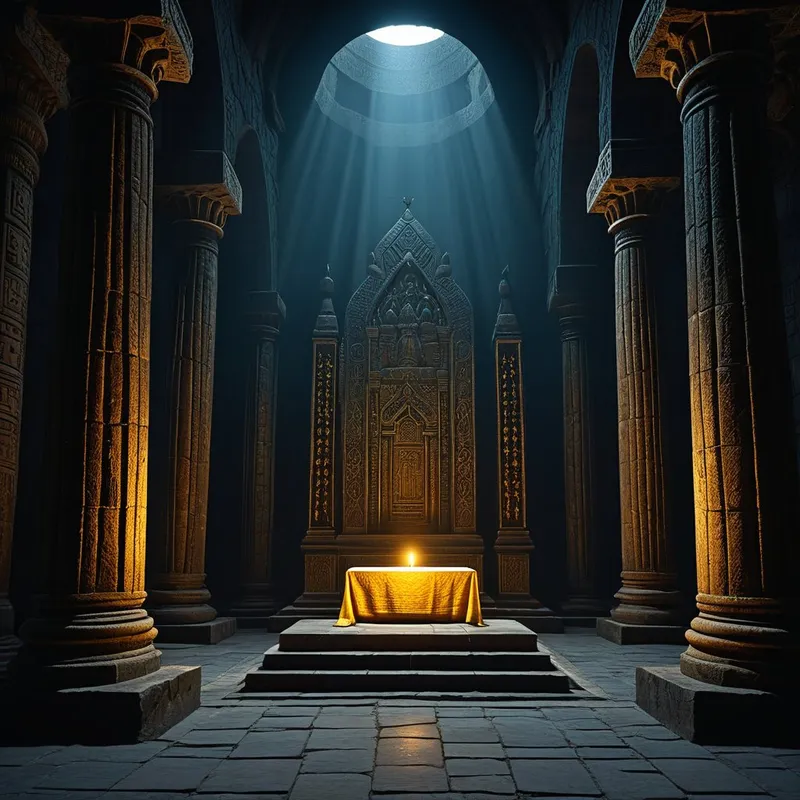
Cultural Origins & Context
This is the myth that lived in the breath and the bread of the Mexica (Aztec) people. Chicomecoatl, whose name means “Seven Serpent,” was one of the most vital and beloved goddesses in the pantheon. Her story was not merely recited; it was enacted in an annual, state-sponsored festival held during the month of Ochpaniztli (roughly August). Her myth was the foundational drama of agriculture in a world where the margin between abundance and famine was terrifyingly thin.
The tale was passed down through ritual, sculpture, and the meticulous pictographic codices. It was told by priests who wore her likeness, and by mothers who ground maize into masa. Its societal function was multifaceted: it explained the origin of staple food, it justified the practice of human sacrifice as a cosmological necessity (where the victim became the deity), and it provided a framework for understanding life itself as a cyclical gift born from sacrifice. To eat was to participate in a holy transaction.
Symbolic Architecture
Chicomecoatl is not merely a “corn goddess.” She is the archetypal embodiment of nourishment itself, and the terrifying, beautiful cost at which true sustenance arrives. She represents the principle that what feeds us must first be broken open. The maize seed must die in the earth; the grain must be crushed on the metate; the myth states that the deity must be offered on the altar.
The deepest nourishment is never free. It is always a transaction between loss and gain, between a sacrifice made and a life sustained.
Her seven ears symbolize completeness (seven being a sacred number of cycles and totality) and diversity—the many varieties and colors of maize that were cultivated. Her serpent aspect connects her to the earth, to fertility, and to cyclical rebirth, as the serpent sheds its skin. She is the ultimate Caregiver, but one whose care is an act of self-annihilation and regeneration. Psychologically, she represents the source of our emotional and spiritual sustenance—the love, the insight, the creativity that feels like it feeds our soul. Her myth asks: What was sacrificed to bring this forth?
The Dreamer's Resonance
When this myth stirs in the modern unconscious, it often manifests in dreams of profound hunger or miraculous feeding. You may dream of finding a single, perfect fruit in a barren landscape, or of a feast that turns to dust in your mouth. You may dream of being both the priest and the offering on the altar, or of a loved one transforming into a source of food.
These dreams signal a somatic and psychological process concerning nourishment and its cost. Are you feeling spiritually or emotionally starved? What internal or external “Chicomecoatl” needs to be acknowledged and honored for the sustenance you receive? Conversely, the dream may ask where you are being asked to become the offering—where must you “break open” and allow some part of yourself to be transformed to feed a deeper need, a relationship, or a creative endeavor? The dream presents the ancient equation: life feeds on life. The process is one of confronting the sacred debt of existence.
Alchemical Translation
For the modern individual navigating the path of individuation, the myth of Chicomecoatl models a critical alchemical stage: the solve et coagula—the dissolution and reconstitution—of the nurturing principle within the psyche. We all internalize sources of nourishment (parents, mentors, beliefs) and must eventually confront that they are not infinite external resources. The alchemical work is to internalize this function, to become our own source of sustenance.
This requires a sacrifice. The old, dependent identity that only knows how to receive nourishment must be “offered up” on the altar of consciousness. Our childish expectations, our passive consumption of external validation, our untended talents—these must be willingly surrendered. It is a terrifying psychic death.
Individuation demands we become both the sacrificed goddess and the nourishing grain. We break ourselves open on the stone of self-awareness to feed our own becoming.
From that sacrifice, a new, self-sustaining core coalesces. You learn to feed yourself with your own hard-won wisdom, your own cultivated creativity, your own committed action. The “maize” that grows is your authentic life, resilient and generative. You no longer just look for sustenance; you understand you are part of the sacred cycle that creates it. The myth of Chicomecoatl thus becomes an internal map, showing that our deepest growth and capacity to nourish others is born from the courageous offering of our former selves to the transformative fire of consciousness.
Associated Symbols
Explore related symbols from the CaleaDream lexicon: