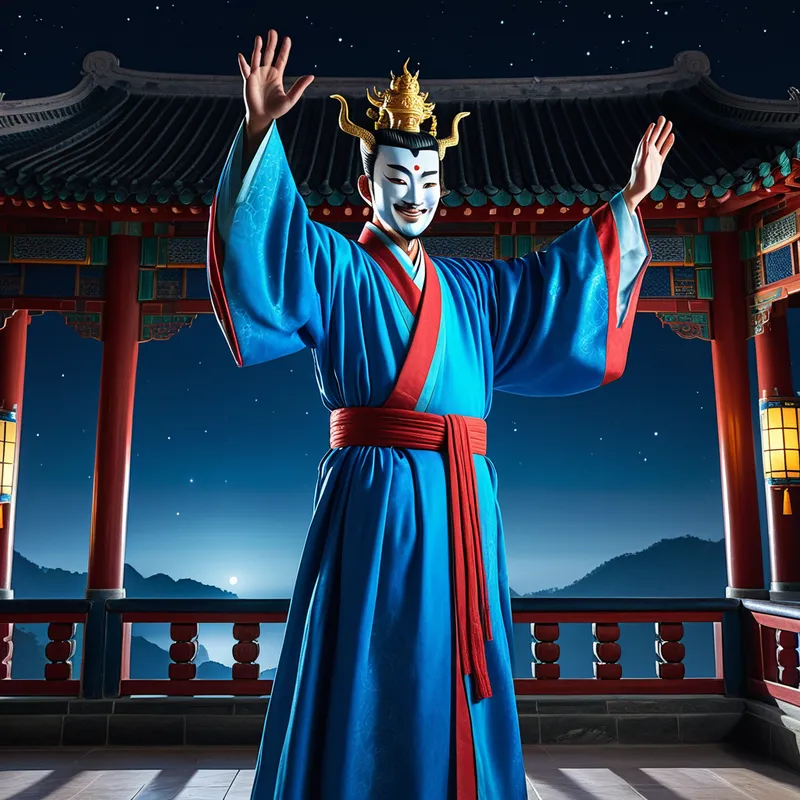
Cheoyong Mask Dance Spirit Myth Meaning & Symbolism
A divine son, born of a dragon king, uses song and dance to pacify a plague spirit, transforming fear into a protective mask of sacred laughter.
The Tale of Cheoyong Mask Dance Spirit
Hear now the tale whispered by the sea winds of the East Sea, sung by the shamans beneath the Sobaek peaks, and carved into the very soul of the Silla kingdom.
In the age when dragon kings still ruled the deep, the great Yongwang took a mortal wife. From their union was born a son, not of scale and wave, but of remarkable human form, save for the power in his blood. They named him Cheoyong. His skin held the pallor of moonlit foam, and his eyes held the depth of the abyss. He came ashore, this son of two worlds, and took a wife of the land, building his home where the stone met the shore.
But a shadow fell upon the capital city of Seorabeol. A spirit of pestilence, a Sonnim, slithered from the realm of misfortune. It was a being of jealous malice, a creeping chill that sought the warmth of the royal house. One fateful night, under a moon veiled by thin cloud, the spirit entered the very bedchamber of the king. It stood by the royal bed, a presence of palpable ill intent, its form shifting like malignant smoke.
Cheoyong, returning home from his travels, felt the disturbance in the world’s harmony—a discordant note in the song of the night. He entered his own house to find his wife asleep. And there, beside her, was the spirit of the smallpox. It had come for him, for his household, its intent as clear and deadly as a winter frost.
A rage, hot as his father’s underwater vents, could have risen within him. A warrior’s shout could have shattered the silence. But Cheoyong was a son of the dragon, a being of profound power and profound wisdom. He understood that some forces cannot be fought with blade or fist, for they feed on conflict. Instead, he drew a deep breath, not of air, but of the ocean’s timeless rhythm. And he began to sing.
His voice was not thunder; it was a resonant, sorrowful, yet strangely joyful melody, a song of the vastness of the sea and the fragility of the shore. As he sang, his body began to move. He danced. It was a slow, circling, graceful dance, his sleeves flowing like gentle waves, his steps marking a sacred geometry upon the floor. He sang of his own sorrow at finding the spirit here, of the beauty of his wife, of the transience of all things—even malice.
The spirit of the plague, caught in the act, froze. The song entered it not as a weapon, but as a question, a lament, an invitation. The dance wove a net not of rope, but of understanding. Confounded, disarmed by this response of art and grief where it expected fear and violence, the spirit was undone. It bowed deeply to Cheoyong. “I came with evil intent,” it spoke, its voice like rustling dry leaves. “But finding a man of such virtue, who does not raise his hand even in righteous anger, I cannot bear to trespass. I shall never enter a house where your likeness is displayed.”
With that, the spirit vanished into the night air. And Cheoyong, to commemorate this strange victory of pacification, took up a knife and wood. He carved a mask—a mask with his own face, but transformed: a bright red face, with large, benevolent eyes, a wide, smiling mouth, and the distinct marks of the scholar upon its brow. He painted two round, crimson spots upon its cheeks. And he danced again, this time wearing the mask, a dance of protection, a ritual to seal the covenant. Where the mask was hung, no plague would enter.
Cultural Origins & Context
This myth is rooted in the Silla period, specifically during the reign of King Heongang (r. 875–886 CE), as recorded in the Samguk Yusa. It is not merely a folktale but a foundational narrative for a vital performative and spiritual practice: the Talchum. The Cheoyongmu, or Dance of Cheoyong, evolved into a court ritual and later a more widespread folk exorcism.
The tale was preserved and transmitted by court historians, Buddhist monks (as the Samguk Yusa was compiled by the monk Iryeon), and most importantly, by the performers themselves—the masked dancers and Mudang who enacted the story. Its societal function was multifaceted: as a Gut for epidemic disease, as a performance to ensure royal and national well-being during the New Year, and as a cultural vessel for the philosophy of harmony (Hwa). It modeled a uniquely Korean approach to conflict resolution—not through annihilation, but through transformative engagement, using art as a sacred technology.
Symbolic Architecture
At its core, the myth of Cheoyong is a masterclass in the alchemy of consciousness. The plague spirit represents not just physical disease, but any invasive, corrosive psychic content: jealousy, rage, depression, or generational trauma that enters the “house” of the self or the community.
The true exorcism is not banishment, but the transformation of the demon into a witness, through the courage to face it with creative expression.
Cheoyong himself is the archetype of the Liminal Healer. Born of a dragon (the unconscious, primal, chaotic depths) and a human (the conscious, ordered world), he is the embodied bridge. His power lies in his hybrid nature. He does not meet chaos with more chaos (rage), nor does he rigidly deny it (repression). He meets it with the third thing: Sacred Art. The song is the acknowledgment of pain; the dance is the reorganization of energy. The resulting mask is the solidified symbol—a “face” given to the resolution, a tangible reminder of the covenant between the self and the once-threatening unconscious force.
The two red spots on the mask’s cheeks are often interpreted as shamanic symbols of power or, more psychologically, as the “heated” or vitalized aspects of the self that have been reclaimed from the encounter. The mask is not a hiding place, but a revelation of the transformed self that has stared into the shadow and sung it into peace.
The Dreamer's Resonance
When this myth stirs in the modern dreamer, it often manifests as an encounter with a pervasive, unsettling presence—a climate of anxiety, a pattern of self-sabotage, or a “sickness” in a relationship. The dreamer may feel this presence in their home (the psyche) or see it approaching a loved one (an aspect of the self).
The somatic process is key. The dream ego may feel the impulse to fight or flee, but the mythic pattern urges a different response. One might find themselves, as Cheoyong did, beginning to create in the dream—humming, drawing, building, or moving in a specific, ritualistic way. This is the psyche’s innate healing intelligence activating. The resolution is not the disappearance of the problem, but its transformation into an agreement. The threatening figure may bow, leave a token, or change form. Upon waking, the feeling is not of victory, but of profound, settled peace and empowerment. The process indicates the dreamer is moving from a state of being possessed by a complex to becoming the ritual container for it.
Alchemical Translation
For the individual on the path of Individuation, Cheoyong’s journey models the crucial stage of engaging the Shadow. The plague spirit is the ultimate shadow projection—the unwanted, sickly, destructive element that seems to come from “out there” to invade our sanctum.
Individuation requires we stop building higher walls against the shadow, and instead learn the song it has come to teach us.
The first alchemical step is Recognition (Nigredo). Cheoyong sees the spirit clearly, without denial. He names the intrusion. The modern parallel is acknowledging the pattern: “This rage is in my house. This grief is in my bed.”
The second is Transformation (Albedo). Here, the base material (the violent confrontation) is washed in the “lunar” water of art and feeling. Instead of reacting from the ego, he responds from the deeper Self (his dragon heritage). He sings his truth—his sorrow, his love, his reality. This creative act reframes the encounter.
The final stage is Integration (Rubedo). The product is the red-faced mask. The energy of the conflict is not gone; it is redeemed and given a new, protective function. The individual internalizes the lesson of the shadow, and it becomes a part of their psychic armor. What was once a source of fear (plague) now becomes a source of protection (the mask on the door). The individual learns that their deepest wounds, when faced with creative courage, can become their most authentic guardians.
Associated Symbols
Explore related symbols from the CaleaDream lexicon:
- Mask — The solidified symbol of the transformed self, a benevolent face carved from confrontation that serves as a protective ward and a reminder of a sacred covenant.
- Dance — The sacred, physical reorganization of chaotic energy into harmonious pattern, a ritual of pacification that moves through conflict rather than against it.
- Spirit — Represents the autonomous, often disruptive complex from the unconscious that must be engaged relationally, not destroyed.
- Water — The realm of the unconscious, emotion, and fluidity from which Cheoyong originates, symbolizing the deep wisdom that arises when one draws from the primal self.
- Song — The authentic expression of feeling that disarms hostility; the vocalization of one's truth that transforms a battlefield into a ritual space.
- Protective Spirit Animal — Cheoyong himself, as a hybrid son of a dragon, embodies this archetype, acting as a guardian whose power stems from his connection to both primal and human realms.
- Ritual — The entire sequence of song, dance, and mask-making constitutes a precise ritual for transforming malignant energy into a protective force through prescribed, meaningful action.
- Shadow — The plague spirit is a classic manifestation of the psychological shadow, the rejected, feared aspect of existence that demands recognition and integration.
- Healing — The ultimate outcome of the myth, achieved not through eradication of disease, but through the alchemical transformation of the relationship to it.
- Dragon — Symbolizes the vast, untamed, potent power of the unconscious depths, the source of Cheoyong's non-ordinary strength and wisdom.
- Harmony — The core philosophical goal of the myth and the dance, representing the state of dynamic balance achieved when opposites are reconciled through creative engagement.
- Ancestral Mask — The Cheoyong mask becomes an ancestral talisman, passed down as a cultural memory of how to face collective and personal adversity with grace and art.