Checkered Floor Myth Meaning & Symbolism
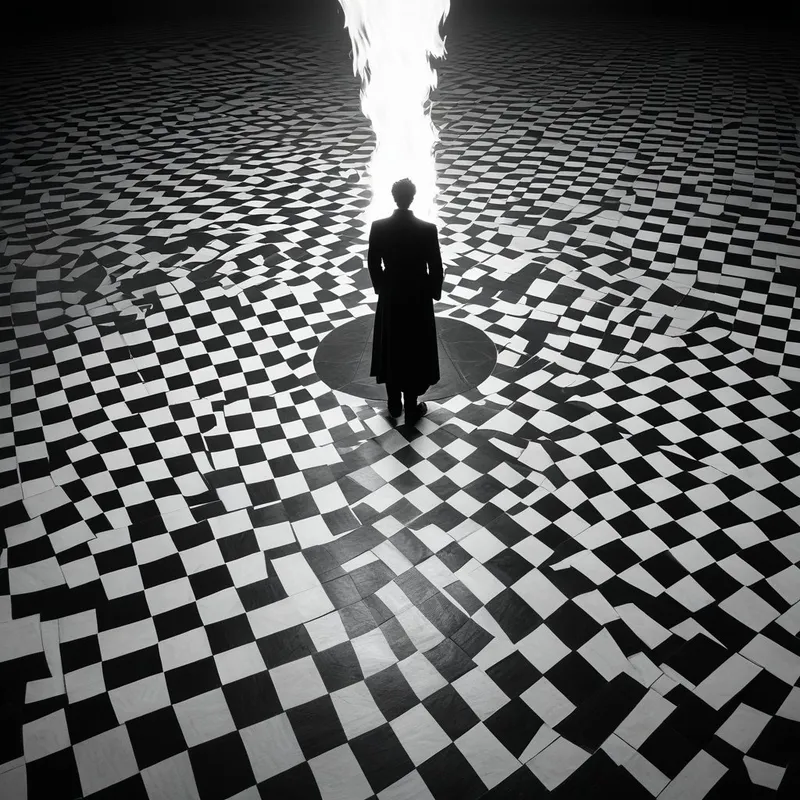
A myth of a divine artisan who descends into chaos to lay a floor of perfect duality, creating the first pattern of order and the path to the Self.
The Tale of Checkered Floor
In the time before time, when the world was a single, unbroken breath of potential, there existed only the Prima Materia. It was a swirling, silent sea of all-that-could-be, a beautiful and terrifying chaos without distinction, without up or down, light or dark, self or other. From the heart of this boundless potential, a consciousness stirred. It was not a god of thunder or love, but an Artifex, the spirit of the Pattern.
The Artifex gazed upon the seamless unity and felt a profound longing—not for dominion, but for relationship. For relationship requires an other, and an other requires distinction. So, the Artifex descended from the realm of pure idea into the churning, formless waters of the Prima Materia. The chaos resisted. It was a place of no footing, no reference, a dizzying eternity of sameness. The Artifex, adrift, knew the first agony: the loneliness of the unmanifest.
From this agony, a resolve was forged. The Artifex reached into its own essence and performed the first great division. From its right hand, it drew forth a brilliant, solar light—pure, active, and defining. From its left, it drew forth a deep, lunar shadow—receptive, mysterious, and containing. Holding these two forces, now separate yet born of the same source, the Artifex began the great work.
It knelt upon the void. With the hand of light, it placed a tile of radiant, polished alabaster upon the nothingness. With the hand of shadow, it placed a tile of deep, polished obsidian beside it. Where each tile was laid, the chaotic swirl stilled. A point of reference was born. Tile by tile, square by square, a vast, infinite plane began to spread—the first Checkered Floor.
The action was not one of conquest, but of sacred invitation. The black tile did not defeat the white; the white did not banish the black. They existed in perfect, alternating tension. With each pair laid, a rhythm emerged, a heartbeat in the silence. The floor became a membrane, a threshold between the chaos below and the possibility of structured worlds above. The Artifex did not cover the chaos, but gave it a dance floor. The Prima Materia, once a terrifying abyss, now had a pattern to play against, a grid upon which the drama of creation—of life and death, joy and sorrow, self and shadow—could finally unfold. The Artifex, its task complete, did not rule from a throne above, but dissolved into the pattern itself, becoming the living principle of order within duality, the hidden architect in every choice between opposites.
Cultural Origins & Context
The myth of the Checkered Floor is central to the symbolic language of Western Alchemy. It is not a myth of a distant pantheon, but an cosmogonic parable passed down through encrypted texts, intricate illustrations in splendor solis texts, and oral teachings within guilds and philosophical circles. Its tellers were not bards, but adepts and philosophers—figures like the legendary Hermes Trismegistus—who used narrative to cloak profound psychological and cosmological truths.
Its societal function was multifaceted. For the culture of alchemy, which stood at the crossroads of science, mysticism, and art, the myth provided a foundational metaphor for the entire Work. It explained the necessity of beginning with the chaotic, base material of the soul or matter (Prima Materia). It established that the creator’s first act is not to make a thing, but to establish a condition—a field of defined opposites (the Nigredo and Albedo). This sacred floor was seen as the laboratory floor, the page of a manuscript, and the ground of the seeker’s own mind. It was a map for navigating the essential duality of existence.
Symbolic Architecture
The Checkered Floor is the archetypal blueprint for conscious existence. It represents the fundamental psychic act of discrimination, without which experience is a blur and the self cannot coalesce.
The Floor is not the answer, but the first and necessary question. It is the stage upon which the drama of the soul is compelled to perform.
The Artifex symbolizes the emerging ego-consciousness, or the Self in its initial, active posture. Its descent is the incarnation of spirit into the messy, undefined realm of matter and the unconscious. The agony of the unmanifest is the pain of potential unrealized, the depression of the unified state that lacks tension and therefore life.
The black and white tiles are the irreducible opposites: conscious/unconscious, light/shadow, masculine/feminine, spirit/matter, known/unknown. Crucially, they are drawn from the Artifex’s own essence. This signifies that our inner conflicts, our dualities, are not invasions from an external enemy, but inherent aspects of our own wholeness that have been separated to create the field of experience. The Floor is thus a symbol of the psyche’s own structure.
The Dreamer's Resonance
When the checkered pattern appears in modern dreams, it signals a profound process of inner re-ordering. The dreamer is encountering the foundational architecture of their own psyche.
To dream of walking on a checkered floor suggests the dreamer is navigating a period of significant choice, moral clarity, or the need to establish boundaries and personal order. The stability of the floor reflects the stability of the ego in that moment. A shifting, unstable, or dissolving checkered floor, however, points to a Nigredo experience—a de-structuring of old, rigid patterns. The conscious worldview is being re-submerged into the Prima Materia for renewal.
Dreams of laying tiles, or of one tile being out of place, often correlate with integration work. The dream ego is actively participating in the creation of its own psychic structure, perhaps trying to assimilate a new insight (a white tile) or acknowledge a repressed aspect (a black tile). The pattern is a somatic map; to feel it in a dream is to feel the grid of one’s own being being reconfigured.
Alchemical Translation
The myth models the entire journey of individuation—the process of becoming an integrated, whole individual. We all begin in a personal Prima Materia: the blended, chaotic state of childhood, where our instincts, potentials, and conflicts are undifferentiated.
The first, crucial step in the Work is the creation of our own inner Checkered Floor. This is the often-painful development of ego-consciousness, where we learn to discriminate: good from bad, self from other, what we will embrace from what we will repress into shadow. This is not the final goal, but the essential foundation. We must have two clear opposites to later reconcile.
The ultimate alchemical goal is not to live perfectly upon the checkered floor, but to remember the Artifex that laid it, and to perceive the unity from which both black and white were born.
The later alchemical stages—the Coniunctio, the emergence of the filius philosophorum—represent the transcendence of this duality. But one cannot transcend what one has not first fully constructed and inhabited. The modern seeker’s "laboratory work" involves consciously walking their own floor: owning their light (strengths, persona) and their shadow (repressed faults, hidden talents), not to eliminate one for the other, but to see them as the alternating, necessary tiles that create the path forward. In doing so, they cease to be merely a traveler on the floor and become, like the Artifex, its quiet, conscious sustainer. The pattern becomes not a prison of choice, but the sacred dance of a soul coming to know itself.
Associated Symbols
Explore related symbols from the CaleaDream lexicon: