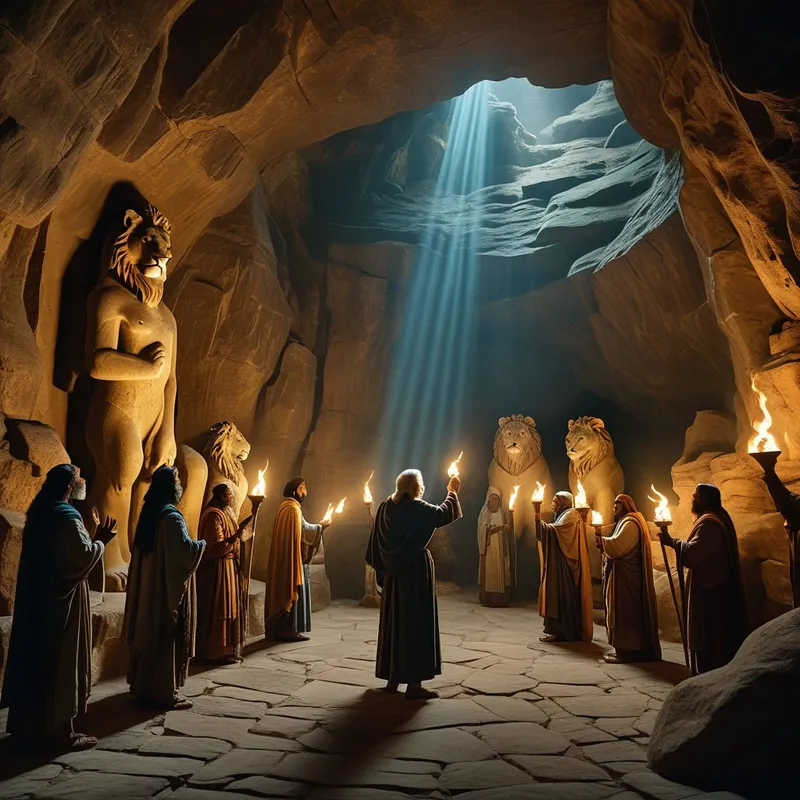
Chauvet Cave Artists Myth Meaning & Symbolism
A myth of the first artists who journeyed into the deep earth to capture the living spirits of animals on stone, forging a covenant between worlds.
The Tale of Chauvet Cave Artists
Listen. Listen to the silence beneath the world. Not the silence of the wind in the pines, nor the quiet of a sleeping camp. This is the silence of the deep earth, of stone dreaming of the sun it has forgotten. Into this dreaming darkness, they went.
They were not called artists then. They were the ones who listened when the herd passed, feeling the tremor in the ground as a tremor in their own bones. They were the ones who saw the lion not just as meat or threat, but as a streak of concentrated night, a spirit of the hunt made flesh. And they were haunted. Haunted by the beauty of the fleeting form, by the terror of the vanishing spirit when the breath left the body. The world was alive with presences—the numen of the aurochs, the whispering ghost of the mammoth in its own tusks—and these presences were slipping away, unremembered, into the dark.
So they took fire. They took charcoal from the hearth, and ochre, the blood of the earth itself. They followed the whispers of the underground rivers, the breath of the caves, deep into the belly of the mountain. The air grew cold and still. The world of light and sound fell away. Here, in the absolute dark, lit only by the animal-fat flame that danced like a captive star, they found the walls.
And the walls were not empty. In the flickering light, the stone breathed. It swelled with the forms of beasts not yet born. They saw the arch of a horse’s neck in a ripple of calcite, the looming bulk of a woolly rhinoceros in a shadowy overhang. The cave was not a blank canvas; it was a womb, pregnant with potential images.
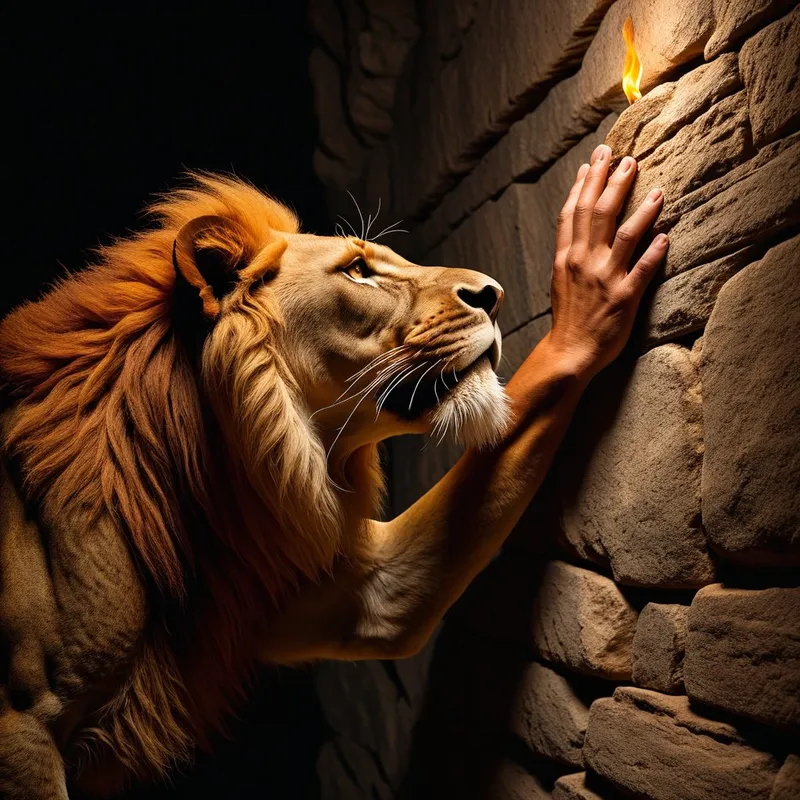
Then, the first hand was placed. Palm flat against the cool, living rock. They blew the ochre, and the hand’s echo remained—a human signature in the realm of stone. This was the covenant. Then, the first line was drawn. A charcoal stroke following the curve already suggested by the rock. It was not invention; it was release. They were midwives, drawing the spirit-animal out of the stone and into a form that could be seen, remembered, honored.
They worked in a trance of necessity. The great lions, their muscles coiled in eternal spring, flowed from the walls. Herds of bison, vast and thunderous in their stillness, crowded the chambers. A strange, chimeric creature—the therianthrope—part man, part bison, stood witness. The artists did not merely depict; they conjured. In the shuddering light, the animals moved. They breathed. The artists captured not the body, but the force—the charge of the charge, the essence of the gallop, the silent intensity of the predator’s gaze.
When they emerged, blinking in the sun, they were changed. They carried the deep-time silence in their eyes. They had been to the place where the world’s dream is stored, and they had brought back a piece of its soul, fixed upon the wall. They had built a bridge. Now, the spirit of the lion would not vanish. It lived, forever poised in the sacred dark, and the people could go to it, could remember, could know. The memory of life was no longer held only in fragile mind and story; it was anchored in the eternal stone.
Cultural Origins & Context
This is not a myth with a single name or a linear story passed down by bards. It is the ur-myth, the foundational act encoded not in words, but in gesture, pigment, and place. It originates from the Upper Paleolithic, a period spanning roughly 50,000 to 12,000 years ago, within cultures of hunter-gatherers whose entire cosmology was animistic. Every hill, river, tree, and animal possessed a conscious spirit, a numen.
The myth was transmitted through the ritual act itself. The telling was the painting. The cave was not an art gallery; it was a sanctum sanctorum, a ritual theater accessible only to the few—likely shamans or spiritual specialists. The journey into the cave was a symbolic descent into the underworld, the realm of spirits, ancestors, and the generative forces of the earth. By capturing the animal spirits there, they performed a profound act of sympathetic magic and spiritual husbandry. It ensured the herd’s return, honored the spirit of the hunted, and maintained the cosmic balance. The myth’s function was existential: it was a technology of memory and meaning, a way to fix the fleeting, powerful realities of their world into something permanent, thus asserting human consciousness against the abyss of time and forgetting.
Symbolic Architecture
At its core, the myth symbolizes the human psyche confronting its own depths and birthing a new faculty of consciousness. The cave is the collective unconscious. The undrawn, suggestive walls represent the latent, archetypal forms swimming in the primordial soup of the psyche—the raw, instinctual energies of the Self.
The artist does not create from nothing, but midwifes what the world dreams of becoming.
The animals are not literal beasts, but archetypal powers: the Lion (untamed aggression, royal instinct), the Horse (spirit, freedom, travel), the Rhinoceros (immovable will, primal durability). The artists’ act of tracing them is the act of individuation—bringing unconscious contents into the light of awareness. The hand stencil is the crucial symbol: the “I” asserting its presence (“I was here”) while simultaneously surrendering to and merging with the greater field of being. It is the ego acknowledging the Self. The composite therianthrope is the ultimate symbol of this psychic integration: the human and the animal instinct united, a portrait of the whole being.
The Dreamer's Resonance
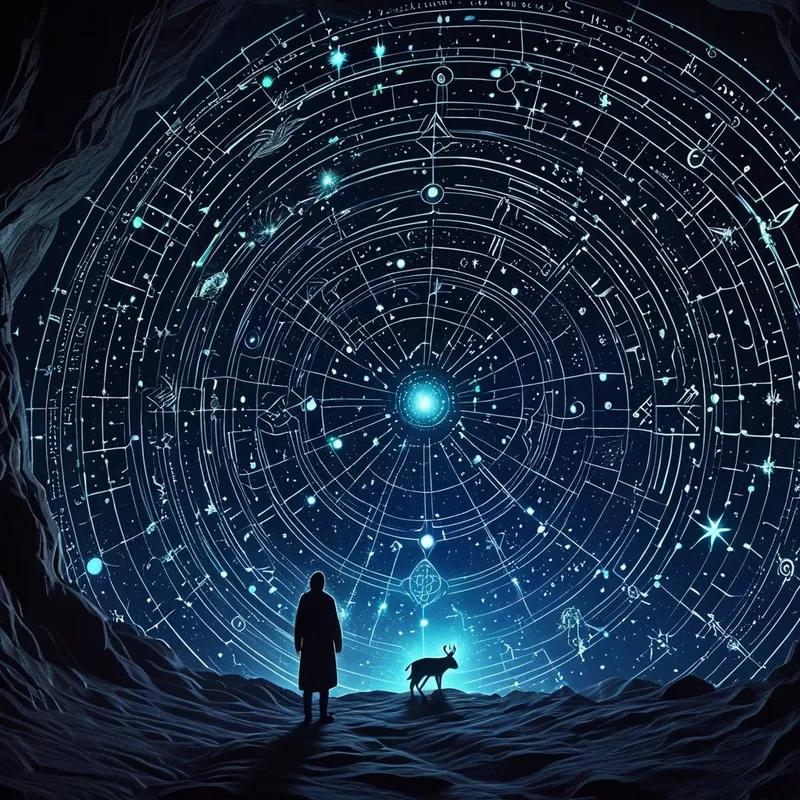
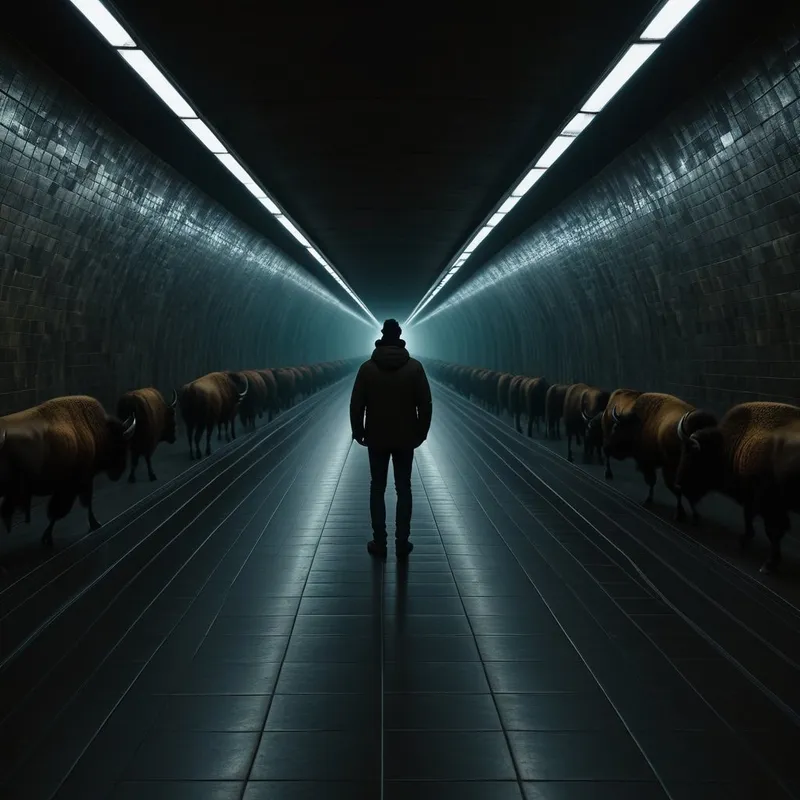
When this myth stirs in the modern dreamer, it signals a profound call to engage with the raw, instinctual material of the psyche. Dreaming of dark, labyrinthine places (basements, tunnels, caves) where powerful animal forms are glimpsed or felt, suggests a confrontation with the shadow—the repressed, instinctual parts of the self.
The somatic process is one of deep, often anxious, anticipation. There is a feeling of being drawn into a gravity well of one’s own interiority. The psychological process is one of active imagination. The dream ego is being asked not to flee, but to stop, to bring the “torch” of attention to the frightening or majestic form on the “wall” of the unconscious. To trace its outline. This is the work of acknowledging a powerful complex—be it a buried rage (the lion), a blocked vitality (the horse), or a stubborn, defensive pattern (the rhino). The dream is an invitation to perform the ancient ritual: to give form to the formless energy within, thereby transforming it from a haunting specter into a known, potentially allied, aspect of the self.
Alchemical Translation
The alchemical process modeled here is the opus contra naturam, the work against nature’s flow of entropy and forgetting. The prima materia (base material) is the chaotic swirl of unconscious impulses, fears, and creative potentials—the dark cave of the soul.
The descent into the cave is the nigredo, the blackening, the confrontation with the shadow. The application of pigment is the albedo, the whitening, where form emerges from chaos.
The first stage (nigredo) is the courageous descent: the willingness to enter one’s own darkness, confusion, or depression without immediate answers. The second stage (albedo) is the patient, meticulous work of “tracing”—through therapy, journaling, art, or deep reflection—the patterns of one’s behavior and the contours of one’s inner figures. What is that recurrent feeling? What is the shape of that anger? The charcoal and ochre are the tools of consciousness: focused attention and felt, embodied emotion.
The final stage (rubedo, the reddening) is the moment of integration, symbolized by the completed, living image on the wall. The instinctual energy, once raw and threatening, is now seen, named, and contained within a symbolic form. It is no longer an autonomous complex that possesses you; it is a known quantity that adds its power to your totality. You have performed the ancient magic. You have stolen a piece of eternity from the realm of forgetting and given it a home in the lighted world of your own aware being. You have become, like the first artist, a bridge between the worlds.
Associated Symbols
Explore related symbols from the CaleaDream lexicon: