Charybdis Myth Meaning & Symbolism
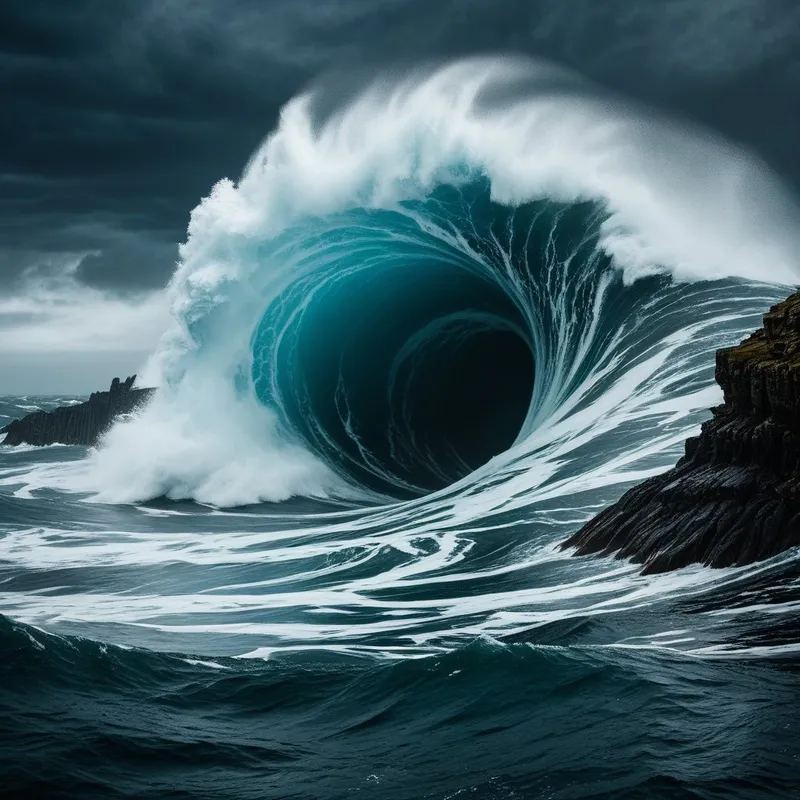
A monstrous, all-consuming whirlpool, once a divine daughter, now an eternal vortex guarding a narrow strait, representing the inescapable, cyclical nature of primal forces.
The Tale of Charybdis
Hear now of the gullet of the sea, the throat that drinks the world. In the narrow, cliff-walled strait where the wine-dark sea grows frantic, she waits. Not a beast of tooth and claw, but a breathing of the deep itself—Charybdis.
She was not born to this hunger. Once, she was daughter to Gaia and the great Pontus, a nymph in the court of her brother, the Earth-Shaker Poseidon. Her sin was a loyalty that defied the king of gods. When the mighty Zeus warred against the Titans, she aided her father’s kin. She would flood great swaths of land with seawater to claim them for Poseidon’s domain. For this theft of earth, Zeus struck her down. With a thunderbolt that cracked the ocean floor, he transformed her. He chained her essence to a single, terrible point in the strait, condemning her to an eternal, ravenous cycle. Three times a day, with a groan that shakes the bedrock, she swallows the sea, drawing down ships, whales, and all the flotsam of the world into her black stomach. Three times a day, she vomits it all back, a geyser of ruin.
This is the pass that every captain fears. To one side, the sheer rock, and in it, the six-headed horror, Scylla, who plucks men from the deck with shrieking, serpentine necks. To the other, the yawning void. The choice is no choice: lose six men to the monster’s jaws, or lose all to the abyss.
Only one hero faced her maw and lived to tell the tale. Odysseus, bound for home, was warned by the sorceress Circe. “Hug the cliffs of Scylla,” she whispered, her voice grave. “Better to mourn six than to mourn all.” And so he did, gripping the mast as his six best men were snatched screaming into the air. But later, bereft of all guidance, his ship was shattered by the wrath of Helios. Clinging to the keel of his broken vessel, Odysseus was swept back into the strait. He saw the water begin to drain away, a roar filling the world, as the timbers of his ship were sucked toward the funnel of doom. He leapt for the great fig tree that grew from the cliff above the vortex, clinging like a bat to its roots as Charybdis drank his ship whole. For a day and a night, he hung there, until the whirlpool belched forth the splintered wreckage. He dropped upon the floating debris and paddled away, spared by the very cycle that destroys all.
Cultural Origins & Context
This myth was not mere entertainment; it was a nautical chart of the soul, passed from sailor to sailor long before Homer gave it immortal form in the Odyssey. It is a story born from the terrifying reality of ancient Mediterranean navigation. The likely geographical referent is the Strait of Messina between Italy and Sicily, where dangerous currents and whirlpools are still known today. For the Greeks, the sea was both highway and abyss, a realm of Chaos barely held at bay by divine order.
Homer’s epic codified the oral tradition, embedding Charybdis into the foundational narrative of Greek identity: the journey home (nostos). The story functioned as a profound warning and a theological explanation. It personified the inexplicable, deadly forces of nature—not as a monster one could fight, but as a transformed deity, a permanent fixture of divine punishment. It taught that some dangers are elemental and absolute, and that survival often depends on accepting a terrible, pre-calculated loss. The myth served as a cultural container for the trauma of loss at sea, transforming random tragedy into a story with a logic, however brutal.
Symbolic Architecture
Charybdis is the archetypal inescapable dilemma, the forced choice between two catastrophic outcomes. She represents the devouring aspect of the unconscious, the cyclical, compulsive pattern that consumes our energy and resources.
She is the psychological truth that some parts of our psyche are not enemies to be slain, but natural forces to be timed, endured, and escaped.
Unlike Scylla, who represents sudden, multifaceted, and personal attacks (the “many-headed” crisis), Charybdis is singular, impersonal, and total. She is the depressive collapse, the addictive spiral, the financial ruin that pulls everything down. Her three-times-daily cycle speaks to the rhythmic, predictable-yet-unavoidable nature of such forces—the binge and purge, the manic and depressive phase, the build-up and collapse of repressed material. She is not evil; she is a function of a divine order (Zeus’s punishment), making her a part of the cosmos’s structure. To encounter her is to confront a fundamental law of your existence.
Her origin as a punished nymph is crucial. She symbolizes a natural, perhaps even noble, instinct (loyalty to family, expansion) that has been pathologized by a higher authority (the superego, societal law). She is now a trapped goddess, a divine power turned against itself, doing nothing but consuming and disgorging in an eternal, meaningless loop.
The Dreamer's Resonance
To dream of a Charybdis-vortex is to experience the somatic pull of a psychic undertow. The dream landscape—be it an office, a house, or a familiar street—suddenly develops a zone of absolute gravitational collapse. There is no monster here, only a terrifying, silent, or deeply roaring suction.
This dream emerges when the dreamer is facing a true lose-lose scenario in waking life, or is in the grip of a compulsive behavior that feels larger than their will. The body in the dream often feels heavy, stuck, or being pulled inexorably. The vortex might swallow a cherished object, a room, or even the dreamer’s voice. This is the unconscious illustrating a process of engulfment. The psyche is being consumed by an autonomous complex, a bundle of energy and ideas that has split off and operates with a life of its own. The dream is not a prophecy of doom, but a stark map of the inner terrain. It says: “Here is the force that is draining you. You cannot fight it head-on. You must find the fig tree—the one point of stability—and cling.”
Alchemical Translation
The individuation journey is not about avoiding Charybdis; it is about surviving her passage. She represents the nigredo, the blackening, the necessary dissolution of the old, rigid structure of the ego. The ship of our conscious identity must be broken apart by the wrath of the Sun (the burning light of consciousness, Helios) before we are thrown back into the whirlpool of the unconscious.
The alchemical work is in the clinging. Odysseus does not defeat the vortex; he finds the single, rooted thing that exists within the sphere of its influence and holds on.
The fig tree is the symbol of salvation. It is instinctual, earthy, and tenacious. It represents a grounding in the body, in a simple ritual, in a core memory, or in a non-negotiable truth that persists even in the midst of psychic annihilation. This is the act of observing the complex without being identified with it. You cling to the root of your witnessing consciousness while the whirlpool of emotion, obsession, or despair does its work below.
The final transmutation occurs when the vortex, having completed its cycle, returns something. It vomits up the wreckage. This is the key. The ordeal does not leave you with nothing. It returns the raw materials of your former self—shattered, but present. From these splintered timbers, Odysseus builds a new, humble raft. The alchemical translation is thus: The devouring mother (Charybdis as a perverted feminine force) must be endured to break down the inflated vessel of the ego. From that dissolution, the conscious mind, having clung to life, can salvage the prima materia—the essential, stripped-down self—from which a more authentic life can be slowly, painstakingly, rebuilt. You do not conquer the impossible choice; you are metabolized by it, and emerge, not triumphant, but simply alive, and finally free of the strait.
Associated Symbols
Explore related symbols from the CaleaDream lexicon: