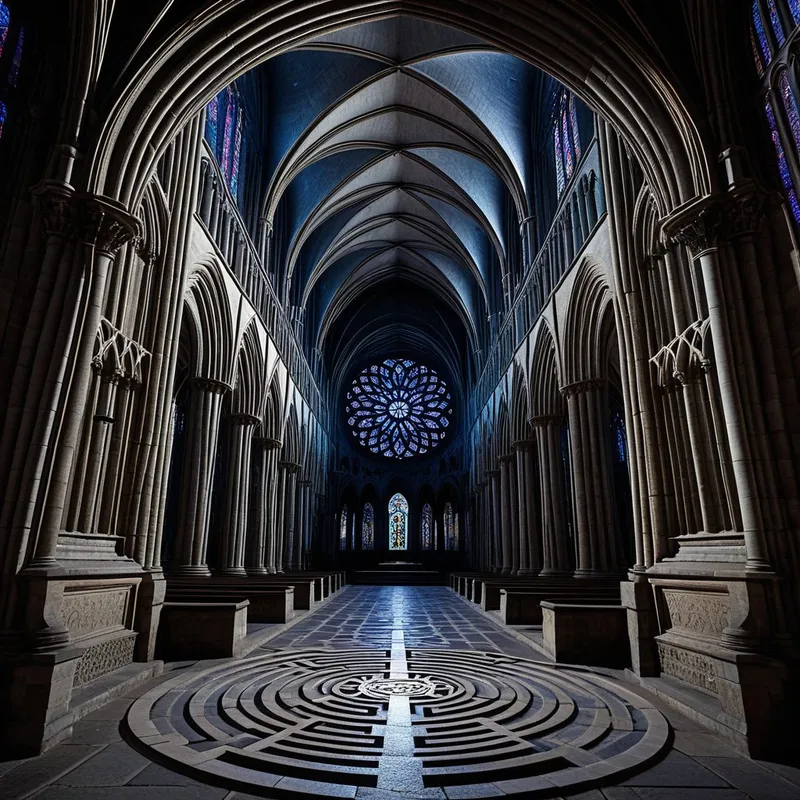
Chartres Labyrinth Myth Meaning & Symbolism
A sacred stone path within a cathedral, a silent myth of pilgrimage where the walker journeys to the center and back, transformed by the path itself.
The Tale of Chartres Labyrinth
Listen. Not with your ears, but with the soles of your feet. For the tale is not told in words, but in stone. It is etched into the cold, grey floor of a cathedral that scrapes the sky, a cathedral born of faith and fire, where light is fractured into a thousand saints and stories. But here, at your feet, lies a quieter scripture.
It begins not with a hero, but with a breath. Your own. The air is thick with incense and centuries. Before you, a vast circle is held captive within the nave’s embrace. It is a path, a single, unbroken line of pale stone woven into a pattern of such complexity it stills the mind. Eleven concentric circles, folded back upon themselves in a dance of divine geometry. This is the Chartres Labyrinth.
There is no monster at its heart. No Minotaur waiting in the dark. The conflict is subtler, more intimate. It is the conflict between the pilgrim’s restless will and the path’s implacable design. You take the first step. The stone is smooth, worn by ten thousand prayers made flesh. The path does not rush you to the goal. It turns you away. Just as you feel you approach the sacred center, the rosace, it sweeps you to the outermost ring, to the very edge of the sacred space. You walk the perimeter, a stranger looking in.
The rising action is the rhythm of your own doubt and surrender. The path is the teacher. It forces confrontation—not with a beast, but with your own haste, your expectation of a straight line to grace. You feel the coolness of the stone through thin soles, hear the distant echo of a chant from the choir. The labyrinth offers no shortcuts, only the long, necessary way. You pass others on the path, moving in the opposite direction, their faces etched with inward focus. You do not speak. You are each alone in your journey, yet bound by the same, singular thread.
And then, the turn. After long arcs that seem to lead nowhere, the path folds inward with a sudden, gentle certainty. The circles tighten. The world of the cathedral—the towering pillars, the distant altar—falls away. There is only the path, and your feet upon it. You arrive not with a fanfare, but with a breath released. The center. A rosette of six petals, a stone flower. You stand in the omphalos, the navel. Here, the conflict resolves into a profound stillness. You have not slain anything but your own illusion of control. You have been led.
The return journey is the second half of the myth, often forgotten. You do not stay in the center. The path, the same unbroken line, now carries you back out, weaving through the same circuits, but with a different heart. You carry the center with you. You walk back into the world, retracing your steps, but you are not the same pilgrim who entered. The labyrinth has spoken its silent tale, and you have walked its every word.
Cultural Origins & Context
This myth in stone was born in the early 13th century, embedded in the floor of the newly rebuilt Cathedral of Our Lady of Chartres. It existed not in scrolls or sermons, but underfoot, a participatory scripture for the common believer. In an age when a physical pilgrimage to Jerusalem was a perilous, often impossible dream for most, the Church offered "pilgrimages of substitution."
The labyrinth was one such substitute. It was known as "La Lieue"—"The League"—suggesting the distance one might walk in an hour, a metaphorical journey. On certain days, the faithful would walk its path on their knees, praying the rosary, their physical effort mirroring the spiritual ascent. It was a democratized myth. One did not need to be a scholar to understand the complexities of typology; one needed only to walk. The labyrinth served as a somatic meditation, a way to embody the Christian soul's journey through the twists and turns of life toward God, and its subsequent return to the world, sanctified.
Symbolic Architecture
The labyrinth is not a maze. A maze is a puzzle of choices, designed to confuse and lose. The labyrinth is a unicursal path. It has no dead ends, no false turns. Its symbolic power lies in this very fact: the journey is mandatory and specific, but the outcome is assured for those who persist.
The path is not an obstacle to the goal; the path is the teacher that makes the goal meaningful.
Psychologically, it represents the circuitous, non-linear path of individuation. The ego, intent on a direct route to fulfillment (the center), is repeatedly turned back, forced to experience the periphery of its own being—the overlooked, the rejected, the shadow. The center symbolizes the Self, the divine spark within. Reaching it is not an achievement of the will, but a surrender to the design of a larger psyche. The eleven circuits may correspond to the layers of the soul or the stages of purification. The six-petaled center echoes the Rosette Window above and the cosmic order.
The Dreamer's Resonance
When the Chartres pattern appears in a modern dream, it rarely appears as a cathedral floor. It may manifest as a garden hedge, a pattern on a carpet, a network of lights on a dark plain, or even the convoluted layout of an endless, familiar building. The dreamer is compelled to walk it.
This dream signals a profound somatic and psychological process: the psyche is orchestrating a necessary, guided confrontation with complexity. The dreamer is in a phase where linear problem-solving has failed. The labyrinth dream imposes a different logic—the logic of process. The frustration felt in the dream, the seeming back-tracking and delay, mirrors a conscious feeling of being stuck or led astray in life. The dream is assuring the dreamer that this circuitous route is not error, but integral to the journey. The somatic sensation is key: the feeling of feet on the path, the kinetic memory of turning. The psyche is literally re-patterning, walking a new neural and spiritual pathway toward integration. Reaching the center in the dream often brings a wave of profound, wordless peace—a direct experience of the Self.
Alchemical Translation
The alchemical process mirrored in the labyrinth is the solve et coagula—dissolve and coagulate. The journey in is the solve. The ego’s rigid plans and conscious intentions are dissolved by the path’s winding, non-negotiable design. Old identities and attachments are stripped away as the pilgrim is led to the outer edges of their understanding. This is the nigredo, the blackening, the feeling of being lost in one’s own life.
To walk the labyrinth is to consent to the psyche’s own timeline, to be cooked in the slow fire of indirect experience.
The center represents the albedo, the illuminating encounter with the core Self. It is a moment of clarity, not of thought, but of being. Here, the divine spark is recognized not as a distant deity, but as the core of one’s own existence.
The return journey is the coagula, the re-forming. The insight gained at the center must now be woven back into the fabric of daily life. The pilgrim returns to the world, but the world is now seen through the lens of the center. This is the rubedo, the reddening, the embodiment of the spirit. The modern individual completes this alchemy not by reaching a static state of enlightenment, but by embracing the entire cycle—the journey out into complexity, the centering, and the responsible return. The labyrinth teaches that wholeness is not a destination where one remains, but a quality one carries along the unending path.
Associated Symbols
Explore related symbols from the CaleaDream lexicon: