Charon's Skiff Myth Meaning & Symbolism
The myth of the grim ferryman who carries souls across the river Styx, demanding a coin for passage into the realm of Hades.
The Tale of Charon's Skiff
Listen, and hear the whisper of the reeds on a shore that knows no sun. Feel the chill that is not of wind, but of absence. This is the bank of the Acheron, though some name it Styx. Here, the light is a memory, and the air hangs heavy with the sighs of countless multitudes.
They gather, these shades—pale, insubstantial echoes of who they once were. They are drawn from the sunlit world by an inexorable pull, down through dark caverns and silent groves, until their feet find the gravel of this desolate strand. Before them lies a water like polished slate, wide, black, and impossibly still. On the far side, lost in perpetual twilight, rise the formidable walls and gates of Hades.
But the water does not yield. It must be crossed. And for that, there is only one craft, and one pilot.
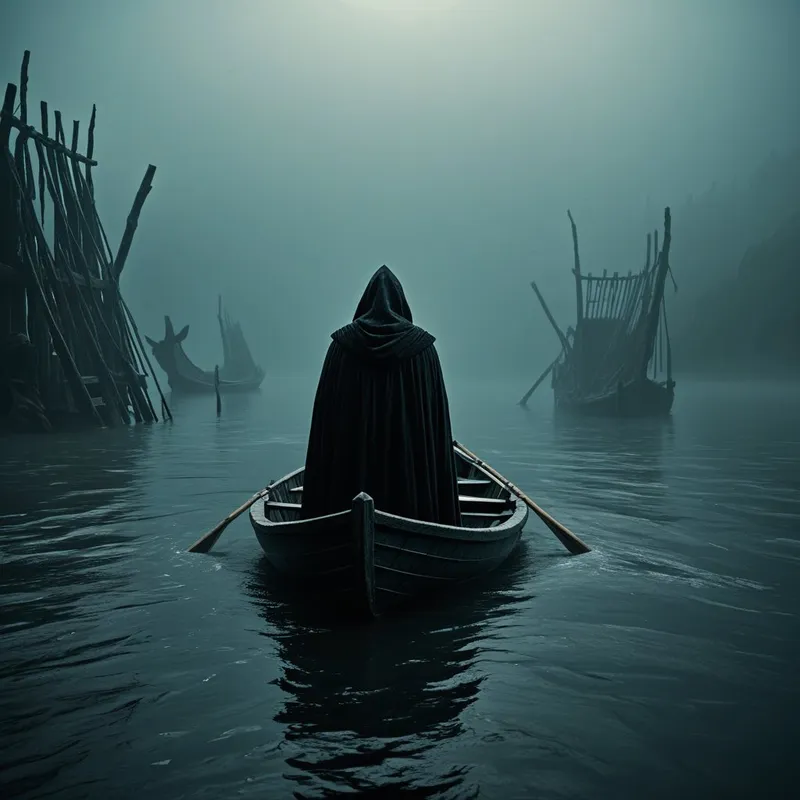
From the mist, a shape resolves. It is a skiff, low in the water, its wood aged to the color of stone. And in it, a figure. He is Charon. Not a god of Olympus, but a daimon, an ancient force appointed to his eternal task. His form is tall and shrouded in a cloak the hue of mud and shadows. What flesh is visible is tough and leathery, his eyes burning with a dim, patient fire. He does not speak. He merely extends a hand—long-fingered, gripping a pole—and his skiff grinds against the gravel.
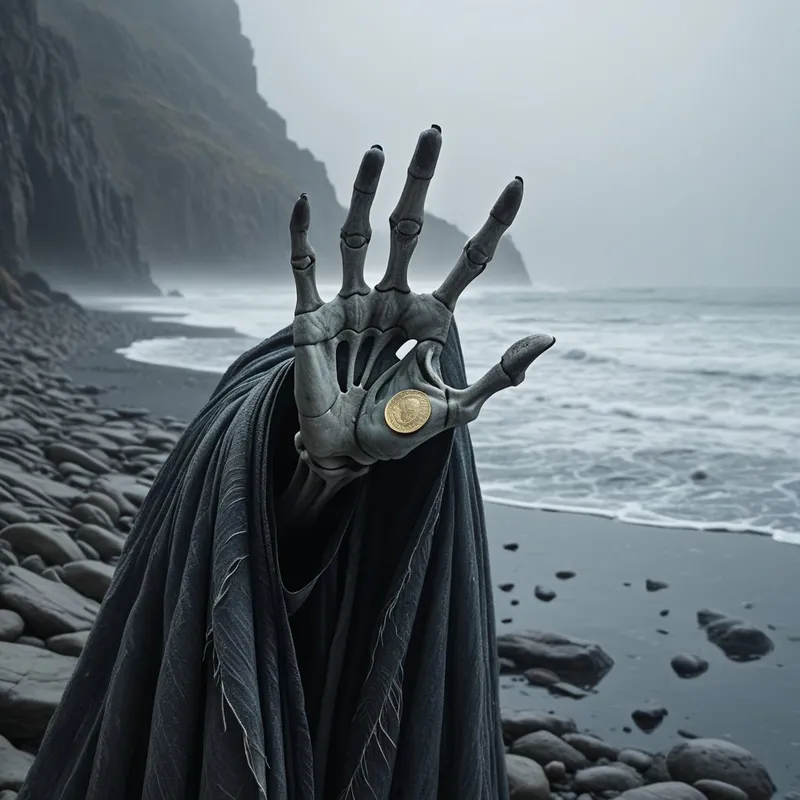
This is the moment of reckoning. Each shade approaches. In life, their loved ones placed a single obol upon their tongue, or in their hand. Now, they must produce it. The coin is the key, the fare, the only currency this bleak economy accepts. The shade whose burial rites were neglected, who has no coin, lets out a soundless cry of despair. For them, Charon turns his hooded head away. His pole pushes off, and he leaves them on the shore, condemned to wander the banks for a hundred years, a whisper among the reeds.
But for the one who holds the coin, the ritual unfolds. The shade places the small, cold silver into Charon’s waiting palm. The grip closes. A nod, almost imperceptible. The shade is permitted to step into the unstable craft, to sit among other silent passengers. Then, with a great heave, Charon plants his pole into the unseen depths. The skiff moves, slicing the black water without a ripple.
The journey is silence itself. No water laps the hull. No wind stirs. The passengers do not look at one another. They only stare ahead, at the approaching shore, where the monstrous, three-headed form of Cerberus can be glimpsed, and where the judges of the dead await. Charon poles on, a study in grim efficiency, until the bow crunches onto the underworld’s shore. The shades disembark, their debt paid, their passage complete. Charon does not watch them go. He is already turning his skiff, ready for the endless return journey, back across the void to gather yet more souls from the twilight shore. His work is never done.
Cultural Origins & Context
The myth of Charon is not the stuff of grand Olympian feats, but a fundamental piece of Greek funerary practice and cosmic geography. It emerges from the deep, collective need to map the uncharted territory of death. While vividly crystallized in later literary works like Virgil’s Aeneid and Dante’s Inferno (which adopted and adapted the figure), Charon’s roots are older and more visceral.
He is a fixture in the Greek imagination of the afterlife from at least the 5th century BCE, appearing on funeral vases and in the plays of Aristophanes and Euripides. The myth was not merely a story told by bards, but a living ritual enacted by every family. The placement of the obol in the mouth of the deceased was a critical, non-negotiable final act of care. Its function was starkly practical within the mythological framework: it ensured your loved one could complete the journey. This practice reveals a society deeply concerned with proper rites (nomoi), where social obligation extended beyond the grave. Charon’s myth served as both a comfort—providing a structured path through the chaos of death—and a warning, reinforcing the sacred duty of the living to the dead.
Symbolic Architecture
Charon’s Skiff is not merely a boat; it is the ultimate symbol of the liminal—the threshold state itself. It operates in the space between worlds, between identities (living/dead), and between states of being. Every element is a profound cipher.
The coin is not payment for a service, but an acknowledgment of a cosmic law: all profound transition requires a sacrifice, a letting go of a former currency.
Charon himself is the archetypal Psychopomp, but a stark and unsentimental one. He is not a comforting guide but the embodiment of the impersonal, inevitable process of transition. His refusal of those without the coin symbolizes nature’s—and the psyche’s—refusal to process what has not been properly prepared for. The river is the boundary of the unconscious, its dark waters representing the dissolution of the ego and the journey into the unknown depths of the self. The skiff is the fragile vessel of consciousness or the provisional identity that must carry us across this inner abyss.
The Dreamer's Resonance
When Charon poles his skiff into modern dreams, he signals a profound psychological transition that is already underway. To dream of waiting on that shore is to feel oneself in a liminal state—perhaps after a major loss, the end of a relationship, or a career change. The somatic feeling is one of suspension, chill, and anxious anticipation.
Dreaming of having no coin for Charon speaks to a deep-seated fear of being unprepared, of having failed to “pay one’s dues” or integrate a necessary experience. It is the dream-equivalent of psychic stagnation. Conversely, to dream of successfully paying and boarding the skiff indicates a subconscious acceptance of a necessary ending. The dream ego is acquiescing to a process it cannot control, trusting the impersonal, often grim, ferryman of the psyche to carry it to the next phase. The silence of the journey in the dream mirrors the introspective, wordless processing that true inner transformation requires.

Alchemical Translation
In the alchemy of the soul, the myth of Charon’s Skiff models the critical, non-negotiable stage of mortificatio—the symbolic death necessary for rebirth. The modern individual’s journey of individuation is punctuated by these crossings.
To step into Charon’s skiff is to consciously submit to the dissolution of a outworn self-image. The obol is the valued piece of the old identity—a pride, a grievance, a familiar story—that must be willingly surrendered as the fare for passage.
The hero’s task here is not to fight Charon, but to have prepared the coin. This preparation is the life’s work of self-awareness: acknowledging what must end, grieving it properly (the funeral rite), and crafting the “coin” of conscious understanding. The far shore of Hades represents not eternal damnation, but the temenos—the sacred precinct—of the deeper unconscious, where the soul will be judged, sorted, and ultimately, reconstituted. The triumph is not in avoiding the journey, but in securing passage. It is the ultimate act of humility and courage to pay the ferryman his due and entrust oneself to the dark waters, knowing they lead not to oblivion, but to the necessary ground of all future becoming.
Associated Symbols
Explore related symbols from the CaleaDream lexicon: