Charon and the River Styx Myth Meaning & Symbolism
The ancient tale of the ferryman who guides souls across the boundary river for a coin, a myth of transition, payment, and irreversible passage.
The Tale of Charon and the River Styx
Listen, and hear the tale of the last journey, the one no living foot may walk. It begins not with a breath, but with its cessation. When the thread spun by the [Moirai](/myths/moirai “Myth from Greek culture.”/) is finally sheared, the essence of a person—the [psyche](/myths/psyche “Myth from Greek culture.”/)—detaches, weightless and bewildered. It is drawn, as [water](/myths/water “Myth from Chinese culture.”/) seeks the lowest ground, toward a place of profound chill and deeper shadow.
The path ends at a shore. This is no shore of sand and surf, but of coarse, grey ash and silent pebbles. Before it lies a body of water so still it seems not liquid, but solidified darkness: the [River Styx](/myths/river-styx “Myth from Greek culture.”/). Its far bank is swallowed by mist, from which echoes the faint, collective sigh of forgotten multitudes. The air carries the scent of damp stone and cold clay.
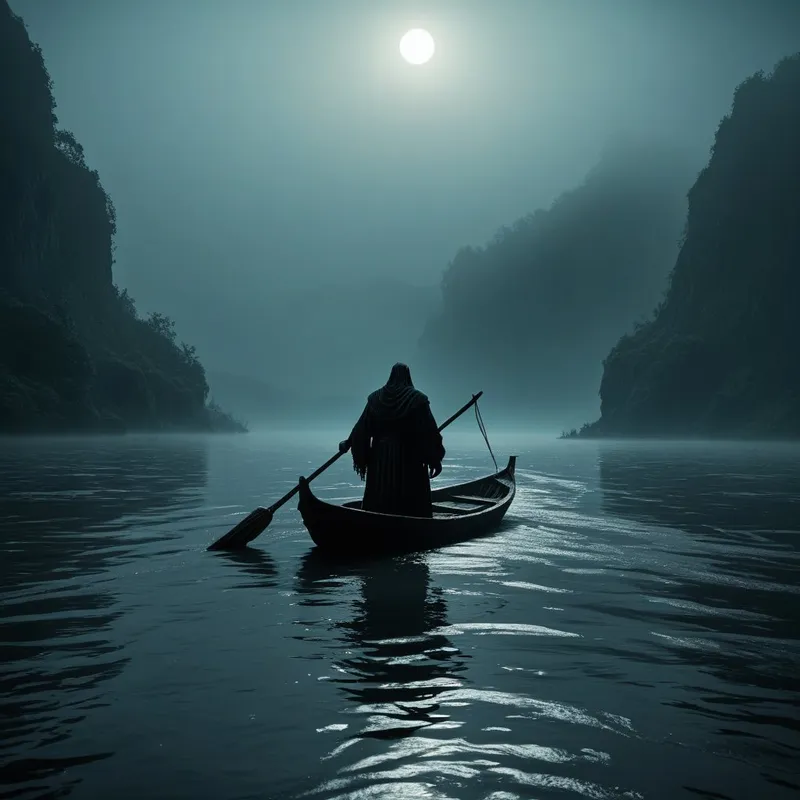
Here, at this [terminus](/myths/terminus “Myth from Roman culture.”/), waits the keeper of [the threshold](/myths/the-threshold “Myth from Folklore culture.”/). He is [Charon](/myths/charon “Myth from Greek culture.”/). Do not imagine a gentle guide. He is antiquity given form: a towering, gaunt figure shrouded in a hooded cloak the color of river mud. What flesh is visible is parched and leathery, stretched over unyielding bone; his eyes are hollow pits that have witnessed the end of all things. In his grip is a long pole, stained by the abyssal waters. His boat, beached upon the ash, is a skeletal [thing](/myths/thing “Myth from Norse culture.”/) of worm-eaten wood, large enough for a host of shades, yet forever looking as though it might dissolve into the next wave.
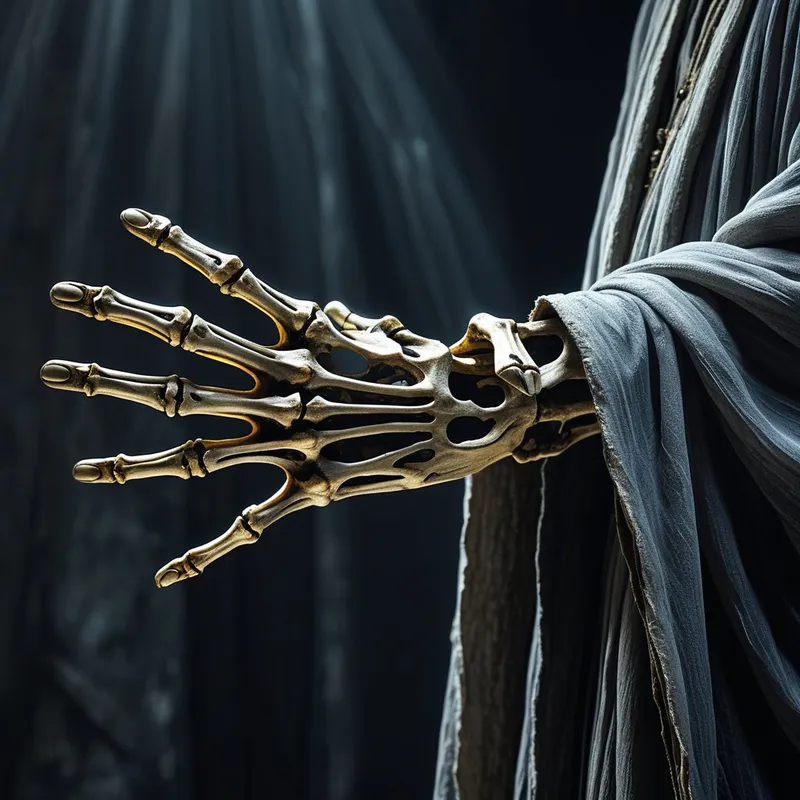
The newly arrived shade approaches, drawn by an inexorable pull. But passage is not a right; it is a transaction. Charon extends a gnarled, silent hand. His demand is ancient and absolute: the obol, [the ferryman](/myths/the-ferryman “Myth from Various culture.”/)’s fee. For those properly buried with the coin placed upon their tongue or over their eyes, the moment is one of grim relief. The small, cold disk is produced—the last physical token of [the world](/myths/the-world “Myth from Tarot culture.”/) above. It clicks against his palm, a sound final as a tomb door closing. Only then does Charon, with a motion that speaks of infinite repetition, gesture toward his craft.
The shade boards. The boat, with a groan that speaks of immense weight, slides from the ash into [the Styx](/myths/the-styx “Myth from Greek culture.”/). Not a ripple mars the obsidian surface. Charon poles, and the far shore grows from [the mist](/myths/the-mist “Myth from Celtic culture.”/)—tall, black poplars, fields of asphodel, and the looming, bronze gates of [Hades](/myths/hades “Myth from Greek culture.”/) itself. The crossing is soundless, timeless, a lacuna between states of being. To look back is to see the shore of life receding into a memory, then a dream, then nothing at all.
For those who come coinless—the unburied, the unmourned, the paupers—the hand remains outstretched, an immutable barrier. No plea, no memory of glory or love, can move it. They are turned away, condemned to wander the barren, windy shore for a hundred years, whispering their regrets to the uncaring stones, until some mercy or chance allows them passage. The boat departs without them, leaving them to the desolate echo of the waters they cannot cross.
The tale resolves not with an event, but with an arrival. The boat grounds on the distant bank. The shade disembarks, now fully a citizen of [the underworld](/myths/the-underworld “Myth from Greek culture.”/), and joins the countless others in the grey fields. Charon does not watch them go. He is already pushing off, back toward the shore of ash, his empty hand ready, waiting for the next coin, the next soul, to begin the cycle anew. [The river](/myths/the-river “Myth from Buddhist culture.”/) flows on, silent and unforgetting, the absolute boundary between the sun and the shade.
Cultural Origins & Context
The myth of Charon is not the product of a single poet, but a collective, folkloric belief that seeped into the bedrock of Greek consciousness. It finds its most famous literary anchor in Book XI of [Homer](/myths/homer “Myth from Greek culture.”/)’s Odyssey, where [Odysseus](/myths/odysseus “Myth from Greek culture.”/) performs a blood sacrifice to summon the shades and must keep them at bay with his sword—a vivid illustration that the dead were both pitiable and perilous. Later, the Roman poet Virgil, in the Aeneid, provides the iconic, detailed depiction of Charon and the crowded shore that has shaped the Western imagination.
This was not merely priestly doctrine, but practical, domestic ritual. The placement of the obol in the mouth of the deceased was a fundamental duty of the living, typically performed by a family member. Failure was a profound social and religious transgression, believed to doom the soul to limbo. The myth thus functioned as social glue, enforcing burial rites and familial piety. It gave tangible, actionable form to the abstract terror of [death](/myths/death “Myth from Tarot culture.”/): you could do something about it. By providing the coin, the living secured for their loved ones—and ultimately, for themselves—a managed, orderly transition, upholding cosmic order against the [chaos](/myths/chaos “Myth from Greek culture.”/) of an unmourned end.
Symbolic Architecture
At its core, this myth maps the psyche’s confrontation with irreversible change. The [River](/symbols/river “Symbol: A river often symbolizes the flow of emotions, the passage of time, and life’s journey, reflecting transitions and movement in one’s life.”/) Styx is not a geographical feature but the very embodiment of the Threshold. It represents the psychic point of no return, the [moment](/symbols/moment “Symbol: The symbol of a ‘moment’ embodies the significance of transient experiences that encapsulate emotional depth or pivotal transformations in life.”/) when a former state of being—a [relationship](/symbols/relationship “Symbol: A representation of connections we have with others in our lives, often reflecting our emotional state.”/), an [identity](/symbols/identity “Symbol: Identity represents the sense of self, encompassing personal beliefs, cultural background, and social roles.”/), a phase of [life](/symbols/life “Symbol: The symbol of ‘Life’ represents a journey of growth, interconnectedness, and existential meaning, encompassing both the joys and challenges that define human experience.”/)—is conclusively ended. Its waters are the solvent of the old self.
Charon is the archetypal Threshold [Guardian](/symbols/guardian “Symbol: A protector figure representing safety, authority, and guidance, often embodying parental, societal, or spiritual oversight.”/). He is not evil, but utterly impersonal, a personification of [the law](/symbols/the-law “Symbol: Represents external rules, societal order, moral boundaries, and the tension between personal freedom and collective structure.”/) that governs transitions. He does not judge the [soul](/symbols/soul “Symbol: The soul represents the essence of a person, encompassing their spirit, identity, and connection to the universe.”/)’s [character](/symbols/character “Symbol: Characters in dreams often signify different aspects of the dreamer’s personality or influences in their life.”/), only its preparedness. His demand for [payment](/symbols/payment “Symbol: Symbolizes exchange, obligation, and value. Represents what one gives to receive something in return, often tied to fairness, debt, or spiritual balance.”/) underscores a fundamental psychic [truth](/symbols/truth “Symbol: Truth represents authenticity, honesty, and the quest for knowledge beyond mere appearances.”/):
No profound passage is free. Something of value from the old world must be surrendered to enter the new.
The obol is this Payment. It symbolizes the conscious acknowledgment of the ending—the [grief](/symbols/grief “Symbol: A profound emotional response to loss, often manifesting as deep sorrow, yearning, and a sense of emptiness.”/), the regret, the released attachment, the “coin” of conscious suffering paid for [passage](/symbols/passage “Symbol: A passage symbolizes transition, movement from one phase of life to another, or a journey towards personal growth.”/). It is the final token of [the ego](/myths/the-ego “Myth from Jungian culture.”/)’s old [currency](/symbols/currency “Symbol: Currency represents value exchange, personal worth, and societal power dynamics. It symbolizes resources, control, and the abstract systems governing human interaction.”/), rendered useless in the new [realm](/symbols/realm “Symbol: The symbol of ‘Realm’ often signifies the boundaries of one’s consciousness, experiences, or emotional states, suggesting aspects of reality that are either explored or ignored.”/). The coinless soul is one who cannot, or will not, pay this price; who clings to a ghost of the past and is therefore trapped by it, unable to complete the transition.

The Dreamer’s Resonance
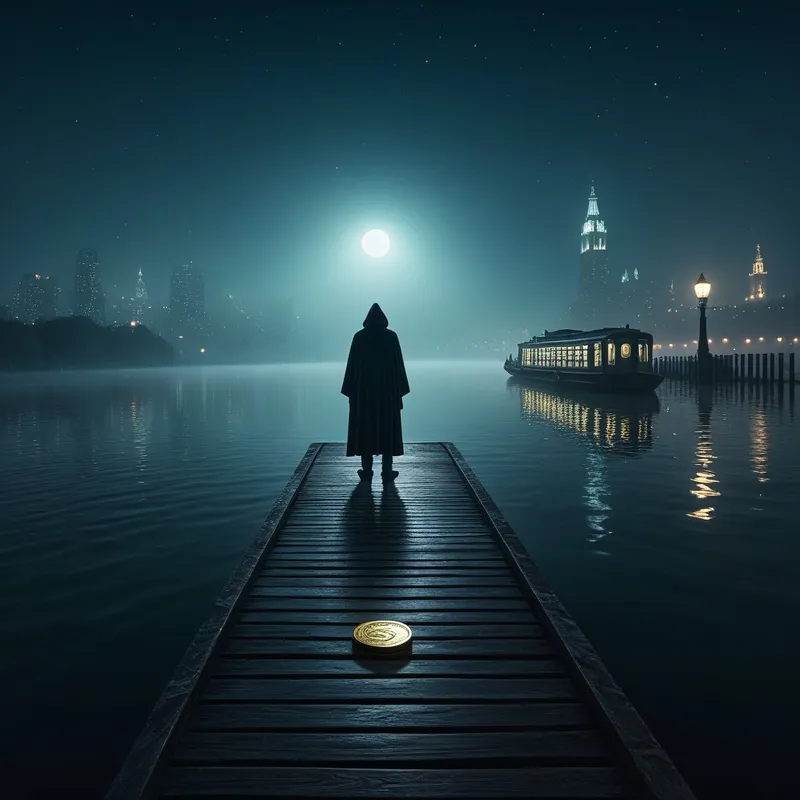
When this myth surfaces in modern dreams, it rarely appears as a classical tableau. The dreamer may find themselves at a deserted train station at night, holding a ticket they cannot read, while a silent conductor watches. They may be trying to board a ferry with expired currency, or standing before a toll booth on a bridge that vanishes into fog. The somatic feeling is one of stuckness, anxiety, and profound liminality.
Psychologically, this signals a psyche at a critical juncture. The “shore” is a prolonged state of indecision or unresolved grief. The dream-Charon represents an inner imperative—often felt as depression, deep restlessness, or a somatic “heaviness”—demanding payment. The missing “coin” is whatever the conscious mind is refusing to relinquish: a grudge, a defunct self-image, an attachment to a past trauma or glory. The hundred years of wandering is the psychic cost of this refusal: a life lived in a ghostly, repetitive, unsatisfying borderland, unable to move forward into new potential.
Alchemical Translation
In the alchemy of individuation, the journey with Charon models the essential process of psychic death and rebirth. The ego, having identified with a particular constellation of attitudes, achievements, and relationships (the “land of the living”), must eventually face its own dissolution. The River Styx is the [nigredo](/myths/nigredo “Myth from Alchemical culture.”/), [the dark night of the soul](/myths/the-dark-night-of-the-soul “Myth from Christian Mysticism culture.”/), where all certainties are drowned.
The conscious engagement with this process is the crafting of the obol. It is the hard-won insight, the humble acceptance of limitation, the forgiven fault, the surrendered ambition. It is the “I was” that must be handed over. To offer this coin willingly is not defeat, but the ultimate act of psychological sovereignty. It is an agreement with the deeper Self to end an epoch.
The ferryman accepts only the currency of truth. The passage he grants is not to oblivion, but to the underworld of the unconscious—the realm where the seeds of new life gestate in the dark.
Arriving on the far shore is the beginning of integration. The shades in the fields of asphodel represent forgotten or repressed aspects of [the self](/myths/the-self “Myth from Jungian culture.”/), now available for recollection and acknowledgment. The encounter with Hades, the lord of this invisible wealth, awaits. Thus, the myth teaches that every ending, no matter how final, is also a crossing. Our task is not to avoid the ferryman, but to discern what we carry that is valuable enough to pay him, and what we must leave behind on the ash-strewn shore, so that we may be borne across the dark water toward what comes next.
Associated Symbols
Explore related symbols from the CaleaDream lexicon: