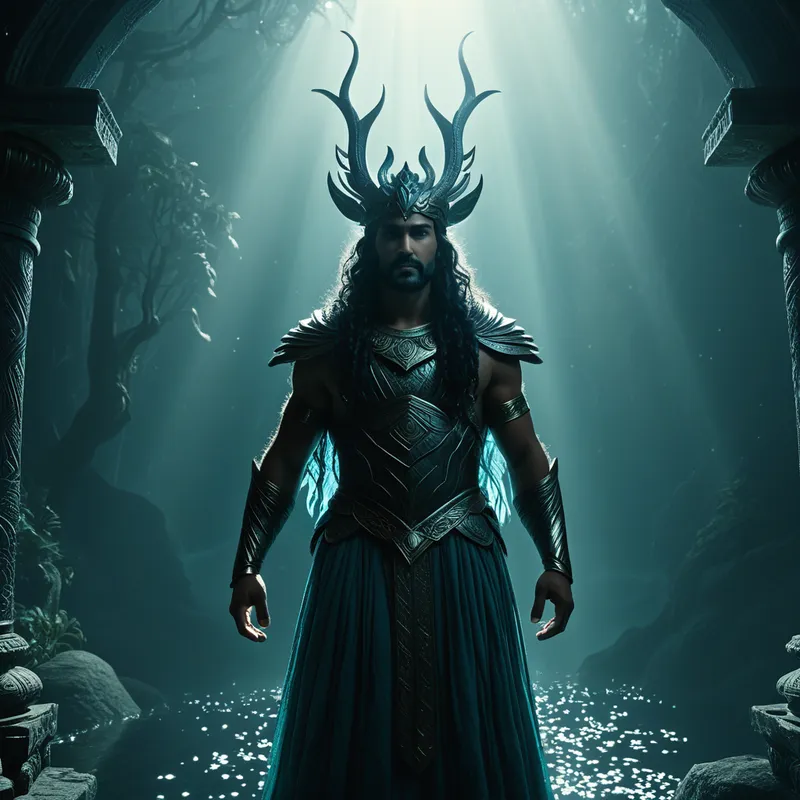
Chang'e Flies to the Moon
A Taoist tale of the moon goddess Chang'e, who consumed an elixir of immortality and ascended to the moon, leaving behind her mortal life and husband.
The Tale of Chang'e Flies to the Moon
The story begins not with Chang'e, but with her husband, the peerless archer Houyi. In an age when ten suns, the sons of the Celestial Emperor, scorched the earth by rising together, Houyi was tasked with restoring order. With his divine bow, he shot down nine of the suns, leaving the one we know today. For this great service, the Queen Mother of the West, Xiwangmu, gifted him a single, precious elixir—a pill of immortality. Consumed whole, it would grant ascension to the heavens; divided, it would confer eternal life on earth for two.
Houyi, deeply in love with his mortal wife Chang'e, chose the latter path. He brought the elixir home, entrusting it to Chang'e’s care, and planned for them to share it on an auspicious day. But fate is a thread pulled by unseen hands. Houyi’s fame bred envy and fear among the celestial court, and his own disciples grew covetous of the divine gift. One day, while Houyi was away, the disciple Fengmeng, driven by greed, forced his way into their home to steal the pill.
Cornered and terrified, faced with the theft of her husband’s hard-won prize and their shared destiny, Chang'e made a choice of impossible finality. To keep it from the thief, she swallowed the elixir whole. Immediately, her body grew light, untethered from the earth’s pull. She began to float upwards, through the roof of her home, into the vast, cold sky. Desperately, she tried to grasp at clouds, at memories, at the fading sight of her earthly home, but the celestial current was irresistible.
Houyi returned to find his home violated and his wife ascending. He seized his bow, but what arrow could pierce the heart of such a tragedy? He could only watch, his great heroism rendered utterly futile, as Chang'e drifted further into the firmament. Drawn not to the glorious sun-palaces but to the cool, silent, reflective orb of the moon, she alighted there, her ascent complete. She gained immortality, but at the cost of everything that gave life meaning: love, warmth, companionship. The moon, once a symbol of yin beauty, became her gilded prison. In some versions, she is transformed there into a three-legged toad, a creature of the damp lunar shadows, a permanent emblem of her metamorphosis and exile. In others, she is accompanied only by a solitary jade rabbit, endlessly pounding herbs in a silent, futile labor. Houyi, heartbroken, built a palace of the sun, and there they remain, eternally separated, the sun and the moon forever chasing but never meeting across the sky.
Cultural Origins & Context
The myth of Chang'e is a tapestry woven from many threads over millennia. Its earliest strands appear in divination texts from the Warring States period, where a figure named Heng’e (the name later softened to Chang'e) is associated with the moon. It was during the Han Dynasty, with the flourishing of Taoist alchemical and cosmological thought, that the narrative crystallized into the form we know. The story is deeply embedded in Taoist xian (immortal) culture, where the pursuit of eternal life was a central spiritual endeavor.
The elixir, or dan, is the ultimate prize in Taoist alchemy, representing the culmination of internal refinement and external ritual. Chang'e’s act, therefore, is not merely a domestic drama but a profound cosmological event. It explores the tension at the heart of the quest for immortality: what is sacrificed when one transcends the mortal condition? The myth also reflects ancient Chinese astronomy and the yin-yang principle. The sun (yang, masculine, active) is embodied by Houyi, the heroic archer. The moon (yin, feminine, receptive) becomes the domain of Chang'e. Their separation is a cosmic illustration of a fundamental duality, a celestial echo of the inevitable distance that can grow between complementary forces, even—or especially—in love.
Symbolic Architecture
At its core, the myth is an archetypal drama of the Orphan, one who is severed from their primal connection and must exist in a state of eternal, conscious solitude. Chang'e is orphaned from her mortal life, her human love, and the warm, yang world of the sun. Her palace on the moon is the ultimate orphan’s refuge: beautiful, serene, and utterly isolating.
The elixir is not a gift, but a test. It presents the paradox of ultimate attainment: to grasp the eternal is to let go of the temporal, and in that letting go, one often loses the very soul one sought to preserve. Chang'e’s immortality is a state of perfected being, yet it is indistinguishable from a state of perfected longing.
Her flight is not an act of betrayal, but a tragic, defensive absorption. She internalizes the ultimate power (the elixir) to protect the shared dream of her marriage from external corruption, yet in doing so, she destroys the dream’s possibility. The moon itself becomes a symbol of this paradox—it illuminates the night with borrowed light, beautiful but cold, forever reflecting the sun’s fire but never generating its own warmth.
The Dreamer's Resonance
This myth speaks to the universal human experience of irreversible choice and its attendant exile. In the dreamscape, to "drink the elixir" might represent any decision that elevates us but severs us from a previous, cherished state of being: a promotion that costs a friendship, a principle upheld that loses a family, a truth spoken that silences a room. Chang'e embodies the part of the psyche that achieves a kind of purity or independence through a catastrophic, lonely act of self-preservation.
Psychologically, she represents the anima (the inner feminine) that has been spiritualized to the point of disembodiment. She is feeling refined into a permanent, melancholic reflection. For the dreamer, the image of the lonely moon goddess can signal a state of emotional isolation born of a perceived necessity, a feeling of being trapped in a beautiful but lifeless achievement, or a grief for a connection that feels cosmically out of reach. The myth asks us: What have we consumed—what ambition, what truth, what fear—that has left us floating in a silent, personal space, watching our former life recede below?
Alchemical Translation
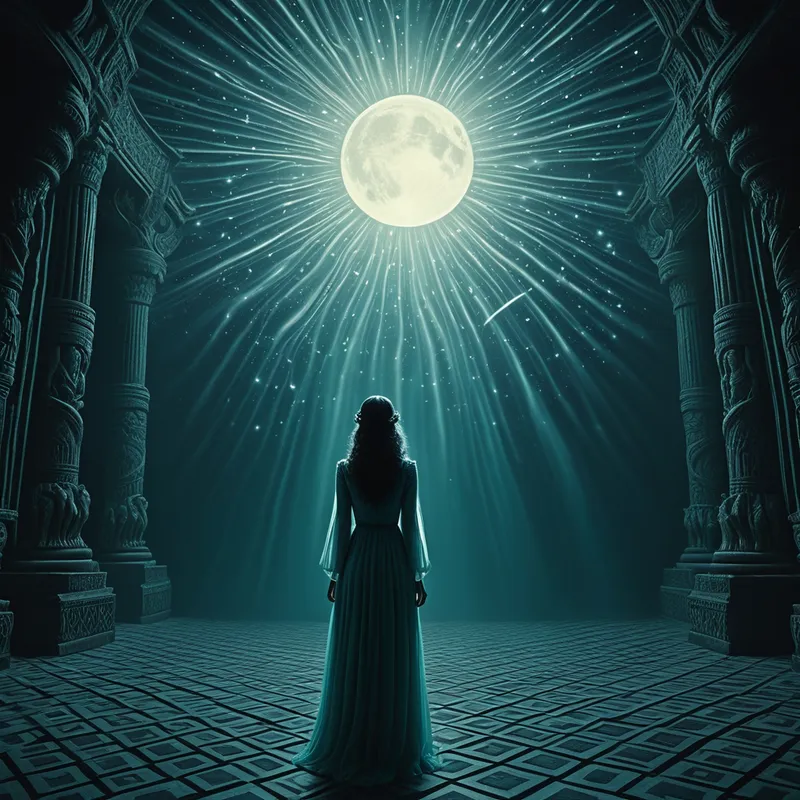
In the laboratory of the soul, the myth maps the perilous final stage of the coniunctio, or sacred marriage, gone awry. The two primary agents—the solar, active principle (Houyi/sulfur) and the lunar, receptive principle (Chang'e/mercury)—are meant to unite to create the immortal gold of the integrated self. Here, the receptive principle prematurely incorporates the entire transformative agent.
This is the danger of the unintegrated spiritual leap: the ego, in a moment of crisis, seizes the transcendent function (the elixir) for itself alone. The result is not enlightenment, but a sublime imprisonment. The psyche is fixed in a state of elevated stasis; one becomes a god, but at the cost of becoming a monument. The "work" is complete, but the alchemist is left outside, holding an empty crucible.
Chang'e on the moon represents the spirit become pure essence, but essence divorced from the heart. The ongoing work of the inner Houyi is then to find a way to relate to this distant, perfected, yet sorrowful aspect of the self—not to bring it down, but to learn to reflect its light, to endure the separation, and to find meaning in the eternal chase.
Associated Symbols
Explore related symbols from the CaleaDream lexicon:
- Moon — The celestial body of reflection, cycles, and the unconscious, becoming a palace of exile and eternal, cool contemplation.
- Sacrifice — The act of surrendering one state of being for another, often involving a profound and permanent loss within the gain.
- Elixir — The concentrated essence of transformation, representing ultimate potential, temptation, and the double-edged nature of perfection.
- Separation — The cosmic and emotional distance between complementary forces, illustrating the pain inherent in duality.
- Immortality — The state of eternal existence, portrayed not as a triumph but as a lonely condition of unchanging stasis.
- Love — The binding force whose loss defines the tragedy, representing the mortal warmth that immortality cannot replicate.
- Journey — An ascent that is also a flight, a path of no return leading to a destination of beautiful isolation.
- Mirror — The moon itself as a reflector of the sun’s light, symbolizing a consciousness that can only receive and reflect, never generate or embrace.
- Grief — The eternal emotional climate of the moon palace, the sorrow of attainment that has cost the attainer everything.
- Cup — The vessel meant to hold the shared potion of destiny, which instead becomes the agent of solitary transcendence.
- Silhouette of a Lover — The distant, recognizable form of the beloved, seen but forever unreachable across an impassable void.
- Eclipsed Moon — A moment of temporary union or contact between the sun and moon, symbolizing the fleeting, tragic beauty of their impossible reunion.