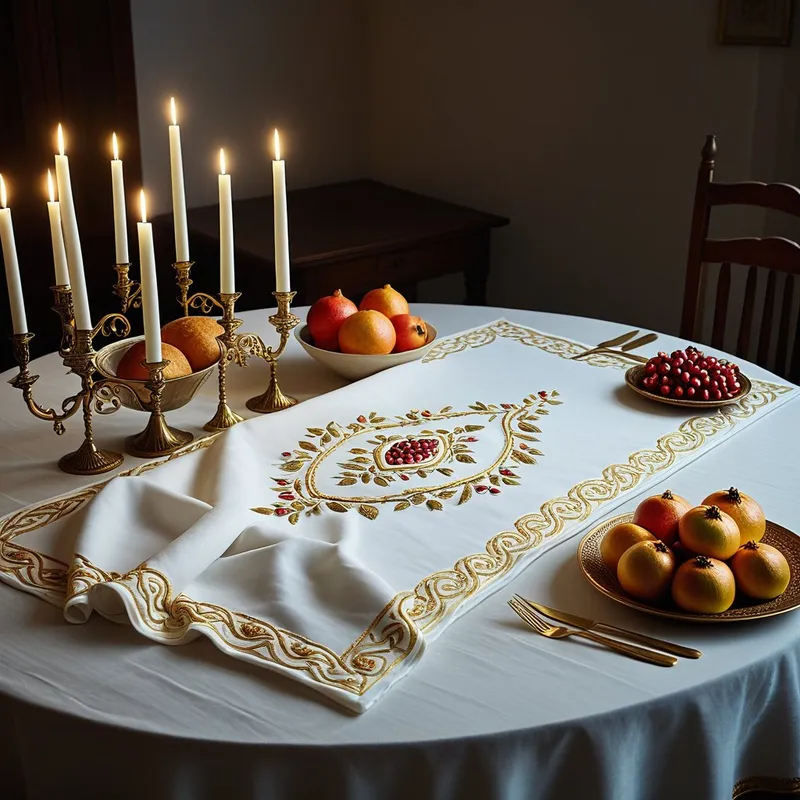
Challah Cover Myth Meaning & Symbolism
A myth of sacred cloth and hidden light, where the act of covering bread becomes a ritual of honoring the divine presence in the ordinary.
The Tale of the Challah Cover
Before the blessing, there is the hush. Before the light is spoken into being, it is first veiled.
In the quiet hour when the sun dips below the world’s edge, a sacred tension fills the home. The table is a kingdom set for a queen, the candles stand like silent sentinels, and upon the board rests the twin crowns of the week’s labor: the challah. They are golden, fragrant, warm with the memory of the oven’s fire—the very substance of earth and human hands.
But they are not yet for us.
For in that suspended moment, between the profane week and the holy day, a remembrance descends. It is the memory of a divine gift, of sustenance that fell like dew from a generous sky, of a wilderness where heaven fed the people with a bread called manna. And with that memory comes a law, a whisper from the mountain: on the day of rest, the manna did not fall. It was hidden. The face of the gift was covered.
So the keeper of the table, the one who tends the threshold between the mundane and the sacred, takes up a cloth. It may be simple linen, worn soft by years, or rich velvet embroidered with threads of silver, with symbols of menorahs and pomegranates, signs of light and abundance. This cloth is not a shroud, but a garment of honor. With a motion that is both practical and profound, they draw the veil over the loaves.
The cloth settles. It conceals the bread from sight. In that act of covering, a transformation occurs. The challah is no longer merely bread to sate hunger. It is become a mystery, a promise, a presence set apart. The covering creates a sacred space of anticipation. It says: what lies beneath is not for the eyes of the ordinary hour. It is reserved, belonging to the time of blessing, to the moment when thanks is given, when the Hamotzi is recited and the veil is lifted.
The conflict is not of clashing armies, but of competing realities: the reality of need and the reality of grace. The rising action is the gentle descent of the cloth. The resolution is the patient waiting, the collective breath held until the appointed word breaks the silence and the covered is revealed, the hidden is shared, and the holy is tasted.
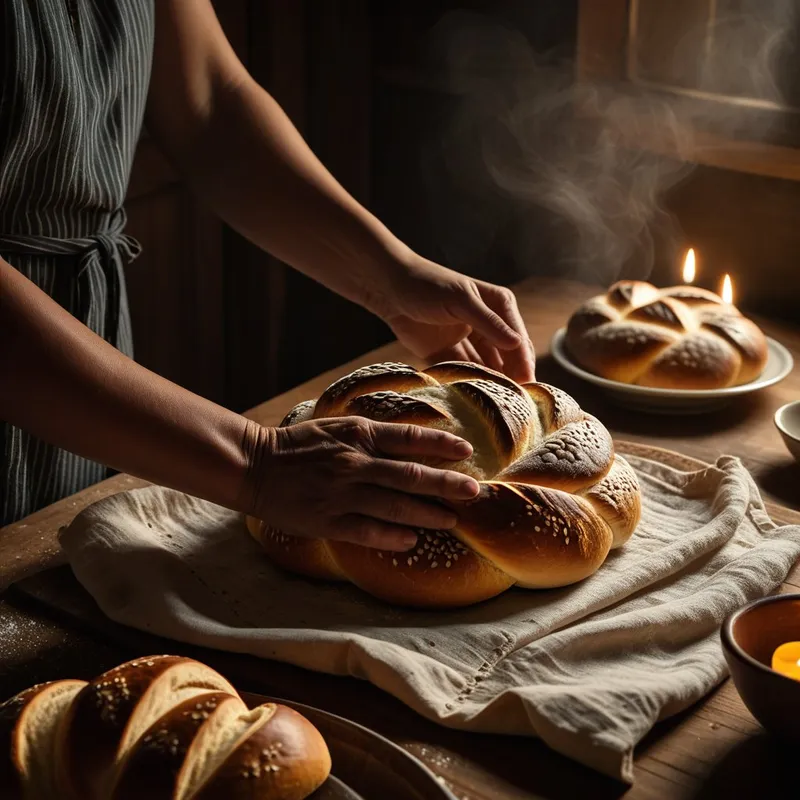
Cultural Origins & Context
This is not a myth of a single hero or a distant age of gods, but a living, domestic mythology enacted weekly in Jewish homes for centuries. Its origins are woven into the biblical narrative of Exodus, specifically the instructions regarding the Shabbat and the story of the manna. The manna, which would spoil if kept overnight, miraculously remained fresh when collected for the Sabbath, and a double portion fell on Friday. This "bread from heaven" was the ultimate symbol of divine dependence and providence.
The ritual of covering the challah derives directly from this. The two loaves on the Shabbat table represent the double portion of manna. The cover performs a dual function. First, it protects the bread’s dignity; in the ritual order of the Shabbat meal, the blessing over wine (Kiddush) comes first. The challah, waiting its turn, is covered so as not to be "shamed" by seeing the wine blessed before it. Second, and more profoundly, it recalls the layer of dew that covered the manna in the desert, a natural veil provided by the divine. The act of covering thus re-enacts that moment of sacred concealment, linking the bread on the table directly to the miraculous sustenance of the ancestors.
Passed down not through epic poems but through the embodied practice of mothers, fathers, and grandparents setting the table, the "myth" of the challah cover is a masterclass in sanctification. Its societal function is to transform the home into a mikdash, a sanctuary, and the meal into a temple service, where even the most basic human act—eating bread—is elevated into a conscious encounter with history, gratitude, and the divine.
Symbolic Architecture
At its core, the myth of the challah cover is an archetypal drama of concealment and revelation, the seen and the unseen. The cloth is the threshold itself.
The most profound truths are not always served plain. They are often delivered veiled, requiring the respectful pause, the ritual uncovering, to be truly received.
The challah represents the fruit of human labor—the transformation of grain, through effort and skill, into nourishment. It is the ego’s achievement, the "I" that provides and sustains. The cover represents the greater context, the divine source or the unconscious ground from which all productivity ultimately springs—the manna, the gift, the grace that precedes and enables all work. Covering the challah is a symbolic subordination of the ego’s product to the soul’s source. It says, "My labor is real, but it rests upon a mystery I did not create."
The act of covering is an act of humility and intentionality. It creates a temenos, a sacred space, around the ordinary. Psychologically, it represents the capacity to hold back our immediate impulses, to create a container for our energies and desires, so they may be integrated and blessed rather than merely consumed. The cover protects the sacred from being profaned by haste or inattention.
The Dreamer's Resonance
When this pattern stirs in the modern dreamer, it often manifests not as a literal loaf and cloth, but as a profound somatic sense of something precious being held in reserve. One might dream of a cherished object being wrapped and put away, of a light source being gently shaded, or of speaking only after a period of enforced silence.
This dream imagery signals a psychological process of incubation. The psyche is indicating that a new potential, a nascent idea, a developing feeling, or a recovering part of the self is in a vulnerable, formative state. It is not yet ready for the full light of conscious scrutiny or the demands of the outer world. The "covering" in the dream is the psyche’s own protective mechanism, creating a necessary boundary so that inner transformation can proceed without interference.
To dream of removing the cover with reverence suggests a readiness to integrate this incubated content, to bring a nurtured insight into the light of day and "share it at the table" of conscious life. To dream of the cover being torn away violently often speaks to a fear of premature exposure, of a fragile self being forced into the open before it is ready.

Alchemical Translation
The alchemical journey modeled here is the transmutation of the prima materia of daily life—our work, our struggles, our simple bread—into the aurum philosophicum of meaning and sanctity. It is the individuation path of the Caregiver, whose task is not to conquer dragons, but to create a holding environment where life can flourish.
The process begins with the acknowledgment of the source (the manna/dew). The conscious ego (the challah) must recognize it is not the sole author of its existence. The next stage is ritualized concealment (the covering). This is the conscious act of setting aside, of creating a Sabbath for the soul—a pause from productivity for reflection, gratitude, and connection to the deeper Self. This is the nigredo, the darkening, where things are hidden to be transformed.
Individuation is not about adding more light, but about learning to see in the sanctified dark, to appreciate the form that the veil itself gives to the formless.
The final stage is blessed revelation (the uncovering and sharing). After the period of respectful waiting, what is revealed is no longer mere "bread." It is now sustenance imbued with story, with connection, with sanctity. The ego’ labor is now tasted as a gift, and in sharing it, community is forged. The personal achievement is alchemized into a transpersonal offering. The individual becomes a vessel who, by first covering and then blessing, turns a meal into a communion, and a home into a vessel for the holy.
Associated Symbols
Explore related symbols from the CaleaDream lexicon: