
Chaac Rain God Myth Meaning & Symbolism
The story of the rain god Chaac, whose tears and thunderous axe bring life to the world, embodying the sacred cycle of sacrifice and renewal.
The Tale of Chaac Rain God
Listen. Before the first green shoot pushed through the dark earth, the world was a silent kiln. The sun, a relentless eye, baked the limestone bones of the land. The great ceiba trees stood as dusty skeletons. In this time of thirst, the four Chaacs were born, not in triumph, but in profound sorrow.
They were old when they were young, these lords of the storm. Their faces were the faces of the earth itself—the curling snout of the serpent, the wise, heavy-lidded eyes of stone. They resided in the four corners of the sky, each holding a quadrant of the world in his care. Yet, their dominion was empty. They looked upon the cracked riverbeds, the still seed, the parched throats of every creature, and a great weight settled in their hearts. It was not anger, but a deep, aching grief—the grief of a parent who has nothing to give a starving child.
Their grief pooled in their chests, a salt sea with no outlet. It swelled until it could no longer be contained. Then, from their eyes, the first waters fell. Not as rain, but as tears. Heavy, hot tears that carved paths down their stony cheeks and fell into the void. But the air drank them, and the earth remained dust.
One among them, the Chaac of the East where the sun is born, felt this failure as a physical wound. He rose from his celestial throne, his body humming with a frustrated power. In his hand, materializing from the very humidity of his sorrow, appeared his lightning axe. It was not a weapon for war, but a tool for breaking open that which is sealed shut.
He raised the axe, and with a cry that was both lament and command, brought it down upon the vault of his own heart. The sound was not of splitting wood or stone, but of the first, cataclysmic crack of thunder. From the symbolic wound, his grief was not spilled, but transmuted. The salt of his tears became the sweet, life-giving rain. The thunder-axe split the hardened sky, and the other Chaacs, understanding, joined him. They struck the clouds with their axes, and the heavens, once a sealed jar, were opened.
The rain did not fall gently. It was a torrent, a roaring gift. It hammered the dry earth, filled the cenotes, and woke the rivers. It soaked into the hidden seeds, whispering the old promise of life. And where the first drops touched the soil, the first tender shoot of maize, the holy sustenance, pushed toward the light. The Chaacs, their grief now a flowing, giving force, became the great nurturers. Their tears, once a sign of lack, became the source of all abundance.
Cultural Origins & Context
This myth, in its many variations, was the living breath of the Maya world. It was not a single, fixed story in a book, but a constellation of beliefs, rituals, and artistic expressions woven into the fabric of daily and ceremonial life. The tale of Chaac was passed down through generations by priests (ah kin), elders, and in the communal acts of ritual itself.
Its primary societal function was one of cosmic and agricultural explanation. The Maya, master observers of their environment in the lush yet demanding rainforests of the Yucatán, understood their absolute dependence on the seasonal rains. Chaac was the personification of that vital, unpredictable force. The myth provided a sacred logic for the weather: thunder was his axe striking the clouds, lightning was its flash, and rain was his benevolent, though sometimes tempestuous, gift.
More than explanation, it was a template for relationship. Ceremonies, particularly at the end of the dry season, were direct enactments of the myth. Cenotes were seen as portals to Chaac's watery realm. Rituals involved music, dance, and offerings—sometimes of precious objects like jade (associated with water and life), sometimes of bloodletting, mirroring the god's own sacrificial act to release life-giving fluid. The myth thus established a sacred reciprocity: as Chaac gave his "tears" for the people, the people offered their devotion and sacrifices to sustain his generative power.
Symbolic Architecture
At its core, the myth of Chaac is an alchemical drama of emotional transmutation. It maps the journey from sterile, internalized suffering to fertile, externalized nurturance.
The unwept tear is a desert in the soul; the wept tear becomes the river that feeds the world.
Chaac begins not as an omnipotent deity, but as a being defined by a potent lack—the inability to fulfill his core nature as a provider. His grief is the psychic weight of unexpressed potential, of love with no outlet. The lightning axe is the symbol of decisive, often painful, intervention into a stagnant state. It represents the courageous act of confronting one's own emotional blockages, of "breaking open" the hardened shell of resignation or depression.
The resulting rain is the symbol of released creativity and emotional flow. It is not rational or controlled; it is a torrential, life-giving catharsis. The myth beautifully inverts the valuation of tears: from a sign of powerlessness, they become the very substance of power. Chaac, the Caregiver, must first experience the depth of the orphan's longing before he can truly give. His nurturing is not naive or effortless; it is born of profound, transformative sacrifice.

The Dreamer's Resonance
When this mythic pattern stirs in the modern dreamer, it often signals a somatic and psychological impasse related to emotional expression or creative fertility. One might dream of arid landscapes, blocked pipes, or silent, weeping figures. There is a feeling of being full to bursting with a feeling—grief, love, inspiration—that has no channel.
The body may echo this with sensations of pressure in the chest, a tight throat, or unexplained fatigue—the physical corollary of dammed-up energy. The dream-ego might be searching for a tool, a key, or a way to break a surface. This is the psyche presenting its own version of the lightning axe: the need for a catalytic, perhaps disruptive, act of expression. To speak the unsaid truth, to finally weep the long-held tears, to begin the project that feels daunting. The thunder in the myth is the internal shock of that breaking point, which in the dream may manifest as a sudden noise, a fall, or a surprising encounter.

Alchemical Translation
For the individual on the path of individuation, Chaac's journey is a masterclass in psychic transmutation. It models how what we often deem our weakest, most "useless" emotions—our grief, our longing, our empathetic pain for the world—can become the source of our greatest generative power.
The process begins with the honest confrontation of the inner drought. What in my life feels barren? Where is my creativity or compassion blocked? This is the Chaacs gazing upon the dry world. The next, crucial step is not to dismiss the resulting sorrow, but to fully feel it, to let it pool. This is the acceptance of the shadow of the Caregiver: the part that feels it has nothing to give.
The axe must fall not on the world, but on the illusion that separates our inner ocean from the outer desert.
The alchemical fire is the courageous decision to use that emotional charge, to direct it outward. This is wielding the axe. It might mean channeling personal grief into compassionate action, transforming anxiety into artistic production, or using righteous anger to fuel advocacy. The "rain" is the resulting flow—of art, of care, of healed relationships, of meaningful work. The individual learns that their vulnerability is not a flaw to be hidden, but the aquifer from which their unique form of nurturance springs. They become, like Chaac, a conduit between the deep waters of the soul and the waiting world, understanding that true abundance often follows a sacred, necessary breaking.
Associated Symbols
Explore related symbols from the CaleaDream lexicon:
- Rain — The primary gift of Chaac, symbolizing emotional release, fertility, cleansing, and the nourishing flow of creativity from a broken-open heart.
- Sacrifice — The central act of the myth, where Chaac's self-wounding releases the rain, representing the necessary giving-up of something (pride, control, old pain) to generate new life.
- Water — The elemental essence of Chaac, representing the unconscious, emotion, life itself, and the primordial substance from which all form emerges.
- Lightning — Manifest as Chaac's axe, it symbolizes sudden, illuminating insight, catalytic disruption, and the divine force that breaks stagnation.
- Thunder — The sound of Chaac's axe, representing the powerful, often frightening, announcement of transformative change and the cracking open of old structures.
- Earth — The recipient of the rain, symbolizing the material world, the body, and the grounded reality that is nourished and made fertile by emotional and spiritual release.
- Tree — Specifically the ceiba, the World Tree of Maya cosmology, which depends on Chaac's rain, representing life, interconnection, and growth sustained by divine nurturance.
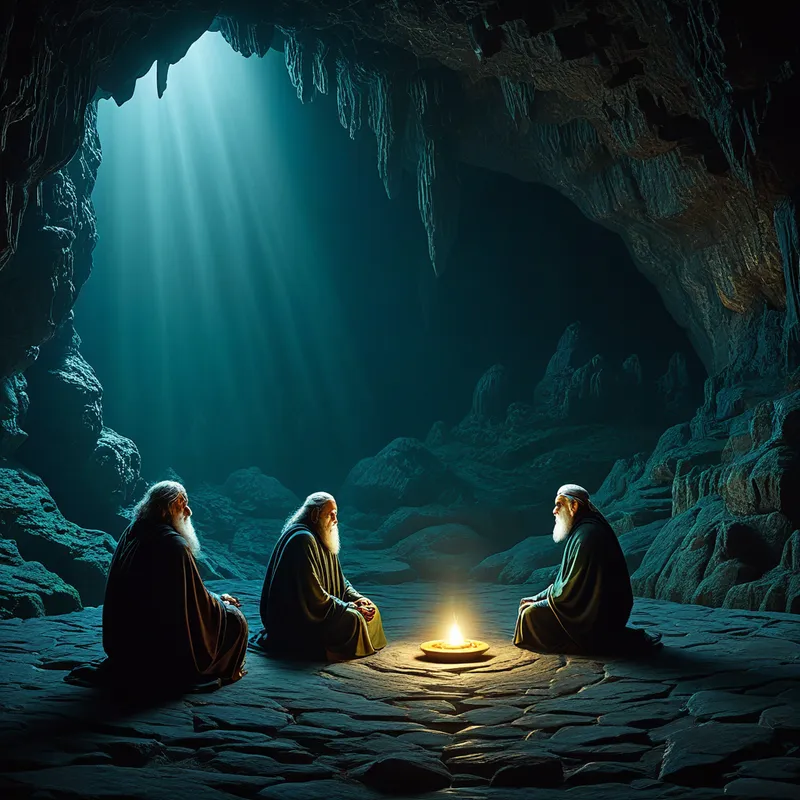
- Cave — The dark, primordial place where the gods' sorrow gathered, symbolizing the unconscious, the place of incubation, and the inner chamber where grief is held before transformation.
- Tears — The raw material of the rain, representing unprocessed grief, empathy, and the potent emotional substance that, when courageously expressed, becomes a source of life.
- Rebirth — The ultimate result of the mythic cycle, seen in the sprouting maize, symbolizing renewal, psychological healing, and the new life that emerges from a period of drought or despair.
- River — The organized, flowing result of the rain, symbolizing the direction of released emotions into sustainable pathways of life and creativity.
- Mountain — Often the dwelling place of storm gods, representing the lofty, isolated place of the gods' perspective and the meeting point between the sky (spirit) and the earth (matter).