
Cedar Canoe Myth Meaning & Symbolism
A myth of a great chief transformed into the first cedar canoe, embodying sacrifice, ancestral wisdom, and the vessel for life's journeys.
The Tale of Cedar Canoe
Listen. The world was younger then, and the great waters of the Salish Sea were a barrier, a vast and hungry mouth that kept the people apart. They lived in rich villages of cedar and stone, but their world was an archipelago of loneliness. They could see the smoke of distant fires, hear the echo of songs carried on the wind, but the treacherous currents and sudden storms made the deep waters a realm of fear. The people were land-bound, their spirits yearning for connection that the sea denied.
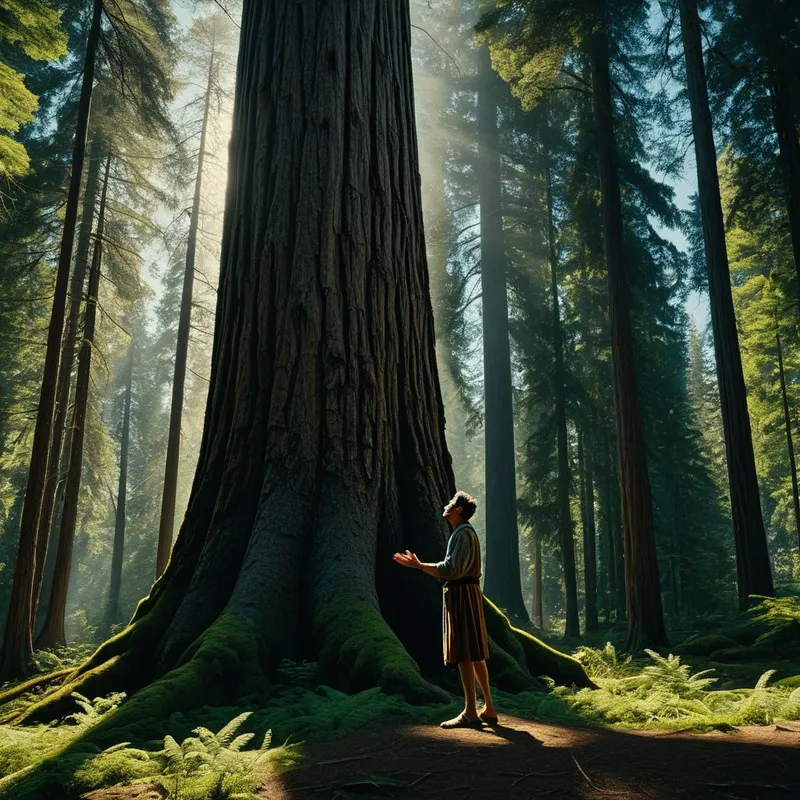
Among them was a great chief, a man whose name is remembered not in sound, but in the sigh of wind through cedar boughs. He was a leader not just of warriors, but of vision. He saw the sorrow of his people, the unfulfilled potential of their isolation. He walked into the deep green cathedral of the forest, where the cedar giants stood as pillars holding up the sky. He placed his hands upon the russet, fibrous bark of the eldest and grandest of them all, a tree that had witnessed generations come and go.
He did not ask for a gift. He offered one.
“My people are fragments of a great bowl,” he whispered to the tree, his voice blending with the forest hum. “We are meant to be whole. But the sea divides us. We need a way to cross her not as conquerors, but as guests, with respect and purpose.”
The forest held its breath. The great cedar, a being of immense patience and stillness, understood the depth of the chief’s heart. It was a heart that mirrored its own: strong, resilient, and deeply rooted in the well-being of the community. A communion passed between man and tree, a silent pact witnessed only by the chickadee and the shifting light.
The chief returned to his village and spoke his final decree. He instructed his people to follow him back to the great tree. There, before their disbelieving eyes, he embraced the trunk once more. This time, he did not let go. His flesh grew calm, his breathing slowed to the rhythm of centuries. His skin took on the texture of bark, his limbs stretched and hardened. His noble face, etched with concern and love, became fixed upon the wood. He was not consumed; he was translated. The great chief and the great cedar became one being, a sacred fusion of human spirit and arboreal body.
Then, with a sound like a deep, releasing sigh, the transformed tree began to change. It shaped itself, guided by the chief’s enduring will. The trunk hollowed with grace, the sides curved into sleek, strong lines. The roots became a prow, and the chief’s visage, now serene with eternal purpose, looked out from the bow. Where once stood a tree, now lay the first Cedar Canoe—a vessel born of ultimate sacrifice.
The people, through tears of grief and awe, understood. They launched the canoe upon the water. It did not fight the waves; it danced with them. It was stable where waters were rough, swift where currents were slack. It was more than a boat; it was a piece of their chief, a piece of the forest, carrying his protective spirit. With it, they bridged the waters. They reunited families, traded knowledge and art, shared songs and stories. The canoe became the lifeblood of the coast, a mobile hearth, a classroom, a diplomatic hall. The chief, in his new form, had not left his people. He had become the very means of their wholeness.
Cultural Origins & Context
This myth, in its many nuanced variations, belongs to the Coastal Salish and other Northwest Coast peoples. It was not a mere story for entertainment, but a cosmogonic narrative told by elders and knowledge-keepers, often during the winter ceremonial season when the natural world was in repose and the spiritual world felt closest. Its transmission was an act of cultural maintenance, passed down through oral tradition with precise, rhythmic language.
Societally, it functioned on multiple levels. Practically, it explained the origin of the central technology that defined Northwest Coast civilization. Spiritually, it encoded the profound relationship between people and the cedar tree, which was considered a relative and a generous being that provided homes, clothing, tools, and now, the means of connection. Ethically, it modeled the highest virtue of leadership: self-sacrifice for the enduring good of the community. The chief did not seek personal glory in an afterlife; he sought a functional, everlasting legacy woven into the daily life of his people.
Symbolic Architecture
The myth’s power lies in its layered symbolism. The Cedar Canoe is the ultimate symbol of the psychic vessel.
To become a vessel for others, one must first undergo the hollowing. The ego must be sacrificed to create space for community, purpose, and journey.
The chief represents the conscious ego that willingly submits to a greater pattern. His transformation is not a death, but a metamorphosis into a more enduring, functional form. The cedar tree symbolizes the ancestral, the timeless, the nourishing matrix of the unconscious and the natural world. Their fusion signifies the moment where personal will aligns with transpersonal purpose.
The hollowing of the trunk is critical. It represents the necessary emptying of selfish desires to create a temenos, a sacred container. This container is then capable of holding life—families, trade goods, songs, futures. The journey across the treacherous sea symbolizes the navigation of the unknown, the unconscious, or life’s great challenges. The canoe, born of sacrifice, provides the safe passage that raw courage alone could not.

The Dreamer's Resonance
When this myth stirs in the modern dreamer, it often surfaces during life transitions that demand a letting go of a familiar identity to serve a larger calling. To dream of transforming into wood, or of a tree becoming a vehicle, signals a profound somatic process of grounding into purpose.
You may feel stiff, resistant, or emotionally “woody” in waking life—a sign of the psyche’s initial resistance to this metamorphosis. Dreams of hollow logs, empty boats waiting to be filled, or of guiding others across dark water point directly to the Cedar Canoe archetype activating. The psychological process is one of moving from a state of “being the hero” to becoming the vehicle for healing. It is the shift from “what can I achieve?” to “what can I make possible for others?” The grief felt in the myth is real in the psyche; it is the mourning of a smaller, more self-contained self.

Alchemical Translation
For the modern individual navigating the path of individuation, the Cedar Canoe myth is a masterful map of psychic alchemy. The prima materia is the isolated self, burdened by its own boundaries. The chief’s crisis—seeing his people’s fragmentation—is the conscious recognition of this isolation, both personal and collective.
The alchemical operation is solutio and coagulatio—dissolution and re-formation. The chief dissolves his human form (the old identity) not into nothingness, but into the substance of the cedar (the enduring Self, the connection to nature and ancestry). This is followed by coagulatio, the re-forming into the canoe—a new, functional identity synthesized from the best of both human intention and natural wisdom.
The goal of this alchemy is not to create gold for oneself, but to forge a vessel that can carry the soul’s true community across the waters of time and tribulation.
The final stage is the journey itself—the rubedo or reddening, the lived experience. The transformed self is not for contemplation alone; it must be launched into the waters of life, relationship, and service. Its seaworthiness is tested, and its value is proven only in its capacity to connect, transport, and preserve. The individuated person, like the canoe, becomes a conduit. They carry culture (values), foster relationship (trade), and navigate the depths (the unconscious) with a stability granted by their integrated, hollowed-out core. They are no longer just a person standing on the shore; they have become the very means of passage.
Associated Symbols
Explore related symbols from the CaleaDream lexicon: