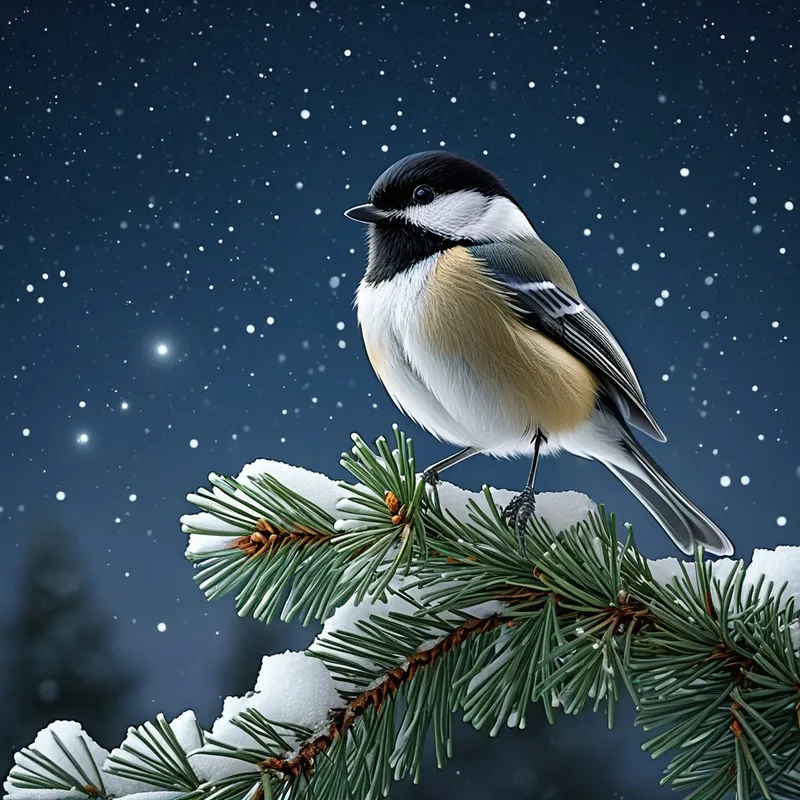
Chickadee Myth Meaning & Symbolism
A small, humble bird outwits a monstrous cannibal through cleverness and courage, teaching that true power lies not in size but in spirit.
The Tale of Chickadee
Listen. In the time when the world was younger and the snow lay deep and hungry upon the land, a great shadow fell over the people. It was the time of the Windigo, a creature born of famine and bitter cold, whose heart was a lump of ice and whose hunger was endless. It stalked the silent forests, its breath a blizzard, its steps cracking the frozen earth. Villages grew quiet with dread; fires burned low. The great hunters and warriors, for all their strength, could not stand before its ravenous frost.
In the deepest part of the winter, when hope itself seemed frozen, a council was called. The mighty Thunderbird beat its wings, but its storms only fed the Windigo’s blizzards. The cunning Nanabozho devised clever traps, but the monster’s cold wit was sharper. The brave bear offered its strength, but was thrown aside like a twig. Despair settled like a new fall of snow.
Then, from the very edge of the gathering, a small voice spoke. It was Chickadee. “I will go,” it said, its chick-a-dee-dee-dee call soft but clear. Laughter, bitter and short, came from some. What could this tiny speck of feathers and bone do against the devourer of worlds? But Chickadee simply fluffed its feathers against the cold and looked with its bright, black eyes. “I have watched. I have listened. My strength is not in my talons, but in my song.”
Without another word, Chickadee flew into the white void of the forest. It followed the trail of unnatural silence and deepening cold, until it found the Windigo in a desolate clearing. The monster towered, a skeletal giant of ice and matted hair, its eyes hollow pits of starvation. It saw the little bird and sneered, a gust of freezing wind. “A morsel,” it rumbled, the sound of glaciers grinding. “A single bite to whet my appetite.”
Chickadee did not flee. It hopped closer, onto a frost-encrusted branch directly before the terrible face. “Great One,” Chickadee chirped, its voice steady. “Before you eat me, surely you wish to know my name? For I am not just any bird.” The Windigo paused, its cruel curiosity piqued. “Speak it then, little fool.”
“My name,” said Chickadee, “is a secret and a power. But it is so long and mighty, I cannot say it all in one breath. I must break it into pieces. Lean closer, so you may hear the full measure of my power and know what it is you consume.”
Flattered and intrigued by the idea of consuming such a powerful name, the Windigo bent its horrific head down, its icy breath washing over the branch. Chickadee began. “Chick,” it said, and hopped one step along the branch. The Windigo’s head followed. “A,” it said, hopping another step. The head followed again. “Dee.” Hop. The monster’s neck was now stretched out, its head hovering just above the branch. With the final, triumphant notes, Chickadee hopped swiftly to the very end. “Dee! Dee!”
Enraged at the trick, the Windigo snapped its jaws shut with a sound like cracking stone—but on empty air. Chickadee had flitted nimbly aside. Again and again the monster bit, and again and again Chickadee dodged, leading the Windigo in a frantic, dizzying dance, its head whipping back and forth, until the great neck, frozen and brittle from its own unnatural cold, could take no more. With a terrible, final SNAP, the Windigo’s neck broke. The monstrous body shuddered and collapsed into a heap of melting ice and old bones.
The deep cold began to recede. A gentle wind from the south was heard for the first time in months. Chickadee, its tiny heart pounding, sang its true name to the freeing forest: Chick-a-dee-dee-dee. And the people knew that the long winter was over.
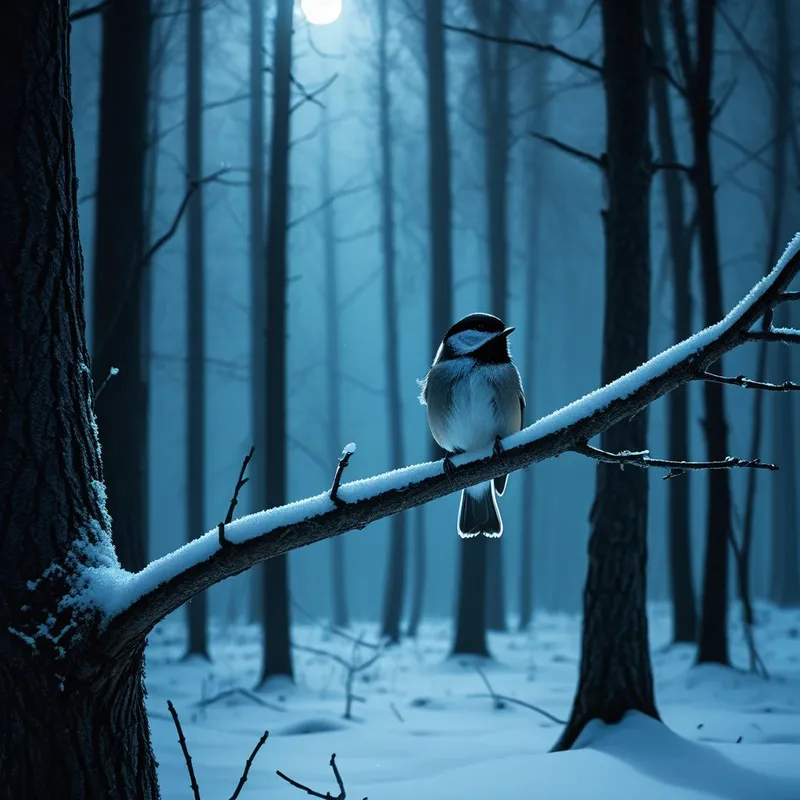
Cultural Origins & Context
This myth originates from the rich oral traditions of the Algonquian</ab-title="A large family of Indigenous peoples of North America, including the Ojibwe, Cree, Mi'kmaq, and others">Algonquian peoples, for whom storytelling was not mere entertainment but a vital vessel for cultural knowledge, ethical instruction, and ecological wisdom. Tales were told in the long winter months, a practice that reinforced community bonds and passed essential survival lessons through generations. The Chickadee story belongs to a cycle of Windigo narratives, which served as profound cautionary tales about the dangers of isolation, greed, and the loss of humanity—especially critical during the harsh winters when famine and desperation could turn a person toward anti-social, "cannibalistic" behaviors.
Chickadee itself is a familiar, year-round resident of the northern forests, a being observed closely. Its survival through the bitterest cold, its cheerful call, and its curious, fearless nature made it a natural candidate for a culture hero. Elders would tell this story to children not just to thrill them, but to instill a specific kind of courage: the courage of the small, the clever, and the persistent. It validated qualities that were as essential for survival as physical strength—keen observation, adaptability, and the strategic use of one’s unique gifts.
Symbolic Architecture
At its heart, this myth is a masterclass in the archetypal victory of the small over the large, the warm over the cold, the connected over the isolated. The Windigo is the ultimate symbol of psychic freezing—a consciousness consumed by its own insatiable, frozen hunger. It represents the unchecked shadow, the aspect of the psyche that grows in isolation, feeding on its own negativity until it becomes a self-perpetuating monster of lack. Its strength is brute, linear, and ultimately brittle.
Chickadee represents the indomitable spark of conscious awareness, the "observing ego" that is small but cannot be extinguished.
Chickadee, in stark contrast, embodies the principle of relationship. Its power is not autonomous force, but interactive intelligence. It does not confront the monster’s hunger with a rival hunger, but with curiosity and dialogue (“What is my name?”). It uses the monster’s own attributes—its arrogance, its linear thinking, its brittle rigidity—as the weapons against it. The “name” Chickadee offers is not a falsehood, but the truth of its own being, broken into a pattern, a rhythm, a song. The victory is achieved through leading the monolithic shadow into a dance of such repetitive, frantic oscillation that it breaks under the strain of its own inflexible nature.

The Dreamer's Resonance
When the pattern of the Chickadee myth arises in modern dreams, it signals a confrontation with a monolithic, "frozen" complex in the psyche. The dreamer may face a towering figure of cold authority, an icy landscape of stagnation, or a devouring sense of anxiety or depression that seems insurmountable. This is the personal Windigo—the complex that consumes all psychic energy and leaves only cold despair.
The appearance of a small, persistent, often overlooked element in the dream—a tiny animal, a faint sound, a small, resilient plant in a crack of ice—is the Chickadee signal. It is the psyche’s instinct pointing toward the solution. The dream is instructing the dreamer not to muster an opposing force of equal magnitude (which often only empowers the complex), but to engage it differently. The task is to name it in parts, to break the overwhelming, monolithic fear into its constituent elements through observation and curiosity. It is a call to use one’s unique, perhaps undervalued, voice and perspective to lead the complex into a pattern where its own rigidity becomes its downfall. The somatic feeling is often a shift from a frozen, clenched dread to a fluttering, focused alertness.

Alchemical Translation
The alchemical process modeled here is the solve et coagula—dissolve and coagulate—applied to the psychic shadow. The Windigo complex is a coagulated mass of frozen trauma, habit, and negative self-belief. Chickadee’s strategy is the solve: it does not attack the mass directly, but engages it, leading it through a rhythmic, almost ritualized interaction (the naming dance) that introduces oscillation, movement, and ultimately, dissolution.
For the modern individual on the path of individuation, this myth teaches that integration of the shadow does not always require heroic battle. Sometimes, it requires the sage’s cunning.
The transformation occurs not by destroying the monster, but by exhausting its singular, rigid pattern of being until it collapses into its component parts, which can then be warmed by consciousness and reclaimed.
Our personal "Windigos"—addictions, chronic fears, patterns of self-sabotage—are often sustained by our attempts to fight them head-on with willpower, which is just another form of rigid, opposing force. The Chickadee method invites us to step sideways. To observe the pattern without immediate judgment. To name its moves: “This is the part where I feel small.” “This is the part where I believe I am not enough.” “This is the part where I freeze.” By breaking the monolithic terror into these smaller, observable pieces and engaging with them curiously, we lead the complex in a dance. We force it to move in ways it is not designed for, until its own unsustainable logic fractures. What remains is not a vanquished enemy, but raw material—the melted ice—ready to be warmed by the spring of a broader consciousness and integrated into the flowing water of the Self. The final song, Chick-a-dee-dee-dee, is the sound of a psyche that has remembered its own true, unbroken name.
Associated Symbols
Explore related symbols from the CaleaDream lexicon: