Cave Paintings Myth Meaning & Symbolism
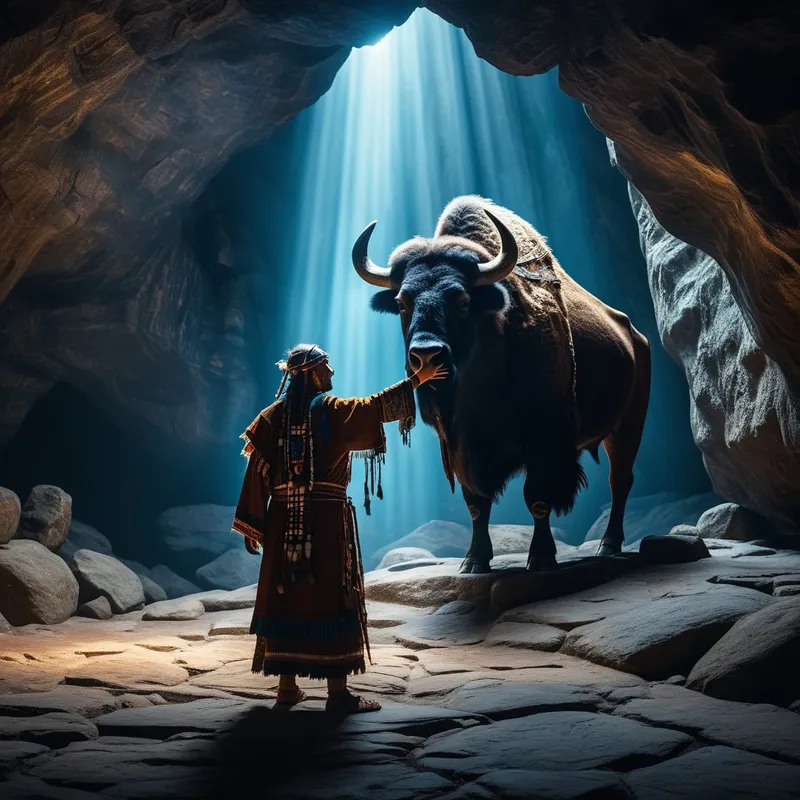
A shaman journeys into the World Below to capture the spirit-essence of the animal, bringing its living image back to the wall of the people.
The Tale of the Cave Paintings
Listen. The world above was hungry. The wind was a knife, the ground was iron, and the bellies of the people were hollow drums. The great herds, the life-blood of the world, had grown thin, their spirits hiding from the sight of hunters. The people gathered in the firelight, their shadows trembling on the rock. They turned their eyes to the one who walks between worlds: the Shaman.
Wrapped in the hide of the first ancestor-beast, face painted with the dust of stars and blood, the Shaman took up the drum, the heartbeat of the earth. The rhythm began, slow and deep, a pulse pulling the soul from the body. The world of sun and tree fell away. Down the Shaman went, not with feet, but with spirit, into the World Below.
It was a place of eternal dark and echoing silence, a labyrinth of stone veins. Here, the animals were not flesh. They were pure spirit—shimmering outlines of bison and aurochs, mammoth and horse, moving like smoke in the deep stillness. They were the eternal templates, the Animal Masters. To hunt in the world above, one must first meet them here.
The Shaman’s spirit called out, a silent song of need and respect. From the darkness, the Master of the Bison emerged. It was a mountain of shadow and power, its eyes like cold embers. A negotiation began, a exchange woven from memory and promise. The Shaman offered songs of honor, dances of gratitude, the sacred breath of the people. The Master demanded remembrance. Not just the taking of flesh, but the capturing of essence.
Then came the peril. To bring the spirit back, the Shaman had to contain a piece of it—not in a bag of hide, but in the mind’s eye. To hold the living image, the coil of its muscle, the curve of its horn, the thunder of its spirit, without being dissolved by its raw, wild power. It was a battle of containment, a fierce, silent straining in the dark.
Victory was not conquest, but a pact sealed. The Shaman turned, the captured image burning like a coal within. The journey back was a fierce ascent, following the thinning thread of the drum’s echo. Breaking back into the world of firelight was a gasp, a rebirth. The body was cold, trembling. Without a word, the Shaman stumbled to the wall of the cave, the living rock womb. Taking powdered ochre, charcoal, and earth, mixed with the spit of life and the fat of the hunted, the hand moved.
It was not drawing. It was releasing. The hand flew, tracing the contour burned on the soul. And there, from the stone, the bison bled into being. It was not a picture of a bison. It was the bison itself—its spirit, its promise, its allowed presence. The people watched, breath held, as the animal emerged from the deep earth onto the wall. The hunt could now begin. The world was restored.
Cultural Origins & Context
This is not a single myth with a fixed text, but the living, inferred narrative embedded in the ritual practice of Upper Paleolithic hunter-gatherers across Europe and beyond, from Lascaux to Chauvet. The “tale” was not told in words around a fire, but performed in the deepest chambers of the earth. The Shaman was the narrator, the cave was the theater, and the act of painting was the climax of the story.
The mythic function was utterly pragmatic and profoundly sacred. It served as the psychic and spiritual technology for survival. By journeying to the source of life in the World Below and negotiating with the Animal Masters, the shaman performed essential ecosystem management—not of populations, but of spiritual relationships. The painting on the wall was the contract made visible, a permanent portal that allowed the spirit of the species to be accessed, honored, and, crucially, persuaded to offer its physical counterparts to the hunters. The cave itself was a liminal boundary, a sacred interface between the mundane world and the numinous underworld.
Symbolic Architecture
At its core, this myth encodes the fundamental human recognition of a rift between the visible world and the invisible source of its vitality. The animal on the plain is a transient manifestation; its true home is in the eternal, archetypal realm.
The cave is the cranium of the world, and the painting is the thought formed in the dark of the unconscious, brought to the light of consciousness.
The Shamanic Descent represents the ego’s voluntary dissolution to commune with the deeper, instinctual layers of the psyche—the collective unconscious. The Animal Masters are the archetypes of instinct themselves: raw, powerful, and autonomous. They are the psychic blueprints of our own animal nature, our vitality, strength, and survival drives. The peril of the journey is the risk of being overwhelmed by these forces, of psychosis or permanent identification with the archetype.
The act of painting is the supreme symbol of creative incarnation. It is the process of giving intangible spirit a tangible form. It represents the human capacity to take an inner vision, a dream, an impulse from the deep unconscious, and translate it into something that exists in the shared, outer world. The paint, made of sacred earth, is the mediating substance—the prima materia—that allows spirit to marry matter.
The Dreamer's Resonance
When this mythic pattern stirs in the modern dreamer, it often manifests as dreams of descending into basements, caves, or subway tunnels, or of discovering hidden, painted rooms in one’s own house. The somatic experience is one of pressure, constriction, then awe.
To dream of finding ancient paintings on a wall signifies a profound encounter with content from the personal or collective unconscious that is seeking recognition and integration. The specific animal image is crucial: a bull may point to untamed masculine potency or rage; a horse to vital energy or the instinctual body; a handprint to the need to leave one’s mark, to assert “I was here.”
The psychological process is one of retrieval. The dream-ego is playing the shaman’s role, going down into the forgotten or repressed parts of the self to recover a lost or disowned “spirit”—a vital instinct, a creative impulse, a piece of one’s innate power that has been left in the dark. The struggle in the dream mirrors the shaman’s peril: can you face this powerful, often frightening, inner content without being swallowed by it? Can you bring it back?
Alchemical Translation
The alchemy of this myth models the entire process of individuation. The initial state is one of psychic hunger and disconnection (the starving tribe). The nigredo, or descent into darkness, is the shaman’s journey into the World Below—the confrontation with the shadow and the chaotic prima materia of the unconscious.
The negotiation with the Animal Master is the crucial stage of relating to the archetype, not being possessed by it. One does not conquer the unconscious; one forms a conscious relationship with it.
The captured image is the idea, the symbol that emerges from the chaos. This is the albedo, the whitening, the beginning of illumination. Finally, the painting on the wall is the rubedo, the reddening. It is the embodied result, the creation that exists in reality. The psychic energy that was latent, dangerous, and unconscious (the wild Animal Master) has been transmuted into a conscious, life-sustaining form (the sacred image that feeds the community).
For the modern individual, the “cave” is one’s own interiority. The “descent” is any deep introspective practice—therapy, meditation, active imagination, or creative incubation. The “Animal Master” is any powerful, autonomous complex or talent that feels bigger than you. The “painting” is the act of giving that inner force a form in your life: writing the book, starting the venture, forging the relationship, or simply consciously integrating that energy into your personality. You journey into the dark to bring back not a carcass, but a living image—a new, vital pattern for your life, etched in the stone of your being.
Associated Symbols
Explore related symbols from the CaleaDream lexicon: