
Cattail as Provider Myth Meaning & Symbolism
A myth of a primordial being who, through profound sacrifice, transforms into the cattail plant, offering sustenance, shelter, and medicine for all time.
The Tale of Cattail as Provider
In the time before memory, when the world was still soft from its making, the People walked a land of both bounty and hunger. The seasons turned, and in the turning, there came a lean time. The game grew scarce and cunning, the berries failed to swell, and the cold breath of the coming winter whispered through the bare trees. The People’s bellies were hollow drums, and their children’s cries were thin as reed whistles.
They sent their prayers on the smoke of sacred fires, and the prayers rose to the ear of Keeper-of-Giving. This being was not a god of thunder or sun, but a spirit of the damp earth, of the quiet places where water meets land. Moved by the People’s plight, Keeper-of-Giving walked from the spirit world into the world of flesh. It appeared not as a warrior or a hunter, but as a tall, gentle figure whose skin held the hue of rich soil and whose eyes were the deep brown of still pools.
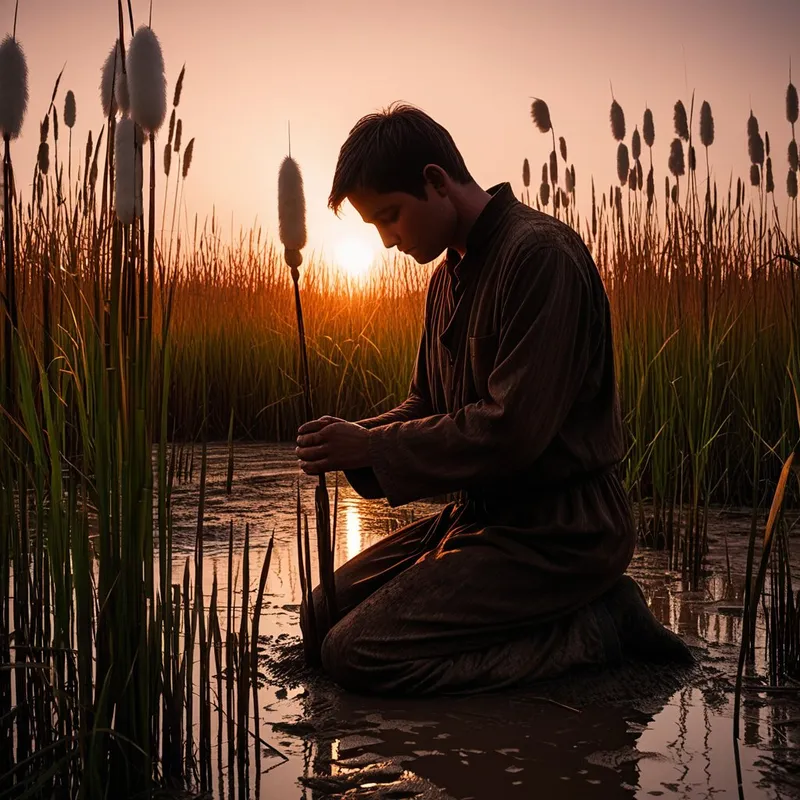
Keeper-of-Giving came to the edge of a great marsh, where the water lay in silver sheets under a gray sky. The People gathered, their hope a fragile thread. The spirit did not speak of great battles or stolen fire. Instead, it knelt in the soft, black mud and placed its hands upon the earth. “You have asked for a provider,” its voice was the rustle of a thousand reeds. “A provider must be of this place, must give not once, but for all the turns of the world.”
Then began the great transformation. The spirit’s feet sank deep, becoming strong, fibrous roots that drank from the dark water. Its body stretched upward, becoming a tall, straight stalk, sturdy as a spear. Its arms reached out, and from its hands burst forth the dense, brown cylinder of the cattail head, velvety and full. From its core, where its heart had been, grew the tender, white shoot at the stalk’s base. The spirit’s essence did not vanish; it poured itself into this new form.
The People watched in awe as the marsh, once a place of mist and mystery, now stood adorned with countless new plants—the cattails. Keeper-of-Giving was gone, yet everywhere present. The spirit’s final whisper carried on the wind: “Take. I am here.” They learned. They peeled the young shoots, crisp and sweet as cucumber. They gathered the golden pollen from the stalks. They found the starchy rhizomes, hidden treasures in the mud. The fluffy down from the mature heads could stuff cradleboards for warmth; the leaves could be woven into mats and baskets. Medicine for wounds was found in its roots. Every part offered itself. The hunger retreated, not with a roar, but with the quiet, enduring presence of the cattail, standing sentinel in the marsh, a testament to a sacrifice that became sustenance.
Cultural Origins & Context
The myth of the Cattail as Provider is not the property of a single nation, but a story whispered across many tongues—among Anishinaabe, Haudenosaunee, and various Plains and wetland tribes. It is a teaching story, a narrative of ecological kinship. Passed down by elders and storytellers, often during the practical work of harvesting or weaving, the myth was never mere entertainment. It served a vital societal function: it encoded survival information within a sacred framework.
To call the plant “cattail” was to speak only half its name. To know its story was to know it as “the gift of the provider culture.") spirit.” This transformed the act of harvesting from one of taking to one of receiving a sacred offering. The myth taught respect, reciprocity, and the profound truth that the line between the spiritual and the practical is a fiction. The story ensured that children learning to gather would understand why they gave thanks, fostering a worldview where the natural world is not a warehouse, but a community of conscious, giving relations.
Symbolic Architecture
At its core, this myth dismantles the archetype of the hero who conquers and returns. Here, the ultimate act of provision is not conquest, but dissolution and reconstitution. The provider-hero achieves its purpose not by doing, but by becoming.
The most profound giving is not an act, but a state of being. It is to make one’s very substance into shelter, one’s essence into food.
The Keeper-of-Giving symbolizes the principle of self-sacrificial generativity. Psychologically, it represents the part of the psyche that understands true nurture requires a relinquishment of a separate, bounded self to become part of a larger, life-sustaining system. The cattail plant itself is a perfect symbol of this: every part has a purpose (root, shoot, stalk, head, fluff), representing a psyche that has integrated all its components into a functional, offering whole. The marsh—a liminal space between water (emotion, the unconscious) and land (matter, consciousness)—is the crucible where this alchemy occurs. The transformation happens not on a mountain peak, but in the humble, fertile mud, teaching that provision emerges from engagement with the messy, foundational layers of existence.
The Dreamer's Resonance
When this myth stirs in the modern dreamer, it often surfaces during periods of felt depletion or when one is called to a role of caregiving that threatens to consume their identity. To dream of wandering a vast wetland, hungry, and coming upon a stand of glowing cattails that offer nourishment is to touch this archetype.
Somatically, this can correlate with a deep, gut-level yearning—not just for food, but for substantive support, for something that feeds the soul as well as the body. The dream may present the self as both the hungry seeker and the transforming plant, indicating an internal process where one part of the psyche is learning to nourish another. The act of peeling the shoot or gathering the fluff in a dream is a powerful symbol of accepting help, of learning to receive from the depths of one’s own being or environment. It signals a movement away from a psychology of scarcity and competition, toward an inner economy of generosity, where the dreamer is discovering untapped, sustainable resources within their own emotional and psychic marshlands.

Alchemical Translation
For the individual on the path of individuation, the myth of the Cattail as Provider models a critical stage of psychic transmutation: the shift from egoic striving to ecological serving. The initial “hunger” represents the ego’s insatiable wants—for validation, security, status. The prayer is the ego’s admission of its own insufficiency.
The alchemical work begins with the descent into the “marsh”—the conscious engagement with the unconscious, emotional, and instinctual self (the mud and water). Here, the prized, separate identity (the spirit-being) must submit to dissolution. This is the sacrifice: the letting go of “who I am” to discover “what I am for.”
Individuation is not about becoming a more polished version of the self you know, but about becoming a nutrient for the life you are meant to support.
The transformation into the cattail is the transmutation. The ego’s energy is not destroyed; it is repurposed, its fibers rewoven into a structure that exists for a purpose beyond itself. The root (connection to the ancestral/unconscious), the stalk (integrity and strength), the shoot (vulnerable, nourishing core), and the head (fertile, disseminating mind)—all are integrated. The individual becomes a “provider” in their own world, not through heroic effort alone, but by embodying a function. Their creativity, their care, their very presence becomes a sustainable resource—a shelter, a sustenance, a medicine for their community and their own soul. They stand firm in life’s liminal spaces, having learned that true power lies not in holding one’s shape, but in willingly becoming a gift.
Associated Symbols
Explore related symbols from the CaleaDream lexicon: