
The Dream of Sustainability: The Psyche’s Blueprint for Wholeness
The Somatic Echo
It begins not as a thought, but as a texture in the bones. A low-grade hum of depletion, a subtle tremor in the foundation of the self. It feels like running an engine on fumes while ignoring the warning lights—a psychic austerity that tightens the jaw and hollows the breath. Conversely, its positive echo is a deep, cellular sigh of relief: the feeling of a reservoir finally refilling after a long drought, a sense of structural integrity so profound it becomes a quiet, humming joy in the background of your being. This is the body’s knowing of sustainability or its lack—the visceral truth of whether your inner systems are in a state of graceful reciprocity or desperate extraction.
The Dreamer's Log
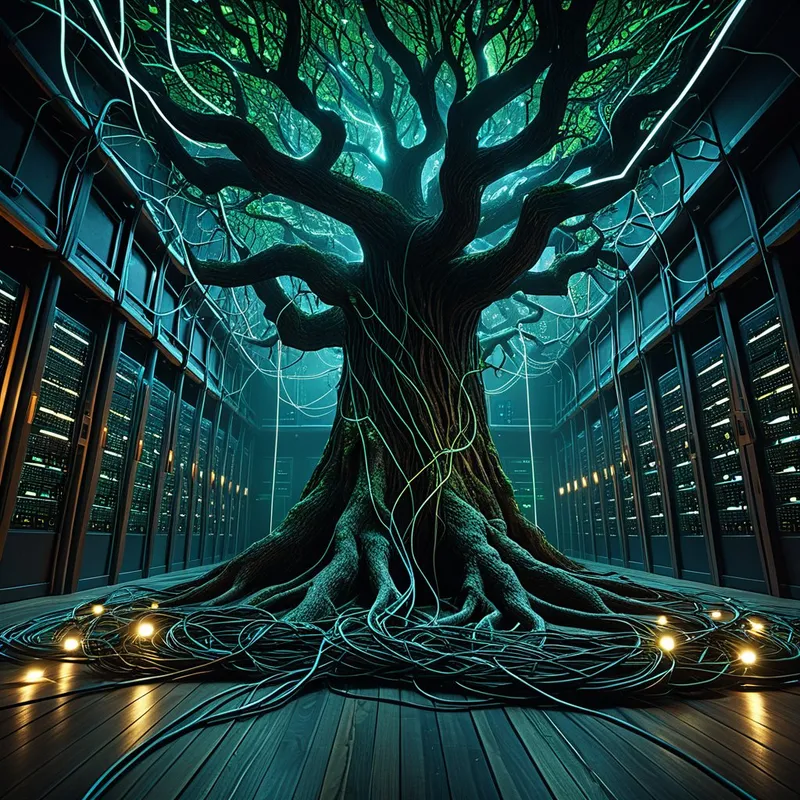
The dreamer stands in a cavernous, forgotten server room, the air thick with the static of dormant data. In the center of the floor, an ancient oak tree has shattered the concrete. Its roots are tangled with severed fiber-optic cables, and its leaves, made of flickering light, are slowly wilting, their glow dimming with each fallen leaf that hits the cold floor.
This is the psyche’s stark report: a vital, living system is being forced to power an outdated and disconnected structure, draining its essence to maintain a ghost of order.
The False Lead
A sustainability dream is not merely a nightmare about running out of time, money, or energy. It is not simple anxiety about a busy week. To mistake it for such is to hear the alarm and blame the battery. The true theme speaks to the architecture of your resources, not their temporary quantity. It asks not “Do I have enough?” but “What is the cost of how I get what I need?” and “What inner landscape am I cultivating to generate it?” It points to the foundational agreements between your various inner parts—the relentless achiever, the neglected artist, the vigilant protector—and reveals whether those agreements are symbiotic or parasitic.
Psychological Architecture
Here, Shadow work is an audit of the interior economy. Individuation in this realm is the move from a colonial psyche—where one part plunders another for fuel—to a sovereign ecosystem. You may discover the Inner Martyr, secretly proud of its exhaustion, mining the wells of your compassion until they run dry. You might meet the Shadow Ruler, enforcing brutal efficiency, demanding endless output from the fertile but fallow fields of your creativity. The process is one of recognizing these extractive relationships within. It is the difficult, compassionate work of sitting with the exhausted child-part, the overburdened caregiver, and asking: “What do you need to generate vitality, not just expend it?” It is redesigning the internal governance from a dictatorship of demand to a council of reciprocal care.
Mythic Resonance
This theme echoes in the myth of the Fisher King and his wounded land. The king’s unhealed wound—a grief held in shadow—manifests as a literal wasteland; his kingdom cannot thrive because its sovereign is in a state of unsustainable decay. The land and the ruler are one system. Healing is not a quick fix but a profound questioning—the Grail question, “Whom does the Grail serve?”—that restores the flow between the king and his realm. Similarly, the alchemical legend of the Philosopher’s Stone is not about creating gold from lead, but about discovering the prima materia, the fundamental, self-renewing substance within, that can sustain the transformative fire without being consumed by it.
Symbolic Nodes
- Failing or Overgrown Systems: Broken irrigation channels, clogged filters, overgrown gardens, collapsing bridges, leaking roofs.
- Resources in Flux: Drying wells, polluted springs, barren fields; or conversely, artesian wells, perennial gardens, compost turning rich and black.
- Hybrid Life/Technology: A tree powered by wires, a heart with clockwork valves, a book whose pages grow like leaves.
- Containers & Foundations: Cracked vases, reinforced roots, deep cellars, geodesic domes, beehives.
- Cyclical Processes: The moon phases, composting, seasons changing within a single room, a snake shedding its skin in a loop.
Archetypal Resonance
The energy at the core of the sustainability dream is that of The Ruler Archetype. Not the Shadow Ruler who hoards control, but the Sovereign in its mature form: the steward, the good gardener, the wise governor. This archetype’s essence is the right ordering of one’s kingdom. Its somatic echo is the feeling of upright, supported sovereignty—a spine aligned with purpose. Its alchemical potential lies in its capacity to move from control over resources (a brittle, fear-based stance) to responsibility for an entire ecosystem (a resilient, generative stance). The dream calls forth the Ruler to abdicate the throne of micromanagement and instead establish a governance of wise laws, fair trade, and long-term vision for the inner realm.
The Alchemical Process
The transmutation here is from extraction to generation. The prima materia is the raw experience of depletion—the grief of the empty well, the terror of the failing structure. The alchemical fire is the conscious, sustained heat of self-auditing. This is the intense pressure of asking, “What part of me am I starving to feed another?” and “What outdated contract am I still honoring?”
You must hold the tension between the desperate urge to find a quick, external fix (more caffeine, more distraction, more people-pleasing) and the slow, internal work of redesigning the system. In this crucible, the brittle, isolating structure of “self-sufficiency” dissolves. In its place, a more resilient, interconnected lattice forms—an understanding of sovereignty as the capacity to be in wise, reciprocal exchange with all parts of yourself and the world. The leaden fear of running out becomes the golden knowledge of being part of a generative cycle.
The Integration Protocol
Question 1: Where in my life does my energy feel like a non-renewable resource being mined, and where does it feel like a perennial spring, replenishing as it flows?
Question 2: Which inner “part” of me operates on a scarcity model, and what is it truly afraid will happen if it rests or receives?
Question 3: If my current way of being were a system—a city, an engine, a garden—what one law or principle would ensure its health for the next hundred years?
Action 1 (The Internal Audit): For one day, track not just your time, but your energy allocations. Note not just what you do, but the psychic cost or yield of each activity. Do not judge, simply record as an anthropologist of your own economy.
Action 2 (The Creative Pact): Using any medium—clay, paint, words, sound—create a simple representation of an inner resource (e.g., your focus, your compassion, your creativity). Then, create a second piece that represents what nourishes and replenishes that resource. Place them together as a sacred pact.
Action 3 (The Ritual of Reciprocity): Perform a small, tangible act of care for a system outside yourself—planting a native plant, cleaning a stretch of land, deeply repairing a beloved object. As you do, hold the intention that this external act of sustainable care mirrors and reinforces the internal restructuring your psyche is undertaking.
Final Validation
To dream of sustainability is to feel the profound weariness of an unsustainable life. It is a difficult, often painful clarity. Honor that fatigue; it is the intelligence of your soul refusing to participate in its own depletion any longer. This dream is not a verdict of failure, but a blueprint—delivered in the silent language of symbols—for how to build a self that can endure, not just survive. It is the psyche’s ultimate act of love: showing you the cracks so you can become the architect of your own unshakable foundation.