Cash Coins Myth Meaning & Symbolism
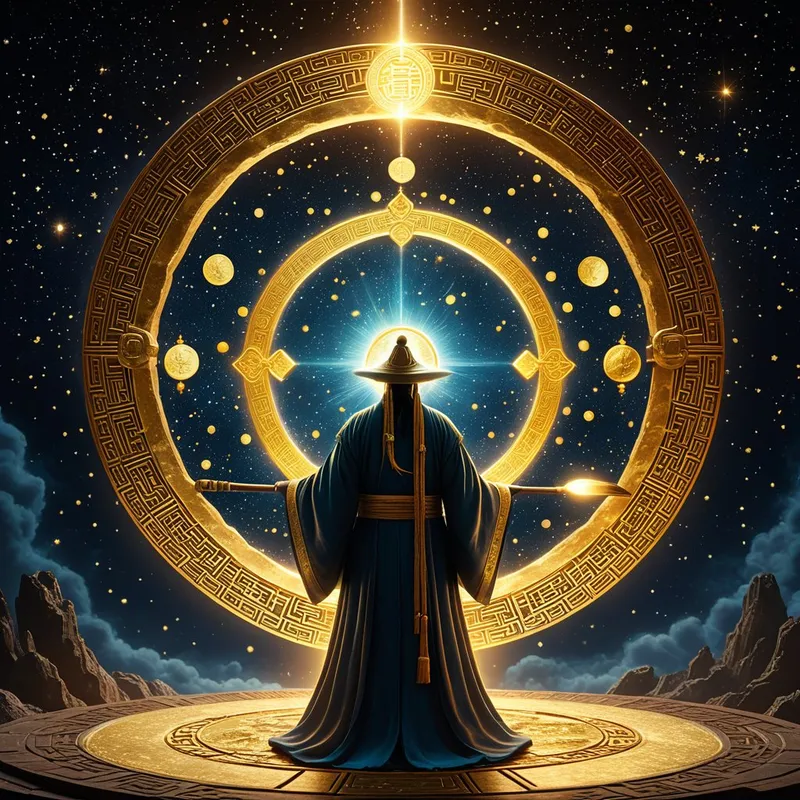
A celestial alchemist forges cosmic currency from his own essence, binding heaven and earth in a cycle of debt, value, and ultimate redemption.
The Tale of Cash Coins
In the time before time, when the Hundun had just begun to settle, the realms were separate. The heavens, a realm of pure principle and celestial breath, the Qi, flowed in splendid isolation. The earth, rich and fecund, groaned with potential but was mute, unable to speak the language of value. And between them stretched a yawning chasm of misunderstanding—a silence where commerce of spirit and matter could not occur. There was no medium, no measure, no agreed-upon dream to facilitate exchange. The cosmos was rich, yet bankrupt.
Into this silence stepped Kui Xing, though in this older tale he bore a different aspect: the Celestial Alchemist. He was not a god of bureaucracy but a principle of transformation itself, a being whose body was a crucible. He saw the stagnant potential. He heard the earth’s silent plea for connection and the heavens’ abstracted indifference. A great work was needed—a substance that could hold intention, that could be both concrete and symbolic, that could circulate like blood between the body of earth and the mind of heaven.
His forge was not of fire and bellows, but of will and essence. In a grove at the axis of the world, where the Jianmu touched the lowest stars, he began his sacrifice. He did not gather ore from the ground; that would be of the earth alone. Instead, he reached into his own celestial core. From his ribs, he drew strands of silver moonlight. From his breath, he condensed droplets of solar gold. From the pulse at his wrist, he spun threads of his own vital Qi. These he placed in the crucible of his cupped hands, which glowed with an inner fire.
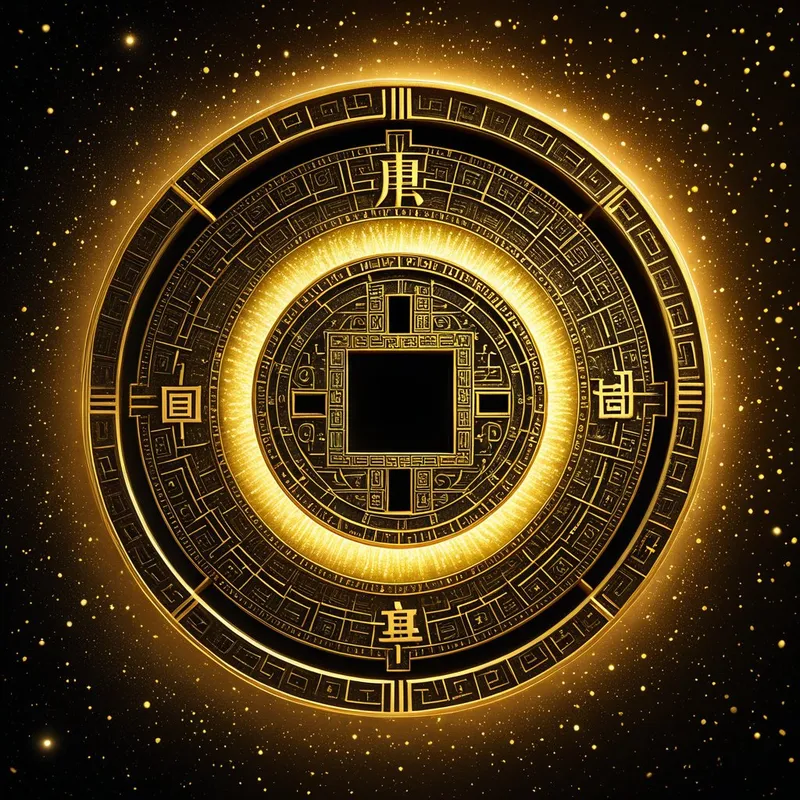
The first casting was a failure—a shapeless nugget, all weight and no meaning. The second was too ethereal, a shimmer that dissolved like mist. The Alchemist knew the formula required a perfect marriage of opposites. Shape was needed. With a final, profound exertion, he imprinted the metal with the pattern of the cosmos itself: round heaven, square earth. He hammered the molten alloy into a perfect disk, and with a finger burning like a star, he pierced a precise square hole at its center. The first cash coin fell into his palm. It was cool, heavy, and hummed with a low, resonant frequency.
But one coin was a token, not a system. To create circulation, he had to create debt—a sacred obligation. He cast coin after coin, each drawing more from his essence. His luminous form dimmed; his steps grew heavy with the weight of the earth he now bound himself to. With the final coin struck, he was no longer purely celestial. He had become the bridge, the principle of exchange itself. He cast the coins into the chasm between the realms. Where they fell, pathways opened. Heavenly virtue could now be "purchased" through earthly action—ritual, filial piety, good governance. Earthly harvest could be "offered" to appease celestial will. The cosmos began to trade, to breathe, to find a dynamic balance. The Alchemist, his great work done, faded into the very system he created, becoming the invisible hand in every transaction, the silent witness to every debt incurred and every value assigned.
Cultural Origins & Context
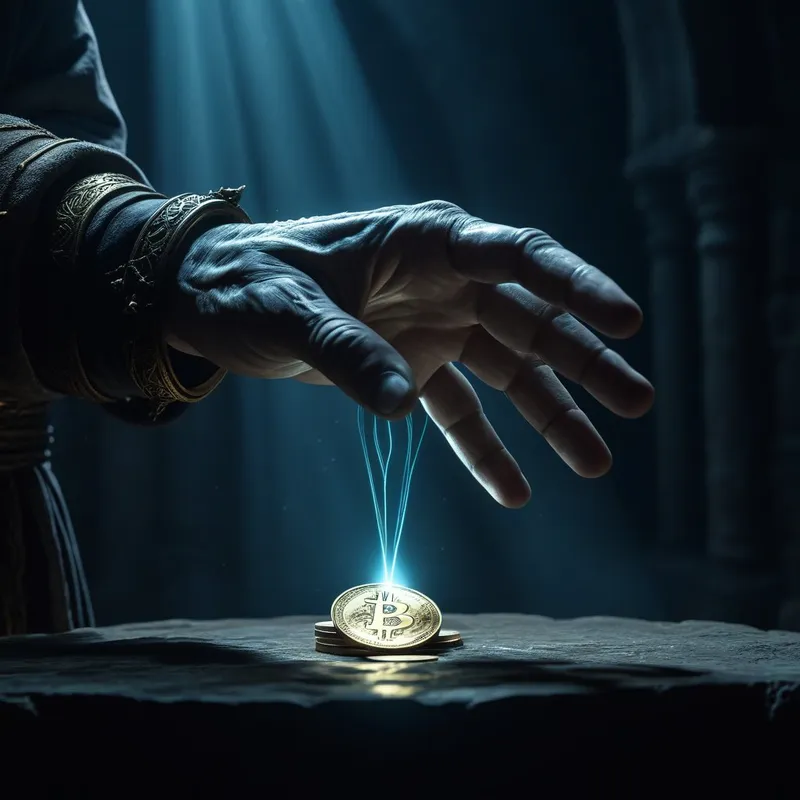
This myth, in its myriad localized forms, is not a single canonical story from a text like the Shan Hai Jing, but a deep, underlying narrative logic excavated from the practice and philosophy surrounding money in traditional China. It is a "myth of function" rather than a myth of personage. It was passed down not by bards, but by merchants counting strings of cash, by farmers paying taxes in grain calculated in coin, and by philosophers pondering the nature of value in texts like the I Ching.
Its societal function was profound: to sanctify the marketplace and moralize the economy. Money was not seen as a profane invention but as a cosmological template. The round shape representing heaven’s perfection and cyclic time, and the square hole representing earth’s stability and the four directions, made every coin a microcosm. This myth explained why money had power—it was literally a piece of a sacrificed god, a fragment of cosmic order. It taught that all wealth carried a spiritual cost (the Alchemist’s sacrifice) and a social obligation (the debt that enables circulation). It was a narrative bulwark against pure greed, embedding the idea that wealth disconnected from its sacred, circulatory purpose was a corruption of the cosmic blueprint.
Symbolic Architecture
At its heart, the myth presents money not as a tool, but as a psychic substance. The cash coin is a mandala of wholeness—the integration of the round (the unconscious, the spiritual, the infinite) with the square (the conscious, the material, the finite). It is the solidified moment where spirit takes a form that matter can recognize and vice versa.
The square hole in the round coin is the irreducible mystery: the void that gives the object its purpose, the debt that makes the asset valuable, the question that animates the answer.
The Celestial Alchemist is the archetype of the Creator who must imbue his creation with his own life. His act is the ultimate alchemy: the transmutation of self into system. Psychologically, he represents the part of the psyche that must sacrifice naive, undifferentiated wholeness (celestial purity) to create a functioning ego-structure that can operate in the world (the economic system). The "dimming" of his light is the necessary inflation of consciousness into the complex, often shadowy, realm of value, negotiation, and relationship—the realm where things are worth something.
The Dreamer's Resonance
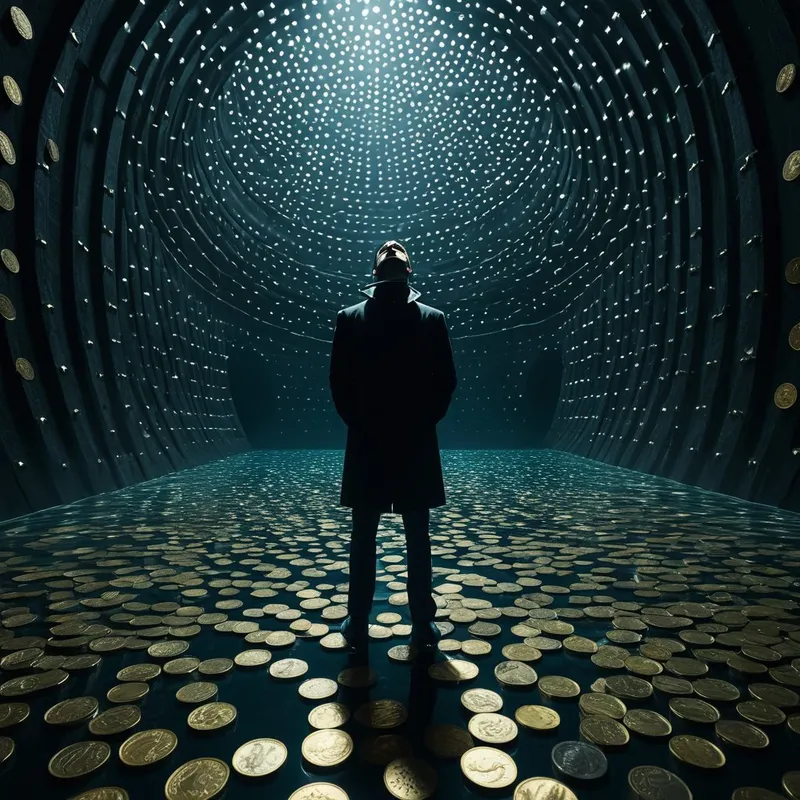
When this myth stirs in the modern unconscious, it often surfaces in dreams of profound valuation and existential debt. To dream of finding endless cash coins may not signal literal greed, but a psyche seeking to quantify an unnamable inner wealth. Conversely, dreams of losing coins, or of coins melting through one’s fingers, speak to a terror of devaluation—a fear that one’s essential "currency" (time, love, talent, vitality) is leaking away without meaningful exchange.
More potently, dreams featuring the act from the myth—pulling coins from one’s own chest, or coins stamped with one’s own face—signal a critical phase of psychic alchemy. The dreamer is engaged in the process of "self-coinage." They are asking: What is my essential substance? What part of my soul am I willing to put into circulation to create connection and value in my world? The somatic feeling is often one of hollow exhaustion or radiant depletion, mirroring the Alchemist’s sacrifice. It is the body sensing the cost of making one’s inner reality tangible.
Alchemical Translation
The individuation journey modeled here is not one of slaying dragons, but of minting currency. It is the process by which the modern individual must consciously undertake the Alchemist’s task: to forge a personal "currency" from the raw ore of their experience and essence.
The first stage is the recognition of the Hundun—the inner chaos of unlived potential and unvalued traits. The second is the painful, sacrificial act of the crucible: determining what is truly "gold" in oneself (one’s solar consciousness, talents) and what is "silver" (one’s lunar intuition, emotions), and willingly submitting them to the fire of life’s pressures to be alloyed into a stronger, more useful substance. The third stage is imprinting this substance with the cosmic pattern: shaping one’s offering to the world (one’s work, relationships, art) in a way that honors both one’s inner truth (the round) and outer reality (the square).
The final and most difficult alchemy is to cast this self-forged coin into the chasm—to release it into circulation without attachment, to allow it to create debts and obligations, to become part of a system larger than oneself. This is the transition from ego-hoarding to ecological participation.
The redemption promised by the myth is not in amassing coins, but in becoming the circulation itself. The integrated individual is no longer merely the miner of personal gold, nor the miser guarding his stash. He becomes the living system of exchange—the one through whom value, insight, and energy flow, connecting the heavens of his ideals with the earth of his actions, having paid the ultimate price of his former, isolated self to fund the commerce of a meaningful life.
Associated Symbols
Explore related symbols from the CaleaDream lexicon: