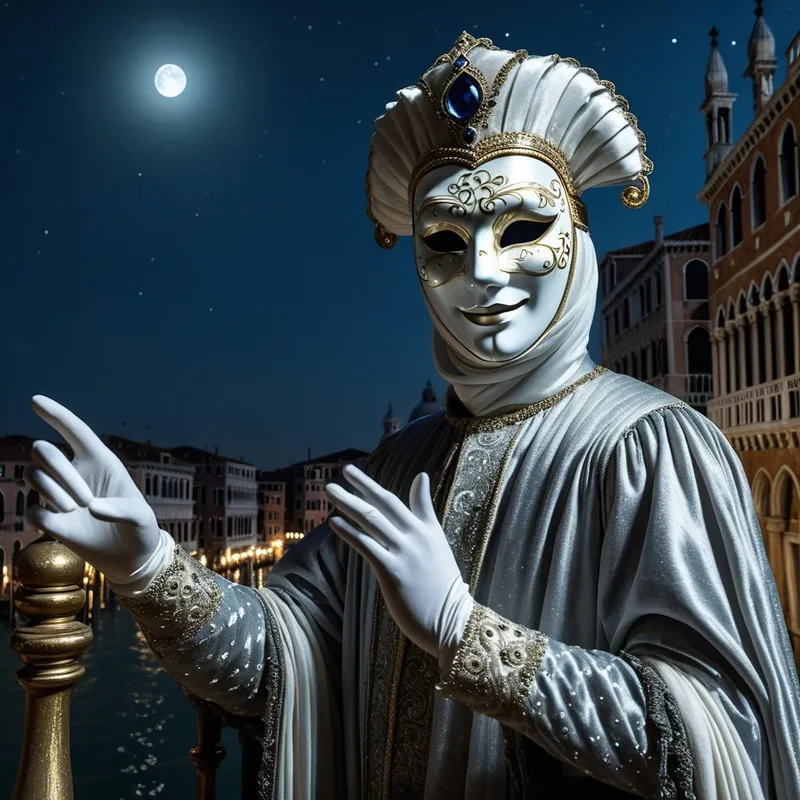
Carnival Masks Myth Meaning & Symbolism
A myth where the city's spirit gifts masks to dissolve social rank, unleashing a sacred chaos that reveals the true self beneath all roles.
The Tale of Carnival Masks
Listen, and hear the tale whispered on the salt-tinged breath of the lagoon, a story not of stone and mortar, but of the soul of the city itself.
Before Venice was a republic of merchants, it was a dream rising from the water. And in that dream lived the city’s first and truest citizen: a spirit known only as Bauta. Bauta was neither man nor woman, noble nor servant. Their face was the shifting surface of the canals—at once a mirror and a mystery. They watched the humans build their palaces and their prisons of class, their lives becoming rigid performances of duty and rank. A great silence, a stiffness of the soul, began to settle over the watery streets.
Bauta’s heart, which beat with the tide, grew heavy. They saw the baker’s unspoken poetry, the duke’s hidden sorrow, the gondolier’s stifled laughter. All were trapped in the roles written for them. So, on the eve of the winter’s end, when the veil between worlds was thin, Bauta descended from their perch in the campanile’s shadow. From the moon’s reflection in the water, they drew silver; from the laughter of hidden lovers, they shaped porcelain; from the sigh of the oppressed, they crafted leather.
With these materials, Bauta fashioned the first masks. Not as disguises, but as keys. The Larva, blank and anonymous. The delicate Columbina, a sliver of mystery. The beaked Medico della Peste, a memento of truths too stark to bear unmasked.
Bauta placed these masks in the Piazza San Marco as the sun vanished. A curious noble, his face etched with the weight of rule, was the first to lift the Larva. As it settled against his skin, a shudder passed through him. The stern lines of his face did not vanish; they dissolved. He felt his title, his name, his history, slip away like a discarded cloak. He let out a sound—a pure, unburdened laugh that echoed like a bell.
It was a signal. The baker took up the Columbina, the servant the Medico della Peste. As each mask was donned, a sacred chaos was unleashed. The duke danced with the maid, speaking truths he dared not tell his council. The pauper critiqued the laws with the wisdom of a scholar. Laughter, raw and real, clattered over the cobblestones. For days, the city became a grand, swirling theater of liberated selves. Secrets were spoken, loves were confessed, and grievances aired—all without fear, for the face that acted bore no name.
When the sun rose on the final day, a profound silence returned, but it was no longer stiff. It was the quiet of catharsis. One by one, the revelers removed their masks. They looked into each other’s eyes—eyes now seen clearly for the first time, stripped of the blinding glare of status. They saw not the role, but the person. The masks, their work done, crumbled to dust, carried away by the same wind that now felt lighter. Bauta, watching from the shadows, smiled their faceless smile. The city had remembered how to breathe.

Cultural Origins & Context
This myth, never codified in a single text, is the soul-narrative of the Venetian Carnival. It was not told by bards in courts but woven into the very fabric of the pre-Lenten festivities, passed down through generations of mask-makers (maschereri) and whispered by parents to children as they prepared their costumes. Its societal function was profound and deeply practical. In a hyper-stratified, mercantile republic where one’s birth determined one’s entire social orbit, Carnival—and the myth that sanctified it—provided a vital pressure valve.
The story served as a sacred permission slip for the temporary dissolution of the social hierarchy. It transformed the act of masking from mere revelry or hiding into a communal ritual of inversion. For a brief, sanctioned period, the servant could play the lord, the man the woman, the pious the profane. This was not anarchy, but a deeply rooted form of social homeostasis, a way for the culture to momentarily embody its own shadows and contradictions, thereby preventing them from festering. The myth provided the "why": you mask not to escape yourself, but to meet the selves the world has asked you to silence.
Symbolic Architecture
At its core, the myth of the Carnival Mask is a masterclass in the psychology of the shadow and the persona. The mask in the story is a paradoxical symbol: it both conceals and reveals.
The mask does not hide the face; it reveals the countenance the face has forgotten how to wear.
The rigid social roles of pre-Carnival Venice represent the over-identified persona—the ego clinging so tightly to its title, its reputation, its "place," that it becomes a prison. The mask, gifted by the androgynous spirit Bauta (the unifying Self of the city), is the tool of liberation. It allows the individual to step into their shadow—the suppressed laughter, grief, desire, or critique—and express it without the catastrophic consequences that would normally attend such a breach of protocol.
Bauta themselves is a key symbol: the primordial, pre-social self. They are faceless, because the true Self exists before and beyond the roles we accumulate. Their act of creating masks from elemental and emotional materials signifies that this tool of transformation is forged from the very stuff of human experience—our dreams (moonlight), our connections (laughter), and our sufferings (sighs).
The climax, where masked interactions lead to unmasked recognition, is the ultimate goal: individuation. One must fully embody the disowned parts (the Carnival) to return to one's core identity (the unmasked face) with greater wholeness and authenticity, now capable of seeing the same in others.

The Dreamer's Resonance
When the Carnival Mask myth pattern arises in modern dreams, it signals a critical juncture in the dreamer's relationship with their own persona. Dreaming of frantically searching for a mask in a crowded piazza points to a felt loss of identity or a desperate need for a new role to navigate social demands. Conversely, dreaming of being unable to remove a mask that has fused to the skin speaks to profound alienation, where the professional or social role has consumed the authentic self.
A more potent manifestation is the dream of wearing a mask and feeling an unexpected emotion flooding through you—uncontrollable laughter in a serious mask, or deep grief in a jester's guise. This is the somatic signal of shadow integration. The body-mind is using the dream symbol to express a feeling the waking ego has deemed unacceptable. The mask provides the safe container, the "Carnival permission," for this buried content to surface. The psychological process here is one of safe exposure; the dream is allowing the dreamer to try on a disowned part of themselves without fully claiming it as "me" yet, testing the waters of a more complete identity.
Alchemical Translation
The myth models the alchemical process of solutio and coagulatio for the modern psyche. Our rigid, daily identities are the prima materia—the leaden, fixed state.
The first stage of the work is not to build, but to dissolve. The mask is the solvent.
Dissolution (Carnival): This is the conscious, often challenging, work of shadow exploration. It involves temporarily "masking" or setting aside our primary identity (the responsible parent, the competent professional, the nice person) in a safe space—perhaps therapy, journaling, art, or trusted community—to allow the contradictory, suppressed elements to speak. Like the noble who laughs freely, we must give voice to the orphan, the rebel, the fool, or the tyrant within. This phase feels like chaos, a loss of solid ground, as old structures melt.
Coagulation (Unmasking): The resolution is not a return to the old, rigid identity. The masks crumble to dust because their purpose is served. The revelers return to their lives, but they are informed by their Carnival experience. The alchemical gold forged here is a more fluid, resilient, and authentic self. The ego, having consciously encountered its shadow, is no longer its brittle puppet. It becomes a more capable servant of the wider Self. The modern individual completes this cycle not annually, but continually, learning to wear many masks consciously—parent, partner, professional—while never mistaking any single one for the totality of who they are. They become, like Bauta, the wearer and the witness, the mask and the face behind it, master of the revels of their own soul.
Associated Symbols
Explore related symbols from the CaleaDream lexicon: