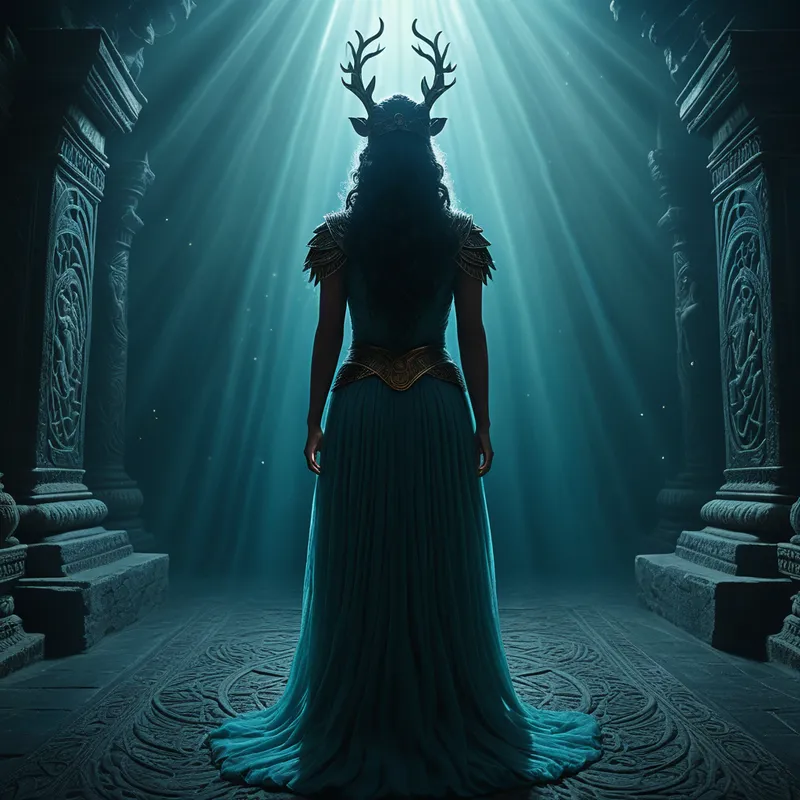
Cangjie Inventor of Writing
A legendary figure credited with inventing Chinese writing after observing nature's patterns, whose breakthrough had profound cosmic consequences.
The Tale of Cangjie Inventor of Writing
In the mist-shrouded dawn of the Yellow Emperor’s reign, before the world had a name that could be fixed, there lived a court historian named Cangjie. His duty was to record the affairs of state, but the tools of his trade were crude: knotted cords and carved notches, systems of memory that frayed and splintered like old rope. He carried the weight of the empire’s past in his mind, a burden that bent his spirit. The Emperor, seeing the strain, charged him with a sacred task: to devise a method to capture truth, to pin the fleeting breath of thought and event onto something more enduring than memory.
Cangjie retired from the court, his soul heavy with the silence of the unrecorded. He wandered into the wilderness, into the heart of things unnamed. He did not seek in libraries or halls of power, but in the raw scripture of the world. He sat by rivers and watched the water’s ceaseless, patterned flow—not just as water, but as a stroke of meaning. He studied the constellations of stars, the veins on a leaf, the tracks of birds in river mud, and the footprints of beasts in forest loam. He saw not just forms, but signatures; not just patterns, but the primal grammar of existence.
One day, as he contemplated the elegant, forked mark left by a bird’s claw, a thunderclap of understanding shattered his inner silence. The claw was not just a track; it was a character. The branching river delta was not just geography; it was a pictograph. In that moment of luminous rupture, he saw that every phenomenon—the sinuous curve of a snake, the sturdy trunk of a tree, the piercing light of the sun—carried within its form its own essential idea. He began to translate the world. He took the roundness of the sun and drew a circle with a dot at its center: 日 (rì). He saw the crescent moon and captured its arc: 月 (yuè). The mountain’s peak became a triad of summits: 山 (shān). From observation, he moved to combination, joining symbols to birth new concepts—resting a man 人 against a tree 木 to form “rest” 休.
But as the first characters flowed from his hand, carved into bamboo and stone, the cosmos itself recoiled. The heavens, it is said, rained down millet like tears of astonishment. The ghosts of the night, those beings who thrived in ambiguity and the unspoken, wailed in despair, for their realm of shadows was now pierced by the unforgiving light of definition. Cangjie had not merely invented a tool; he had performed an act of cosmic surgery, separating the undifferentiated One into the manifold Many. He gave humanity the Key of Knowledge, and with it, he irrevocably altered the relationship between the human soul and the silent, wordless Tao.
Cultural Origins & Context
Cangjie’s story emerges from the deep well of Chinese antiquity, first appearing in texts like the Huainanzi and Shuowen Jiezi. He is less a historical figure and more a personification of a civilization’s foundational leap—the moment culture consciously separated itself from nature through the technology of writing. In the Taoist worldview, this is a moment of profound ambivalence. Taoism venerates the unnamable Tao, the way of nature that operates in spontaneous, wordless harmony (zìrán). Writing, by its very nature, is an act of naming, of fixing the fluid into the static, of creating a map that is forever separate from the territory.
Thus, Cangjie is not a straightforward heroic inventor. He is a liminal figure, a Trickster-creator. His act is one of brilliant, Promethean theft from the natural order. He decodes the universe’s own “writing”—the patterns in shell and bone, star and stream—and repurposes it for human ends. The myth encapsulates the ancient Chinese understanding of writing as a numinous, cosmogonic force. Characters were not arbitrary signs; they were understood as containing the resonant essence (qì) of the things they represented, making writing a form of sympathetic magic and a sacred, ritual technology.
Symbolic Architecture
The myth is built upon a core tension between unity and distinction, between the Tao’s silent wholeness and the intellect’s need to parse and understand.
Cangjie’s act is the archetypal moment of consciousness differentiating itself from the unconscious. The undifferentiated wilderness of the world—the primal, dreaming Forest of phenomena—is analyzed, cataloged, and given discrete form. This is the birth of the ego, the "I" that observes and names.
His method—observation of nature’s patterns—establishes writing as a mimetic art, but one that seeks the essential form, not the superficial likeness. This moves it from mere pictography toward ideography, a system of root concepts. The catastrophic cosmic reaction is the crucial element. It signifies that true creation is never a neutral act; it is a rearrangement of cosmic order. The “milky rain” symbolizes both a blessing (nourishment of a new cultural order) and a lament (for the lost innocence of pre-linguistic unity). The weeping ghosts represent all that is exiled by clarity: ambiguity, mystery, and the fertile darkness of the unknown.
The Dreamer's Resonance
For the modern psyche, Cangjie’s story resonates in the moment we try to articulate a dream, a feeling, or an intuition. The moment we reach for a word to describe the ineffable texture of an experience, we are Cangjie. We are attempting to capture the fluid, multi-faceted truth of the inner wilderness with the fixed symbols of language. Something is always lost in that translation—the full, lived sensation—yet something essential is gained: the ability to share, to reflect, and to build a shared world of meaning.
Psychologically, he represents the function of discernment. He is the archetypal force that allows us to distinguish self from other, thought from feeling, one complex emotion from another. This is the foundation of consciousness and culture, but the myth wisely acknowledges its shadow: the potential for alienation. In naming things, we can believe we have captured their totality. We can mistake the map for the territory, the character for the living reality. The wailing ghosts are the parts of our own psyche that resist this categorization—our wild, intuitive, and chaotic inner forces that chafe under the ego’s need for order and definition.
Alchemical Translation
In the alchemical vessel of the soul, Cangjie’s process is the opus of bringing the unconscious to consciousness. The raw, prima materia of sensory experience and instinct (the Forest, the River tracks) is subjected to the fire of intense observation and the water of reflective contemplation. The resulting “characters” are the lapis philosophorum—the crystallized insights and patterns that give coherent form to the inner chaos.
This is not a one-time event but a perpetual inner ritual. Each time we journal, analyze a dream, or find the precise word for a nebulous emotion, we re-enact Cangjie’s Ritual. We are building our own internal lexicon, forging the Quill of Creation from our lived experience to write the narrative of our becoming.
The Taoist tension remains vital here. The alchemical goal is not to name and cage all mystery, but to achieve a conscious reunion with the Tao—a state where one uses the tools of distinction without being enslaved by them. The mature soul can wield the Key of Knowledge to unlock understanding, yet also knows when to lay it down and simply be in the unmediated presence of the world.
Associated Symbols
Explore related symbols from the CaleaDream lexicon:
- Key of Knowledge — The tool of discernment that unlocks understanding but also separates the knower from the undifferentiated whole, carrying the weight of consequence.
- Forest — The primal, undifferentiated realm of unconscious phenomena and natural patterns, which Cangjie enters as a wilderness to be decoded.
- River — The flowing, ever-changing source of patterns and tracks, representing the stream of consciousness and natural signs from which meaning is derived.
- Ghost — That which wails at being defined; representing ambiguity, forgotten memory, and all aspects of reality exiled by the light of clear distinction.
- Trickster — The archetype embodied by Cangjie as a boundary-crosser who brings a transformative (and disruptive) gift from the natural world to the human realm.
- Quill of Creation — The instrument of conscious formation, turning observed essence into fixed, communicable form, symbolizing the act of artistic or intellectual genesis.
- Ritual — The sacred, repeatable process of observation, contemplation, and inscription by which chaos is given order and the unseen is made visible.
- Mirror — The mind of Cangjie, which does not merely reflect nature but reflects upon it, seeking the essential form within the apparent shape.
- Mountain — Both a concrete form he transcribes into character and a symbol of the enduring, stable truth he seeks to capture against the flow of time.
- Taoist Talisman — The written character itself, understood not as a mere sign but as a vessel of resonant power that can influence the qi of the world.
- Dream — The pre-linguistic state of knowing, the inner wilderness of images and feelings that precedes and often resists the structuring act of writing.
- Chaos and Order — The twin poles of the myth; the chaotic, fertile patterns of nature and the brilliant, imposing order of the written system born from it.