Calypso's Island Myth Meaning & Symbolism
Odysseus, shipwrecked and lost, is held captive by the goddess Calypso on her paradisiacal island, torn between immortal comfort and his mortal home.
The Tale of Calypso's Island
Hear now the tale of the one who was lost, not in the dark of the underworld, but in the blinding light of paradise.
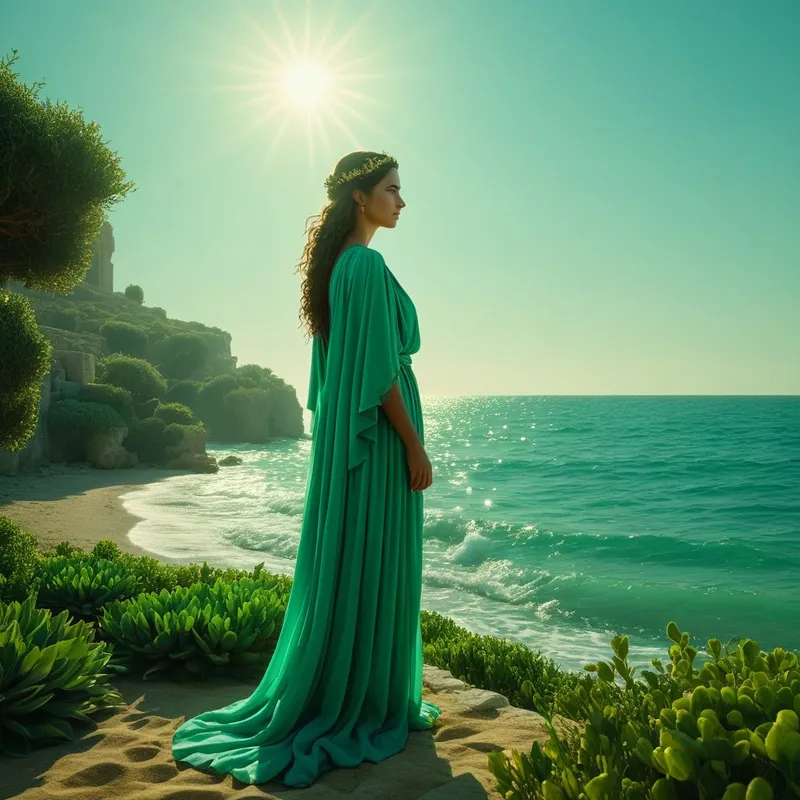
For seven long years, the man of twists and turns, Odysseus, was held in a gilded cage. His prison was not of iron, but of jasmine-scented air and soft, sighing waves. It was the island of Ogygia, hidden in the navel of the wine-dark sea. Its keeper was Calypso, a goddess whose beauty was as deep and timeless as the ocean abyss. She had pulled him, the sole survivor of Poseidon’s wrath, from the splintered wreck of his raft, her heart moved by his broken form.
She offered him everything the mortal heart is said to crave. Immortality. Ageless youth. A love that would never fade. Her cave was a marvel: sweet-smelling cedar, vines heavy with grapes, and four springs that bubbled with clear water, each flowing in a different direction. She wove at her loom with a golden shuttle, her song weaving its own spell. Each day was the same perfect, amber-hued dream. Each night, she took him to her bed, a consort for a goddess.
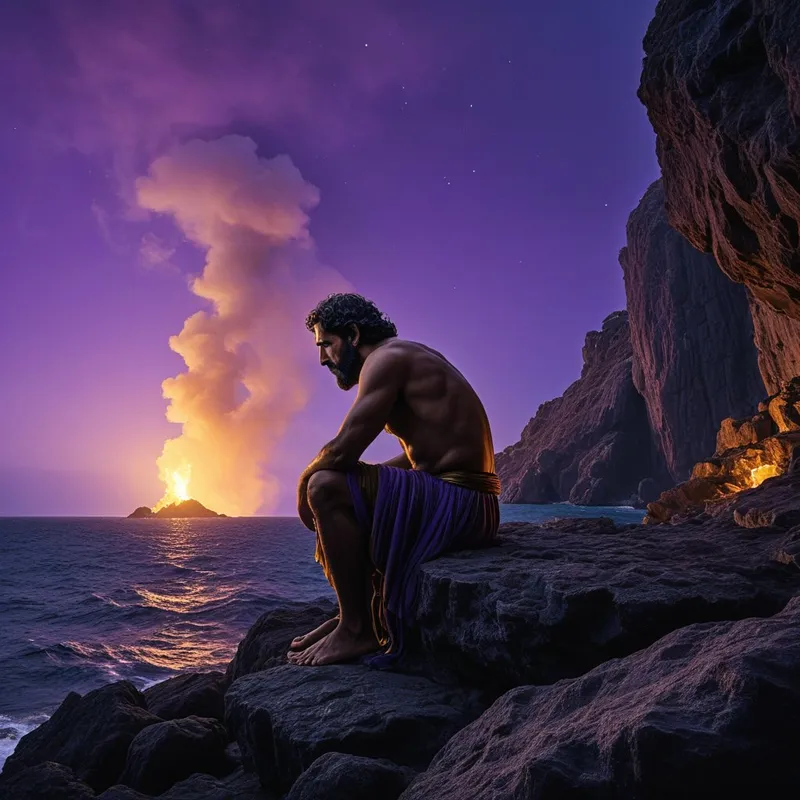
Yet, each dawn found Odysseus on the eastern shore. He would sit on the rocks, his eyes scouring the empty horizon until they were raw with salt and longing. His great heart, which had faced Cyclopes and Sirens, was being worn smooth by the gentle, relentless tide of comfort. He wept for his mortal wife, Penelope, whose face was beginning to blur in his memory. He wept for his son, Telemachus, who would be a man grown. He wept for the rocky shores of Ithaca, a poor and humble place that held his soul.
The conflict was not of clashing swords, but of clashing truths. The truth of divine, endless comfort against the truth of mortal, aching purpose. The gods on Olympus finally took note. Hermes, the guide of souls, flew to Ogygia with a decree from Zeus himself: the hero’s tears had reached the heavens. Calypso must release him.
Her fury was a silent storm. She accused the gods of jealousy, of cruelty in offering a mortal a taste of heaven only to snatch it away. But the will of Zeus was iron. With a heart heavier than any mortal’s, she told Odysseus he was free. She helped him build a sturdy raft, provisioned it with food and wine, and showed him the stars to steer by. Her final gift was a fair wind. She stood on the shore, a figure of eternal beauty and eternal solitude, watching as the man she loved sailed into the dawn, toward his pain, his age, his death, and his destiny.
Cultural Origins & Context
This poignant interlude is a central pillar of Homer’s Odyssey, an epic poem crystallized in the 8th century BCE but echoing with far older oral traditions. For the ancient Greeks, the sea was both highway and tomb, a realm of chaos and opportunity. Stories of sailors seduced or destroyed by otherworldly beings on distant shores spoke to very real fears and wonders.
Calypso’s episode functions as a narrative fulcrum. It follows the fantastical adventures of Odysseus’s journey and precedes the gritty, political realities of his homecoming. The bard, singing in a royal hall or at a festival, used this tale to explore a profound cultural tension: the Greek ideal of nostos (homecoming) versus the allure of kleos (glory won abroad, often through suffering). Here, the allure is not glory, but its opposite—blissful anonymity. The story asks the audience: What is a life without struggle, without identity, without home? For a society built on the oikos (household) and the polis (city-state), Calypso’s offer, while divine, was a kind of social and spiritual death.
Symbolic Architecture
Calypso’s Island is not a place, but a state of being. It is the psyche’s temptation to remain in a state of perfect, undifferentiated bliss, where the hard edges of the self are dissolved.
The greatest prison is often woven from the softest threads of comfort, where every need is met except the need to become who you are.
Odysseus represents the conscious ego, the part of us that carries a name, a history, and a purpose. Calypso is the archetypal anima figure in her most encompassing, devouring form—the Great Mother who offers to take back her child into her womb of eternal safety. Ogygia is the unconscious itself, beautiful and nourishing, but static. The seven years signify a complete cycle, a full period of incubation that has now become stagnation. His weeping by the shore is the first, crucial symptom of a soul in exile from itself; it is the ego’s longing for consciousness, for the difficult but real world of time, choice, and consequence.
The loom of Calypso is key. She weaves, just as The Fates weave. Her weaving is the spell of the timeless, beautiful pattern that entraps. Odysseus’s eventual raft-building is the antithesis: crude, temporal craftsmanship aimed at motion and direction.
The Dreamer's Resonance
When this myth stirs in the modern dreamer, it rarely appears as a classical tableau. Instead, one dreams of being in a beautiful, fully-provided apartment but feeling a desperate, inexplicable claustrophobia. Or of a relationship so comfortable it feels like quicksand, numbing ambition and voice. The dream setting is always a "perfect" stagnation: a job with no challenge, a creative project perpetually in the planning stage, a recovery that has become an identity.
The somatic experience is a heavy lassitude, a feeling of being too comfortable, paired with a sharp, localized ache—a longing with no clear object. Psychologically, this is the soul’s alarm bell. It signals that a necessary period of healing, rest, or incubation (the seven years) has passed its term. The psyche is now crying out for the friction of the world, for the "raft" of a difficult decision, for the "stormy sea" of engagement. The dreamer is encountering the peril of healing so completely into a wounded state that they forget their original, whole shape.

Alchemical Translation
The alchemical process mirrored here is the solutio—dissolution—followed by the imperative for coagulatio—re-solidification. The ego (Odysseus) has been dissolved in the waters of the unconscious (the sea, Calypso’s realm). This is necessary; the old, rigid identity must soften. But the work is incomplete if the individual remains in solution.
Individuation is not the discovery of a perfect, static self, but the continual courage to sail away from the islands of completed selves.
The arrival of Hermes, the psychopomp, is the call from the Self (the total, integrated psyche, symbolized by Zeus’s decree). It is an inner mandate that overrules the seductive comfort of the complex. Building the raft is the coagulatio: the conscious, diligent work of gathering one’s resources (memories, skills, values) to construct a vessel for the journey back to life. It is humble, mortal, and fragile compared to the goddess’s cave, but it is oriented.
The modern individual undergoes this alchemy when they leave the "island" of a defining trauma, a golden childhood memory clung to too long, or a ideology that explains everything and demands nothing. The release is not a victory of will over desire, but a triumph of deeper, soulful longing (for Ithaca) over superficial, egoic longing (for comfort). One chooses the path of becoming, with all its perils, over the paradise of being. In the end, Calypso’s greatest gift is not her love, but the fair wind she provides for the departure. She represents the part of our own nature that, when commanded by the Self, can reluctantly but gracefully release us back into our own story.
Associated Symbols
Explore related symbols from the CaleaDream lexicon: