Calabash Myth Meaning & Symbolism
A myth of primordial unity sundered, creating the world and the human condition, held within the sacred vessel of the Calabash.
The Tale of Calabash
In the time before time, there was no up or down, no light or dark, no you or me. There was only Nzamé, the All, humming in the warm, silent dark of its own being. And Nzamé was contained, whole and perfect, within a single, immense Calabash. This was not a gourd grown from a vine, but the First Vessel, the womb of all possibility. Inside, the spirits of sky and earth, ocean and forest, ancestor and unborn child, danced together in a symphony of pure potential. The hum was the song of unity.
But within that song, a new note began to stir—a longing, a curiosity for form. It was the spirit of Pemba, the yearning for the tangible. Pemba pressed against the smooth, curved walls from the inside. It sought a crack, a seam, a way to know itself by seeing what it was not. The perfect harmony strained.
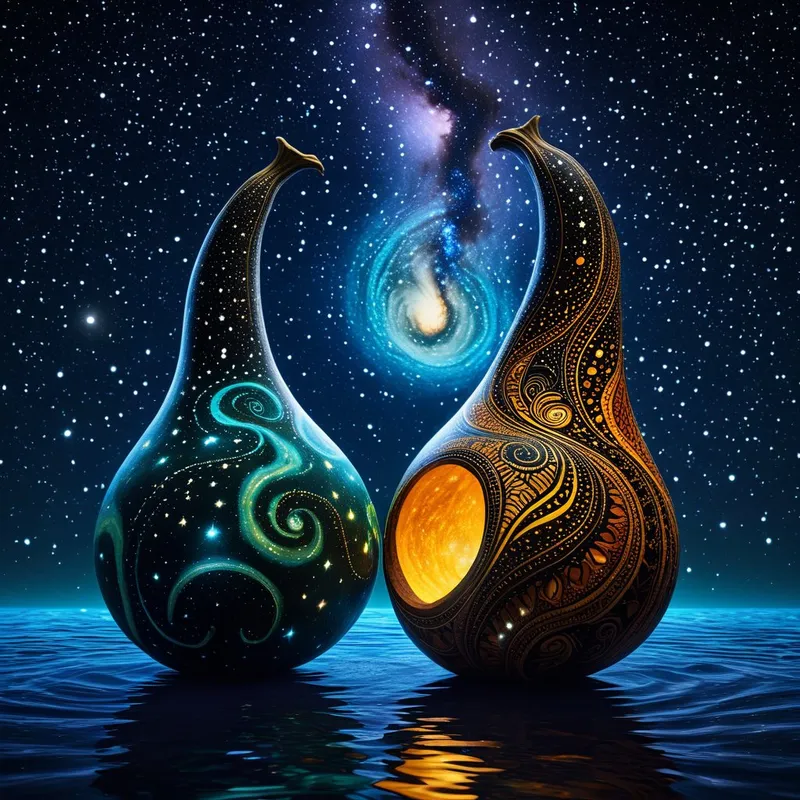
Then came the movement. A great, gentle force—some say it was the first thought, others the first breath—caused the Calabash to tremble. And in that trembling, the unthinkable happened. With a sound that was both a sigh and a thunderclap, the sacred vessel split. Not shattered, but parted. The upper half, lighter than dream, spiraled upward, cooling into the vast, star-dusted dome of the sky. The lower half, heavy with promise, settled into the soft, moist curves of the earth.
From between them, all that was held inside came rushing, singing, weeping into the space now created. Light poured out to become sun and moon. The waters spilled to become rivers and seas. The green essence rooted itself and became the first forests. The echoes of the original hum became the voices of wind, bird, and beast. And the spirits, now separated, took their places—some in the glittering above, some in the fertile below.
The world was born from this sacred separation. And the two halves of the Calabash remained: the Sky-Cup and the Earth-Bowl, forever apart, yet forever remembering they were once one single, containing whole. The crack between them is where life happens. It is the horizon we gaze upon, the space where rain falls, where prayers rise, and where the human soul, born of both earth and sky, forever feels the echo of that first, fateful parting.
Cultural Origins & Context
This myth, in its myriad variations, is a foundational narrative across West and Central Africa, carried like a sacred seed in the memory of those forced across the waters during the Maafa (the Transatlantic Slave Trade). It survived not in written texts, but in the hushed tones of night-time stories, in the rhythms of work songs, in the shapes of carved ritual objects, and in the profound cosmology of diasporic spiritual systems like Vodou, Candomblé, and Santería.
Told by elders and griots, it served as an ontological anchor—a way to explain the very structure of reality and the human place within it. In the brutal fragmentation of enslavement, the story of the Calabash held a devastating and comforting truth: that separation is woven into the fabric of existence itself, from the very beginning. It was not a story of a fall from grace, but of a necessary, creative rupture. The societal function was profound: it modeled resilience. If the cosmos itself came from a breaking, then the broken family, the severed homeland, could still be a site of sacred, world-making potential. The calabash gourd, a practical vessel for carrying water, food, and seeds, became a living symbol of this cosmic truth, a miniature of the original container of all life.
Symbolic Architecture
The Calabash is the ultimate symbol of the Vessel. It represents the womb, the skull, the heart—any container that holds life, consciousness, or spirit. Its splitting is the primordial act of differentiation, the birth of duality from unity: sky/earth, spirit/matter, male/female, self/other.
The crack in the universe is not a wound to be healed, but the aperture through which the world is perceived.
The myth maps the fundamental human psychological condition. We are born from unity (the womb) into separation (individual life). We spend our lives sensing a lost wholeness—that original hum inside the unbroken Calabash—while living in the creative, fertile, and often painful space of the divide. Pemba's yearning is our own ego-consciousness pressing against the limits of the unconscious, seeking definition. The two halves, forever apart, speak to the irreducible tension between opposites within the psyche, which can never fully collapse back into one but must be related to across the horizon of awareness.
The Dreamer's Resonance
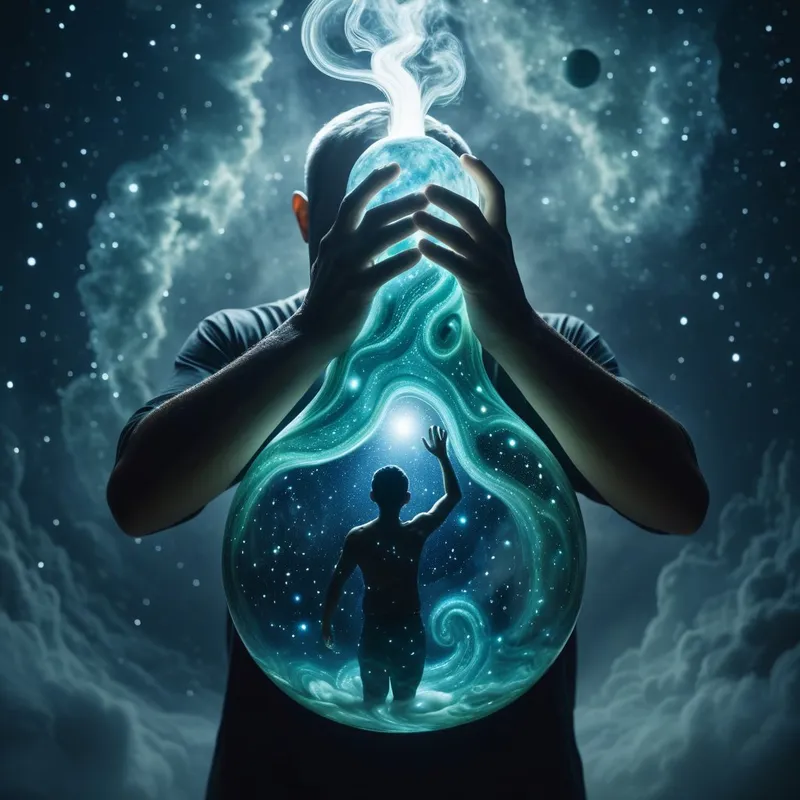
When this myth stirs in the modern dreamscape, it often manifests as dreams of containers breaking or coming apart: a cherished bowl cracking, a house splitting down the middle, one's own body feeling like two disconnected halves. Alternatively, one might dream of desperately trying to fit an overwhelming abundance of things—stars, water, chaotic emotions—into a small, fragile gourd.
Somatically, this can correlate with feelings of fragmentation, a loss of center, or the acute anxiety of a life transition where an old, containing identity is breaking apart. Psychologically, the dreamer is experiencing their own Pemba moment. A previously held sense of wholeness (a relationship, a career, a belief system) is splitting, creating a terrifying and fertile void. The process is one of psychic birth. The dream is not diagnosing brokenness, but echoing the primordial, creative rupture. It asks: What world is waiting to be born from this necessary separation?
Alchemical Translation
The individuation journey is precisely the conscious reckoning with the Calabash. The first, unconscious wholeness of childhood must split for the ego to form—this is the first, inevitable rupture. The spiritual work of adulthood is not to regress to that pre-conscious unity, but to become the conscious vessel that can hold both halves in relationship.
Individuation is the craft of becoming the Calabash that knows it is both the container and the contained, the sky and the earth, holding the tension of its own creation.
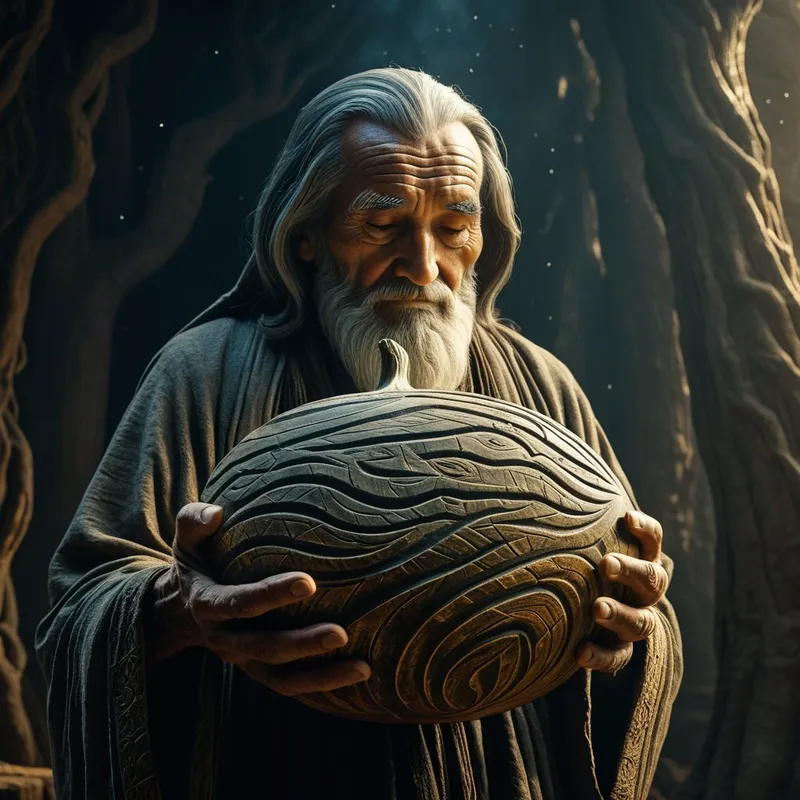
The "alchemical translation" involves several stages. First, one must honor the break: recognize the necessary, life-giving quality of separations, endings, and differentiations in one's personal history. Second, one must tend the space in-between: the horizon where opposites meet. This is the practice of holding tension without collapsing it—allowing conflict between inner figures (e.g., the responsible ruler and the wild rebel) to generate creative energy rather than paralysis. Finally, one achieves a symbolic wholeness: not a return to the original, undifferentiated state, but the development of a psychic vessel—a conscious Self—strong enough to contain the entire cosmos of one's being, light and dark, sky and earth, without identifying with any single part. One becomes, like the elder holding the carved gourd, the steward of one's own creation myth, understanding that the crack is where the soul's light enters and exits the world.
Associated Symbols
Explore related symbols from the CaleaDream lexicon: