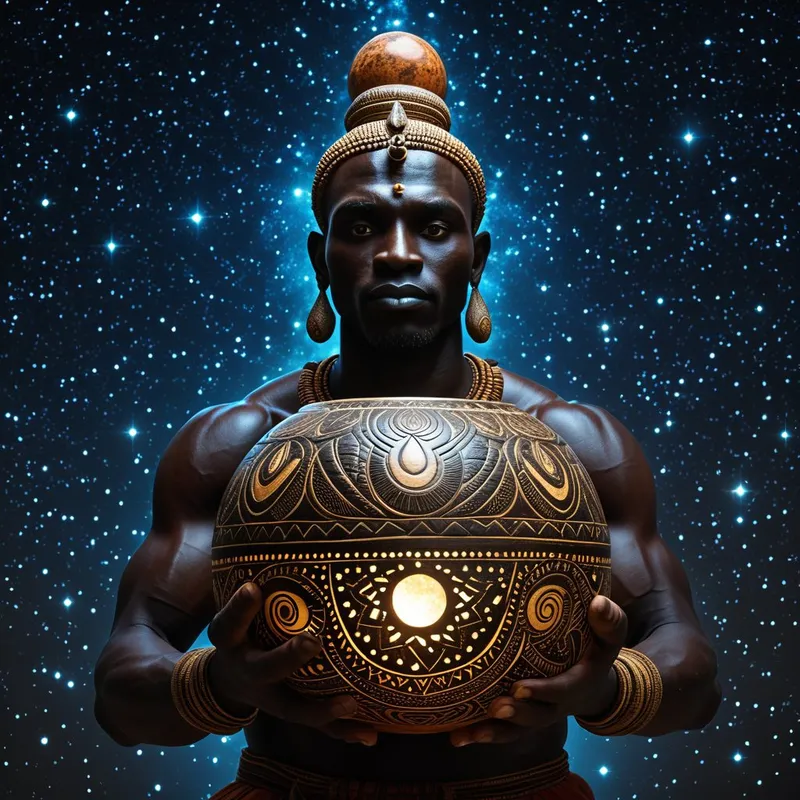
Calabash of Wisdom Myth Meaning & Symbolism
A myth where the gods hide all wisdom in a calabash, which a man tries to steal, only to shatter it and scatter wisdom across the world.
The Tale of Calabash of Wisdom
In the time before time, when the world was still soft and the sky was close enough to touch, all wisdom belonged to the gods. It was not a thing to be read in books or spoken in proverbs, but a living, breathing light. Nyame, the Sky Father, keeper of the sun and rain, held this light in his hands. He saw how it pulsed, how it yearned to be known, and he feared what might happen if it were given freely to the young, restless world below.
So, Nyame called for a vessel. Not of gold or iron, but of the earth itself—a great, smooth calabash, grown from a seed planted at the dawn of creation. Into this humble gourd, he poured every secret: the language of the wind, the mathematics of the spider’s web, the cure for every sickness, the true names of the stars, and the maps of every human heart. When the last drop of luminous wisdom was sealed inside, the calabash glowed with a soft, inner radiance. To keep it safe, Nyame tied it with a cord of spider-silk and lightning to the very top of the tallest tree in all existence, a tree whose roots drank from the underworld and whose branches cradled the moon.
For ages, it hung there, a silent, pulsing jewel in the heavens. But on the earth, there was a stirring. A figure of cunning and immense ambition watched it—Anansi, the spider. He was clever beyond all other creatures, yet his cleverness was a hungry, hollow thing. He saw the calabash and knew that with its light inside him, he would be not just clever, but all-knowing. He would be a god.
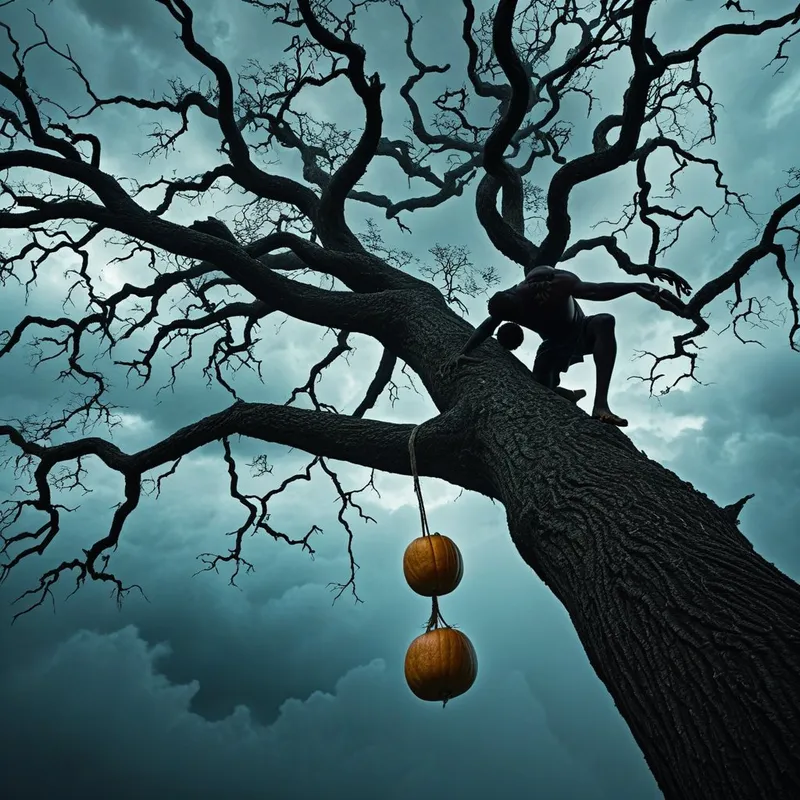
Driven by this thirst, Anansi began his climb. The tree’s bark was like glass, its branches like spears. He transformed, becoming part-spider, part-man, using silk and sheer will to ascend. The air grew thin and cold. The sky darkened into the deep indigo of Nyame’s realm. For days and nights that blurred into one, he climbed, until finally, his trembling hand closed around the cord. The calabash was warm, vibrating with a low hum that shook his bones. Triumph flooded him. He had done it.
But in his arrogance, he tried to descend too quickly. The cord, woven with divine intention, resisted his mortal haste. He slipped. The calabash, so carefully held, tumbled from his grasp. It did not fall gently. It struck a branch, then another, and with a sound like a thousand stars sighing, it shattered.
The world held its breath. Then, a silent explosion of light. Not a destructive blast, but a gentle, inexorable scattering. Beams and droplets and motes of wisdom—pink for healing, blue for truth, gold for justice, silver for song—flew in every direction. They fell into the rivers and were drunk by the fish. They seeped into the soil and were taken up by the roots of trees. They were caught on the wind and carried to the four corners of the earth. A single, largest fragment lodged itself deep in the heart of every human being.
Anansi, clinging to the tree, watched in horror. He had sought to possess all wisdom, and in his grasping, he had ensured that no one ever would again. He was left with only the hollow, aching echo of his own cunning, and the hard, first lesson from the broken vessel: that wisdom, once whole and held by the divine, now belonged to the world, fragmented, hidden, and waiting to be pieced together through a lifetime of seeking.
Cultural Origins & Context
This myth, most prominently told among the Akan and Ashanti peoples of West Africa (modern-day Ghana and Ivory Coast), is a foundational narrative of the Anansi cycle. It was never a story confined to parchment; it lived in the oral tradition, passed down through generations by griots and elders under the shade of baobab trees or by firelight. Its tellers were not merely entertainers but custodians of philosophy, using the flawed, relatable figure of Anansi to teach profound truths about the human condition.
Societally, the myth functioned as a sophisticated ethical and cosmological guide. It explained the perceived state of the world: why knowledge is imperfect, why expertise is distributed, and why understanding requires community and effort. It placed humanity in a specific relationship with the divine (Nyame)—not as passive recipients of grace, but as active participants in a cosmic drama initiated by our own ancestral ambition. The story legitimized the roles of different specialists—the farmer, the healer, the blacksmith, the storyteller—each holding a fragment of the shattered whole. It was a narrative that cultivated humility, patience, and respect for the distributed intelligence of the collective.
Symbolic Architecture
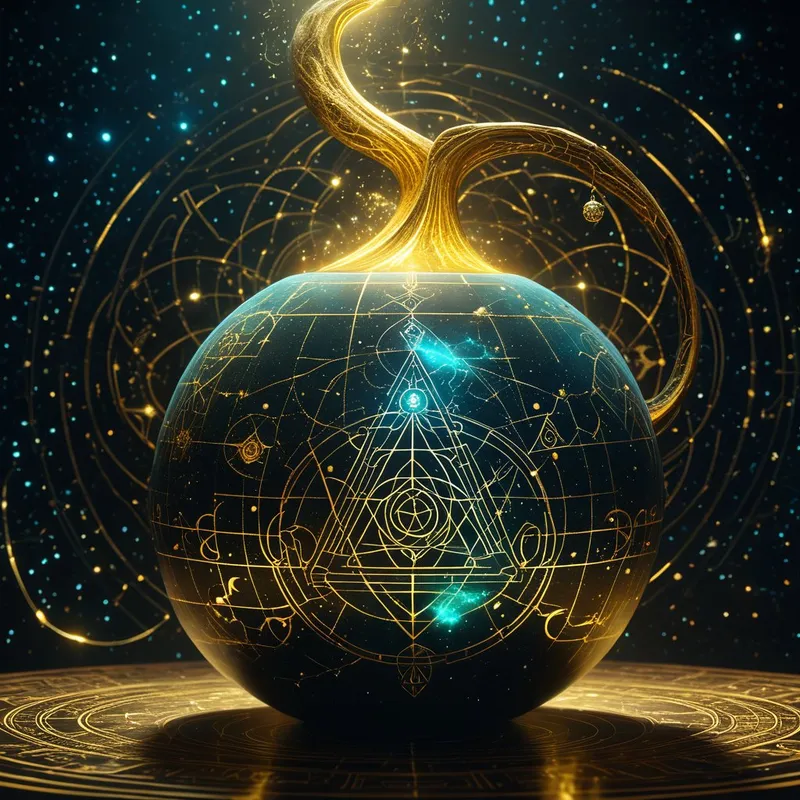
The myth’s power lies in its stark, elegant symbols. The Calabash itself is the perfect vessel: organic, grown, humble, yet capable of containing the infinite. It represents the unified field of divine consciousness, the unus mundus or primordial state of wholeness before the fragmentation of ego.
Anansi is the archetypal trickster, but here, his role deepens into that of the primordial human ego. He is intelligence without wisdom, ambition without reverence, the part of consciousness that believes it can possess and own the totality of knowing. His climb is the inflation of the ego, attempting to usurp the place of the Self.
The shattering is not a punishment, but a necessary, cosmogonic event.
The breaking of the vessel is the birth of the seeker. Wholeness, when hoarded, is a dead end; only in its fragmentation does it become a quest.
Wisdom is thus transformed from a static object of possession into a dynamic process of gathering, interpreting, and integrating. The fragments in every living thing symbolize the psychic reality that all knowledge is partial, and true understanding arises from relationship—listening to the river, learning from the animal, and, most crucially, sharing and combining the fragments held by other people.
The Dreamer's Resonance
When this myth activates in the modern psyche, it often manifests in dreams of profound loss followed by a strange, melancholic liberation. You may dream of dropping a precious, glowing object—a gem, a vial, a phone full of unsaved data—and watching it shatter on hard ground. The initial panic is visceral, a somatic clutch of failure and despair. This is the ego’s reaction to its own limitation, its failed "Anansi project" of trying to control and contain all knowledge or perfection.
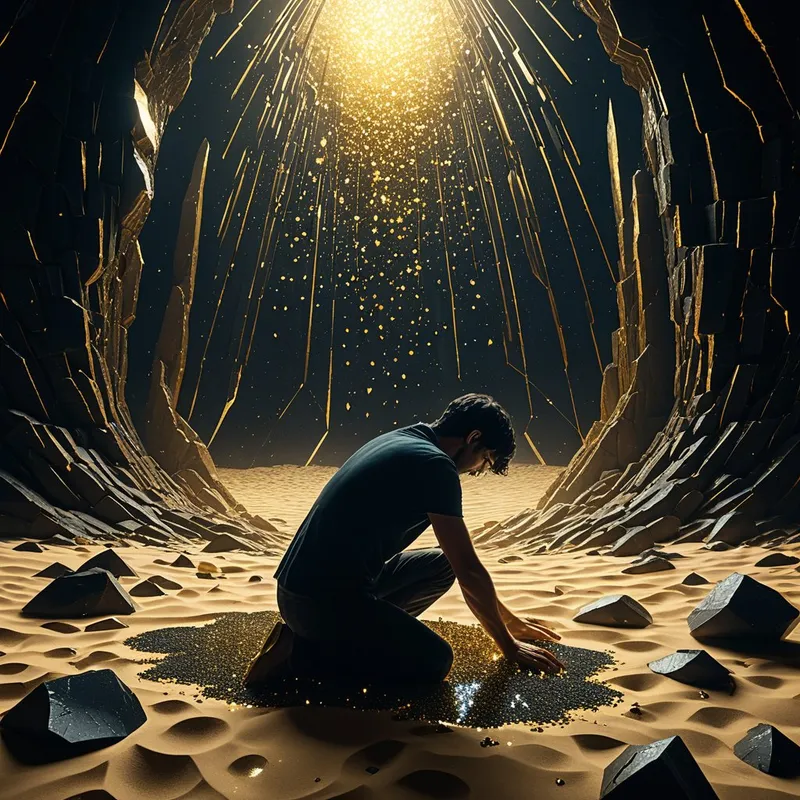
The dream then often shifts. You find yourself not in a clean, empty space, but in a landscape littered with the fragments. They are not dead; they gleam, they hum, they catch the light. The dream-ego is tasked with gathering them, but the rules have changed. They cannot be glued back into the original form. Instead, you must arrange them into a new mosaic, trade them with other dream figures, or simply sit with a single shard and understand its specific, partial truth. This is the psyche initiating the move from a psychology of possession (having the answer) to a psychology of process (being in the question). The anxiety of the drop gives way to the grounded, if weary, work of collection—the true beginning of wisdom.
Alchemical Translation
For the individual on the path of individuation, the myth of the Calabash maps the critical transition from the nigredo—the blackening, the despair of the shattered ideal—to the albedo—the washing clean in the acceptance of limitation. Our modern "calabashes" are often our idealized selves, our perfect plans, our fantasy of complete enlightenment or success. We, like Anansi, climb tirelessly toward this ideal, believing its possession will solve our fundamental longing.
The inevitable "shattering" is a crisis of meaning: the failed project, the broken relationship, the exposed flaw, the realization that we are not, and cannot be, the god of our own story. This is a necessary death.
The psyche cannot be made whole by the ego's ambitions; it must be reassembled from the fragments the ego discarded in its climb.
The alchemical work begins when we stop mourning the lost, perfect vessel and turn our attention to the scattered pieces. That fragment is a neglected talent. That one is a painful memory holding a kernel of truth. That one is a piece of wisdom from an ancestor or a culture not our own. That one is the simple, animal intelligence of the body we ignored while climbing. Individuation is not about reconstructing a pre-fallen, divine perfection. It is about creating a new, more complex, and deeply human vessel—a "self" assembled from the gathered, earned, and integrated fragments of our lived experience and shared humanity. We become not the keeper of a sealed calabash, but a living calabash ourselves, woven from the stories of our falls and the patient, humble light of what we have, piece by piece, managed to gather and understand.
Associated Symbols
Explore related symbols from the CaleaDream lexicon: