Cairns Myth Meaning & Symbolism
A mythic tale of a wanderer who builds stone markers for the dead, becoming a bridge between worlds and the guardian of collective memory.
The Tale of Cairns
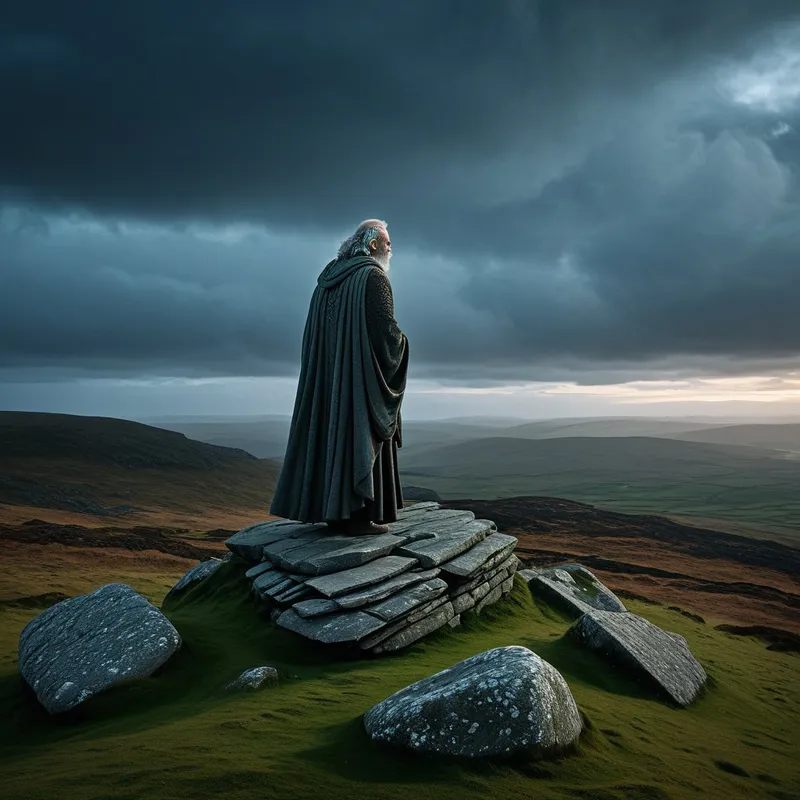
Listen. The wind on the high moor does not blow; it remembers. It carries the names of those who walked here before the roads were born. In a time when the world was woven from song and stone, there walked a figure known only as the Fili. He was not a king, nor a warrior whose name shook the earth. He was a walker of the between-places, the misty glens and the lonely mountain passes where the veil between This World and the Otherworld grew thin as a spider’s silk.
His journey began with a silence that followed the great battle. Not a silence of peace, but one of absence. The land was littered with the fallen, heroes and common folk alike, their stories untold, their names unspoken, lost to the raven and the root. The Sovereignty herself wept in the rivers, for a people forgotten are a people truly dead.
The Fili felt this weeping in his bones. One evening, by a peat-fire that spat shadows like ghosts, he was visited. Not by a god in shining form, but by a pressure in the air, a collective sigh on the wind. It was the anam—the soul-stuff—of the forgotten, swirling, formless, yearning for anchor. A voice, made of many voices, whispered from the flames: “Give us a shoulder to the sky. Let the land remember what the mind has lost.”
With no tool but his hands and no blueprint but the ache in his spirit, he began. At the first place of passing he found—a broken shield by a hawthorn tree—he stopped. He bent, his knees cracking like winter ice, and picked up a stone. It was cold, grey, ordinary. But as he held it, he did not see a rock. He saw the farmer who once tilled the field nearby, the smell of turned earth and the strength in a weathered back. He placed the stone. Then another, for the farmer’s laughter. Another, for his love of a black-haired woman. Stone by stone, memory by memory, a small mound grew.
This was not building. It was listening. At a ford where salmon leapt, he built for a drowned child, using smooth river-stones that held the song of the water. On a windswept cliff, he built for a lost sailor with stones salt-crusted and sharp, each one a fragment of a far horizon. He became an archaeologist of spirit, gathering the scattered shards of stories and assembling them into a new, silent language. The cairns rose—humble, sturdy, undeniable. They were not tombs, but beacons. Not to mark an end, but to make a threshold visible.
As the seasons wheeled, a change stirred. Travellers, seeing his strange, solitary work, began to bring stones. A warrior would bring a stone for his fallen brother, whispering a name as he placed it. A mother would bring a pebble for a babe who never drew breath. The Fili said nothing, only nodded, his eyes holding the depth of still lakes. The cairns grew larger, communal, each stone a votive offering, a syllable in a growing epic of remembrance.
The final test came with the first hard frost. A chieftain, proud and grieving for his son, demanded a mighty cairn, a monument that would dominate the valley. He brought his warriors to build it in a day. The Fili watched as they piled stone upon stone, efficient and empty. The cairn was tall, but it was silent. It held no memory, only ambition. That night, the wind, the same wind that carried the voices, blew with a fierce, focused breath. By morning, the proud cairn was scattered, its stones rolled across the hillside like fallen teeth.
The chieftain raged. The Fili approached the scattered stones, knelt, and picked one up. He held it to his ear, then to his heart. “You built a monument to your loss,” he said, his voice soft as peat-moss. “But a cairn is built with loss, not against it. It is a conversation, not a declaration.” He placed the stone back, not on a high pile, but at the base of a nearby, older cairn. He placed it for the chieftain’s own forgotten father. The man’s rage dissolved into weeping, and he placed the next stone himself.
And so the Fili walked on, his own form growing more like the land with each passing year—stooped, weathered, enduring. He became known as Carn, the living embodiment of the act. He did not conquer death. He did something more profound: he made a pact with it. He built the signposts for the journey, ensuring no soul would be a stranger in the landscape of eternity. When he finally laid down his own body, it was said the people covered him not with a mound of earth, but with a single, perfect cairn. And on stormy nights, if you listen, you can hear not the wind, but the low, steady hum of a story, held aloft, stone by sacred stone.
Cultural Origins & Context
The myth of the Cairn-Builder, while not attached to a single, named deity from the Irish Mythological Cycle, is woven from the very fabric of Celtic world-understanding. It is a folkloric archetype that crystallizes a profound cultural practice. Historically, cairns were ubiquitous across the Celtic world—from Scotland's moors to Ireland's peaks—serving as burial markers, trail guides, territorial boundaries, and memorials.
The myth likely originated not in royal courts but in the oral traditions of the people, passed down by the Aos Dána. Its societal function was multifaceted. Practically, it sanctified the vital act of wayfinding and territorial memory in a landscape without maps. Spiritually, it provided a tangible ritual to manage grief and honor the dead, integrating them into the physical geography, thus denying the finality of oblivion. The cairn transformed anonymous death into located memory, a critical act for a culture that believed in an Otherworld intimately connected to our own. The storyteller, by recounting this myth, was performing the same function as the Fili: building a narrative cairn to hold the community's collective experience of mortality and continuity.
Symbolic Architecture
At its core, the myth of the Cairns is a profound meditation on the architecture of memory and the psyche's need for thresholds.
The cairn is the psyche’s answer to the terror of formlessness; it is the conscious mind stacking stones of experience upon the bare moor of the unconscious.
The Fili represents the conscious ego undertaking a sacred duty: to tend to the soul's dead—the forgotten experiences, the unresolved griefs, the abandoned selves that litter our inner landscape. His journey is one of active witnessing. Each stone is a single, concrete memory, feeling, or fragment of identity that, left alone, is meaningless. Gathered and intentionally placed in relation to others, it becomes part of a stable, enduring structure.
The cairn itself is the central symbol. It is a axis mundi, a midpoint between heaven and earth, but also between the past and present, the living and the dead, the remembered and the forgotten. It is not a sealed tomb but a permeable marker. It says: Something of significance happened here. A transformation was attempted. A passage occurred.
The scattering of the chieftain’s cairn is the myth’s crucial moral and psychological lesson. It distinguishes between a monument built from ego (to glorify one's own pain or status) and a cairn built from soul (to honestly acknowledge and integrate loss). The ego’s structure is brittle and rejected by the wind—the spirit of truth. The soul’s structure, built with humble attention, endures.

The Dreamer's Resonance
When the motif of cairns arises in modern dreams, it signals a profound process of psychic integration at work. The dreamer is likely navigating a period of grief, closure, or the need to make sense of fragmented life experiences.
To dream of building a cairn is a somatic act of consolidation. You are, in the unconscious workshop, gathering scattered pieces of your emotional history. Each stone placed may correlate with acknowledging a past relationship, honoring a lost opportunity, or simply giving weight to a feeling you had previously dismissed. The labor felt in the dream—the weight of the stones, the fatigue—mirrors the real psychological effort of this work.
To dream of finding a cairn on a path often appears at decision points or during life transitions. The cairn is an inner landmark, a signpost from your deeper self saying, “You are on the right path,” or “Note this moment; it is significant.” It can represent discovered wisdom or a connection to ancestral patterns (personal or cultural) that now offer guidance.
To dream of a crumbling or scattered cairn reflects anxiety about legacy, the fear of being forgotten, or the collapse of a belief structure that once gave your life meaning. It is a call from the psyche to begin the work of rebuilding, not with the old, ego-driven blueprint, but with a new, more authentic intention.
Alchemical Translation
The myth of the Cairns provides a stark, beautiful model for the alchemical process of Individuation. This is the psychic transmutation of leaden, unconscious suffering into the golden awareness of a coherent self.
The prima materia, the base matter, is the unmourned and unintegrated past—the “fallen on the battlefield” of one’s life. The Fili’s first act, the humble picking up of a single stone, is the nigredo, the blackening. It is the conscious descent into the dark, messy, and painful material of memory without flinching.
The careful, intentional stacking—relationship by relationship, trauma by triumph—is the albedo, the whitening. Here, analysis and order are applied. Patterns emerge from the chaos. The disparate stones begin to form a coherent, reflective whole. This is the stage of understanding, where the ego listens to the soul.
The true alchemy is not in creating gold from nothing, but in recognizing that every rough stone you carry is already a fragment of the philosopher’s stone, awaiting its place in the greater design.
The final act, where the Fili becomes synonymous with the cairns and travellers add their own stones, is the rubedo, the reddening, and the citrinitas, the yellowing. The work becomes self-sustaining and generative. The individual’s integrated self (the personal cairn) becomes a stable landmark that others can recognize and relate to. It contributes to the collective human landscape. The process is no longer just about healing one’s own wounds but about becoming a threshold—a point of contact and transformation for others. The psyche, once a battlefield of scattered fragments, is now a sacred, visited geography, where every stone, even the heaviest, holds up the sky.
Associated Symbols
Explore related symbols from the CaleaDream lexicon: