Cadmus and the Spartoi Myth Meaning & Symbolism
A Phoenician prince, guided by prophecy, sows the teeth of a slain dragon, which sprout into armed warriors who fight until only five remain to found Thebes.
The Tale of Cadmus and the Spartoi
The world was younger, and the gods walked closer to the dust of mortals. Listen now to the tale of Cadmus, a prince cast adrift by fate. His sister, Europa, had been stolen by a god disguised as a bull, carried across the sea to a distant shore. His father, King Agenor, commanded Cadmus to find her or never return. Thus began a pilgrimage of despair, a search across the wilds of the world that yielded only silence and the mocking whispers of the wind.
Weary to his soul, Cadmus came at last to a lonely place in the land that would be called Boeotia. There, by a clear spring sacred to Ares, he sent his companions to fetch water. But the spring was guarded. Not by a man, but by a monstrous serpent, a child of the war god himself—a dragon with scales like polished bronze and breath that reeked of old blood. One by one, the dragon took them, crushing the life from Cadmus’s men, staining the pure water crimson.
When Cadmus found the scene, grief turned to a cold, clear fury. He took up a mighty stone and, with the strength of the righteous and the doomed, he smashed the beast’s head. As the dragon lay dying, a voice seemed to coil from the air—the voice of Athena. She instructed him to pull the teeth from the fallen monster and sow them in the earth like seeds.
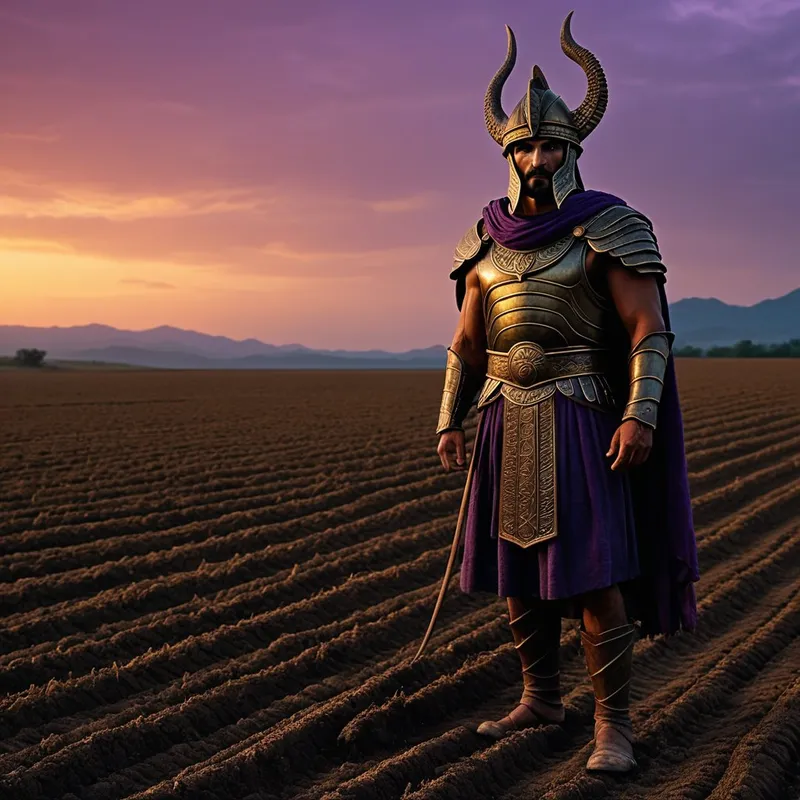
Bewildered but obedient, Cadmus plowed a wide field with a yoke of oxen he was told to sacrifice. Into the dark, receptive furrows, he cast the gleaming, ivory teeth. Then he waited, under a sun that seemed to hold its breath.
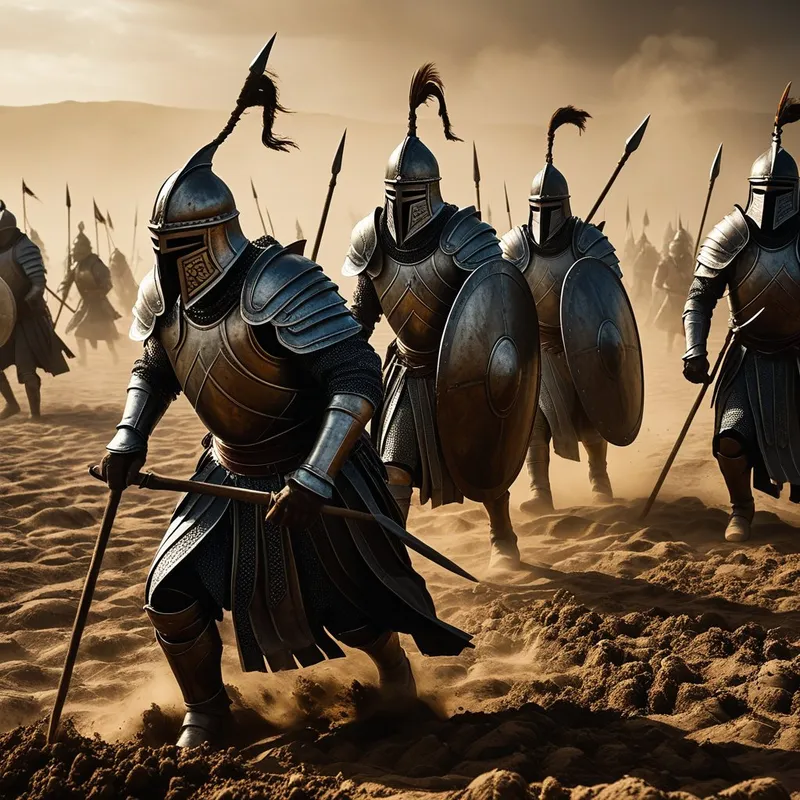
The earth stirred. Not with the gentle push of a green shoot, but with a violent heave. From the soil burst the points of spears, then the rims of shields, then the helmets of fully armed warriors. They were the Spartoi, men born not of woman but of earth and violence, their eyes flashing with immediate, inexplicable rage. They looked at one another and, without a word of cause, they fell upon each other. The field became a cacophony of clashing bronze, war cries, and the terrible thud of bodies falling back to the earth from which they had sprung.
Cadmus watched, horrified, as the sown men slaughtered one another. The conflict was swift and total. When the dust settled, only five remained, their fury spent, standing amidst the corpses of their brothers. These five—Echion, Udaeus, Chthonius, Hyperenor, and Pelorus—laid down their arms. In that moment of exhausted peace, they turned to Cadmus and offered him their loyalty. With these five, born of dragon’s teeth and fratricide, Cadmus founded the mighty citadel of Thebes, the first stones of a civilization built upon a foundation of sacred violence.
Cultural Origins & Context
This myth is a foundational narrative, an aition for the city-state of Thebes. It was a tale told to explain not just how Thebes came to be, but the complex, often brutal nature of its origins and its ruling aristocracy, who claimed descent from these Sown Men. The story is preserved primarily in the epic tradition and later in the works of poets like Hesiod and the tragedians, for whom Theban myths were fertile ground.
In the oral tradition of ancient Greece, such myths served as a cultural memory bank. The tale of Cadmus functioned on multiple levels: as a charter for Theban identity and autochthony (being “sprung from the earth”), as a divine sanction for its existence (via Athena’s guidance), and as a sobering reminder that order (eunomia) emerges from chaos and conflict (eris). It legitimized the ruling class as literally born from the land they ruled, while also encoding the traumatic, fratricidal strife that would haunt Thebes in later cycles, most famously in the stories of Oedipus and his sons.
Symbolic Architecture
At its heart, this is a myth of impossible creation. Cadmus, the exiled seeker, fails in his original quest (finding Europa) but is given a new, terrible destiny: to become a founder. The dragon is not merely a monster to be slain; it is the untamed, chthonic guardian of a place, the raw, instinctual power of Ares. To kill it is an act of necessary sacrilege, a confrontation with the violent soul of the wilderness itself.
The teeth of the dragon are the seeds of latent, aggressive potential. To sow them is to consciously plant conflict in the service of a future order.
The Spartoi represent the archetypal paradox of brotherhood and civil war. They are kin, born of the same act and the same earth, yet their first and only impulse is mutual destruction. They embody the idea that the very forces needed to build and defend a city (martial prowess, courage, strength) are the same forces that can tear it apart. Their spontaneous battle is a ritual of selection, a brutal alchemy where the chaotic multitude is reduced to the viable few. The five survivors represent the necessary consolidation of chaotic energy into a structured, collaborative force—the founding quorum.
Cadmus’s role transforms from dragon-slayer to sower, from destroyer to instigator of a process he must then witness and ultimately guide. He does not fight the Spartoi; he midwifes their birth and bears witness to their self-purification. His founding act is not one of conquest over others, but of creating the conditions for a system to generate and refine its own constituent parts.
The Dreamer’s Resonance
When this myth stirs in the modern unconscious, it rarely appears as a literal narrative. Instead, one might dream of planting objects that birth hostile figures, or of being in a group where sudden, inexplicable conflict erupts among peers, leaving a shocked few allies. The somatic feeling is often of deep anxiety in the gut—a “churning” or “knotting”—mirroring the plowed field and the violent birth from below.
Psychologically, this dream pattern speaks to a phase where the dreamer has “slain a dragon”—perhaps overcome a major personal obstacle, addiction, or toxic pattern (the guardian of the old spring). But the victory releases not peace, but a new, more complex set of internal conflicts. The “dragon’s teeth” are the scattered, hardened remnants of that struggle—old angers, defensive postures, latent aggressions—that the psyche now, consciously or not, “sows” into the soil of one’s new life.
The terrifying eruption of the armed Spartoi symbolizes the unexpected and often hostile aspects of one’s own personality that emerge during a rebuilding phase. These are the inner critics, the competitive drives, the defensive “warrior” parts that turn on each other, creating inner civil war. The dreamer, like Cadmus, is often a horrified witness, feeling these conflicts are autonomous and destructive. The resolution—the few remaining allies—points to the painful but necessary process of internal integration, where only the most essential, cohesive aspects of one’s assertive, protective energy are retained to build a new psychic “city.”

Alchemical Translation
The Cadmus myth is a profound map for the alchemical process of individuation, specifically the stage of nigredo and albedo. The initial quest (for Europa) represents the ego’s conscious desire. Its failure is the necessary dissolution of the old personality, leading to the confrontation with the shadow (the dragon of Ares).
Slaying the dragon is the brutal but essential act of confronting and overcoming the dominant, unconscious complex guarding one’s vital energy (the spring). This is the nigredo, the blackening, a descent into chaos and moral ambiguity.
Sowing the teeth is the conscious acceptance and planting of one’s own destructive potential into the fertile ground of the soul. It is an act of terrifying responsibility.
The birth and battle of the Spartoi represent the coniunctio oppositorum (conjunction of opposites) in its most violent form: the clash of unconscious contents with each other. This is the psyche’s autonomous process of sorting, where latent, undifferentiated energies (archetypal warrior impulses) fight for dominance. The ego, like Cadmus, must not interfere but must hold the space for this bloody internal reckoning. It is a purge by fire and spear.
The five survivors signify the emergence of a stable, usable structure from chaos—the quinta essentia or fifth element. These integrated forces become the foundational pillars of the new, more conscious Self. The founding of Thebes symbolizes the establishment of a coherent, resilient psychic structure (the fortified city) capable of containing both order and the memory of its violent origin. The individual is no longer a wandering seeker, but a founder, having transmuted the teeth of the beast into the cornerstone of their own being. The dragon is not gone; it is transformed, its essence now woven into the very walls of identity.
Associated Symbols
Explore related symbols from the CaleaDream lexicon: