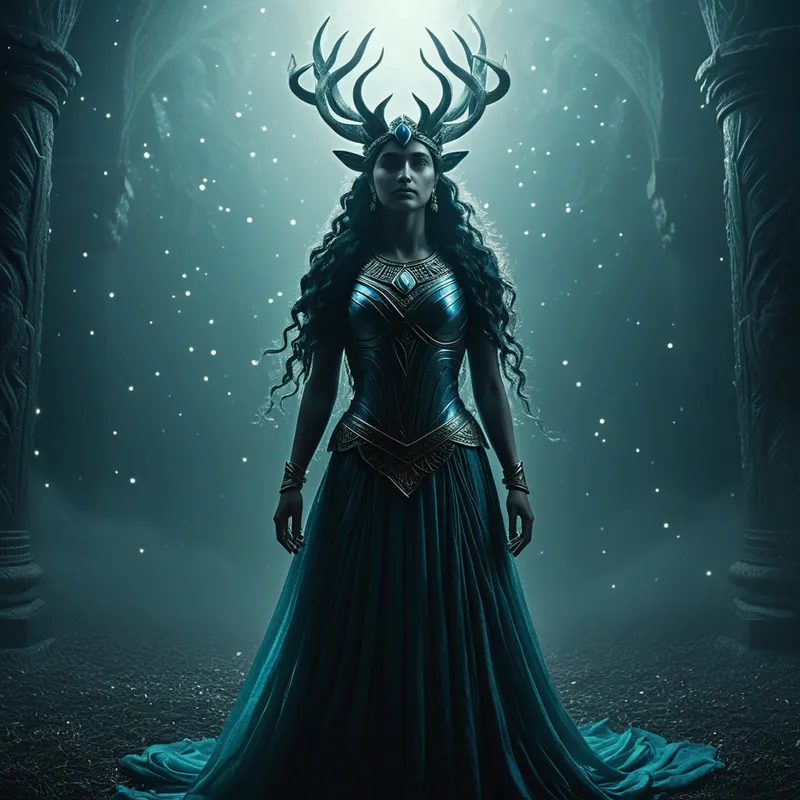
Buraq the Heavenly Steed
A luminous winged creature from Islamic lore that carried the Prophet Muhammad on his miraculous Night Journey, bridging earthly and heavenly realms.
The Tale of Buraq the Heavenly Steed
In the still, profound silence of a night in Mecca, a rupture appeared in the fabric of the mundane. The Prophet Muhammad, in a state between profound sleep and luminous wakefulness, felt the presence of the Divine summon him. From this sacred summons emerged Buraq, a creature of such sublime form that human language strains to contain it. Described as a radiant white steed, smaller than a mule yet larger than a donkey, its beauty was otherworldly. Its body shimmered with a pearlescent light, and its stride consumed the horizon with a single leap. Most wondrous of all were its wings, not of feather and bone, but of beatific energy, folded along its flanks, ready to unfold for celestial ascent.
With the archangel Jibril (Gabriel) as guide, Muhammad mounted this heavenly creature. The journey that unfolded was the Isra and Mi'raj. Buraq’s hooves did not merely gallop; they transcended. With each bound, the earthly landscape—the sands of Arabia, the olive groves of Palestine—fell away beneath them, not as distances traversed but as veils lifted. They alighted at the Al-Aqsa Mosque in Jerusalem, a nexus of prophetic lineage, where Buraq was tethered to a ring used by the prophets of old.
But the journey’s true destination lay beyond the terrestrial sphere. From the Rock in Jerusalem, Buraq ascended, carrying the Prophet through the seven heavens. Here, the steed became the ultimate vehicle of mi'raj, piercing the layers of cosmic reality. At the threshold of each heaven, at the Sidrat al-Muntaha (the Lote Tree of the Utmost Boundary), Buraq halted. It could go no further; this was the limit of form, even celestial form. Muhammad proceeded alone into the direct, unmediated Divine Presence, while Buraq, the faithful conduit, remained at the boundary—the perfect servant who delivers the seeker to the doorstep of the Ultimate.
Cultural Origins & Context
The narrative of Buraq is firmly rooted in the Qur’an and the Hadith literature. The opening verse of Surah Al-Isra states, “Exalted is He who took His Servant by night from al-Masjid al-Haram to al-Masjid al-Aqsa…” This verse, while allusive, forms the scriptural bedrock. The detailed descriptions of Buraq and the Ascension come from the authenticated sayings and traditions of the Prophet Muhammad, compiled by scholars like al-Bukhari and Muslim.
Buraq’s imagery synthesizes pre-Islamic Arabian familiarity with prized, swift mounts and the rich cosmological symbolism of neighboring traditions, such as the winged creatures of Zoroastrian and Mesopotamian lore. However, in Islam, it is thoroughly Islamized—not a mythical beast of independent power, but a creature created by God for a singular, sacred purpose. It exists outside the natural order, a sign (ayah) of God’s absolute power to suspend the laws of creation for a divine objective. The story cemented Jerusalem’s status as the third holiest site in Islam and served to affirm Muhammad’s prophethood, linking him directly to the Abrahamic prophetic chain in a tangible, visionary experience.
Symbolic Architecture
Buraq is not merely transportation; it is the embodied symbol of the purified soul’s capacity for transcendence. Its white color signifies purity, innocence, and divine light. Its size—between a donkey and a mule—suggests its intermediary nature: grounded enough to be recognizable, yet exceptional enough to belong to another realm. Its wings are the faculties of faith and spiritual aspiration that lift the heart beyond its earthly attachments.
Buraq represents the fitrah—the primordial, uncorrupted human nature—that, when properly attended, becomes the vehicle for the soul’s journey back to its Divine source. It is the activated spiritual heart, swift and obedient, that carries consciousness from ritual prayer (salah) to direct witnessing (mushahadah).
The tethering ring at Jerusalem is profoundly significant. It symbolizes the connection of the Islamic revelation to the continuum of monotheistic prophecy. By tying Buraq there, the narrative visually binds Muhammad to Ibrahim (Abraham), Musa (Moses), and Isa (Jesus), asserting not rupture but fulfillment. The journey’s two stages—the horizontal (isra) to the communal heart of prophecy, and the vertical (mi'raj) to the singular Divine—map the spiritual path: outward service to the community of faith, followed by the inward, vertical ascent to God.
The Dreamer's Resonance
In the landscape of the soul, Buraq appears when the conscious self is called beyond its familiar terrain. Psychologically, it embodies the sudden, graceful emergence of a transformative capacity from the unconscious. It is the intuition that arrives complete, the synchronicity that bridges vast internal distances, the dream figure that carries us to vistas of profound meaning. For the dreamer, encountering a Buraq-like creature signals a summons to a night journey of one’s own—a necessary, perhaps terrifying, but ultimately sanctifying voyage that the ego cannot orchestrate or control, only consent to.
This resonance speaks to the archetype of the threshold crossing. The dreamer mounted on Buraq is the psyche, willing to be led into its own depths and heights. The resistance Buraq initially shows (as mentioned in some traditions, needing to be calmed by Jibril) mirrors our own psychic resistance to the transcendent—our pride, fear, or literalism that must be soothed by a higher wisdom (Jibril) before we can proceed. The journey validates the nocturnal, non-rational dimension of human experience as a realm of authentic revelation and reorientation.
Alchemical Translation
In the alchemy of the spirit, Buraq is the lapis philosophorum, the philosopher’s stone, not as a static object but as a dynamic, living process of transmutation. It is the agent that turns the leaden weight of earthly existence into the gold of luminous awareness. The night journey is the alchemical magnum opus in narrative form: the separation (leaving Mecca), the purification (journeying through stations), and the union (the approach to the Divine Presence).
The steed’s leap, which consumes the furthest reach of sight, is the alchemical solve et coagula—dissolving the ordinary boundaries of time and space, only to reconstitute them within a sacred cosmology. The rider is not passive but actively engaged in holding on, symbolizing the crucial balance between surrender to the process and maintaining conscious intention.
Buraq itself undergoes no change; it is already perfect in its function. This reflects the Sufi understanding of the spiritual guide or the innate divine spark within—it is already complete. Our work is to recognize it, mount it, and trust its course. The ultimate “translation” occurs at the Lote Tree, where even this perfect vehicle must be left behind. This signifies the final dissolution of all intermediaries, all symbols, even the most sublime, in the face of the Absolute. The vehicle is consumed in the destination.
Associated Symbols
Explore related symbols from the CaleaDream lexicon:
- Journey — The fundamental motif of spiritual progression, moving from a state of limitation to one of expansion and divine proximity.
- Bridge — A structure that connects separated realms, mirroring Buraq’s function of linking the earthly Jerusalem with the heavenly spheres.
- Horse — A universal symbol of vitality, power, and the journeying soul, refined here into a celestial and obedient form.
- Sky — The domain of ascent and transcendence, representing the higher consciousness and divine reality Buraq traverses.
- Light — The radiant essence of Buraq’s form and the nature of the divine realm to which it ascends, symbolizing purity, knowledge, and revelation.
- Mirror — Reflects the purity of the soul that can become a vehicle for the divine; Buraq itself is a mirror of prophetic readiness.
- Door — The threshold at each heaven and ultimately at the Lote Tree, representing the successive stages of spiritual initiation and access.
- Temple — The sacred destination of Al-Aqsa and the internal sanctuary of the heart where the journey begins and is integrated.
- Star — Celestial guides and markers of the higher realms Buraq passes, symbols of divine light in the darkness and spiritual destiny.
- Faith — The invisible wings that make the journey possible; the trusting surrender of the rider to the divine will and guidance.
- Dream — The state of consciousness in which this visionary journey occurs, affirming the dream realm as a valid plane of spiritual experience.
- Heavenly River — The flowing, nourishing course of divine grace and prophecy that the journey follows from its source to its culmination.