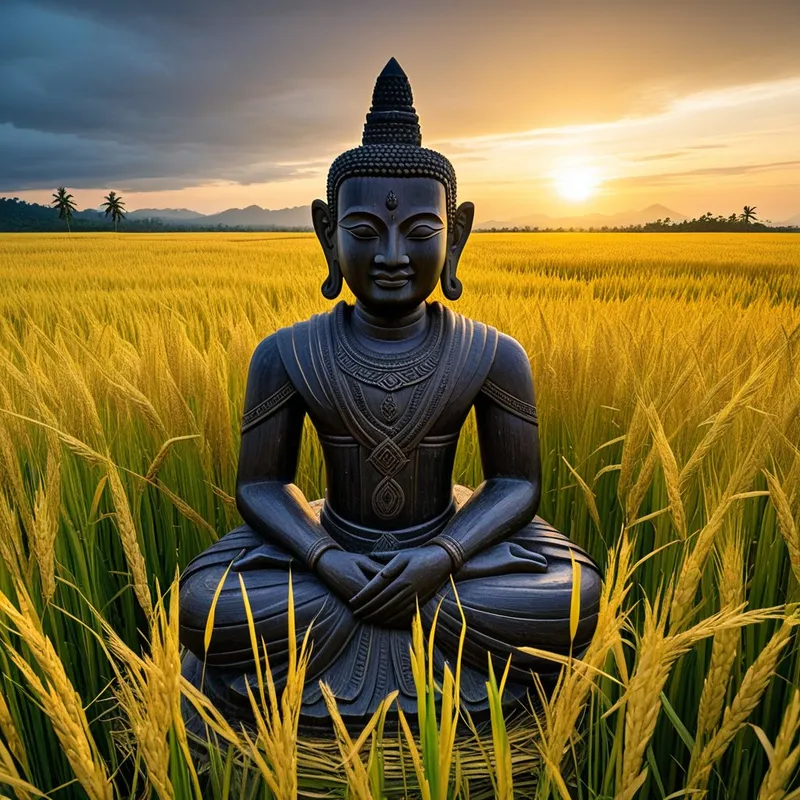
Bulul Myth Meaning & Symbolism
A myth of a guardian spirit who binds its soul to the grain, ensuring abundance through sacred sacrifice and the union of the wild and the cultivated.
The Tale of Bulul
Listen. The story begins not with a bang, but with a whisper—the whisper of wind through the payew, the sigh of the earth before the first seed is sown. In the time when the world was younger and the veil between realms was thin as a rice husk, the people of the mountains knew hunger. They planted, but the rains were fickle. They tended, but the soil was stubborn. Their bellies were hollow echoes of the empty granaries.
In the high forests, where the mist clings to ancient trees, lived the spirits of the land. They were wild, free things of rock and river and root. Among them was one who watched the struggling people not with disdain, but with a strange, aching curiosity. This spirit saw their toil, their prayers rising like smoke, their hands cracked and dark from the earth. It saw not just struggle, but devotion. A longing stirred within its wild heart—a longing not of the forest, but for connection.
One season, when the blight was worst and despair sat heavy in the village, the spirit made a choice. It walked down from the misty heights, its form shifting, settling. It approached the eldest farmer, a man whose eyes held the memory of many failed harvests. The spirit did not speak with words, but with an offering. It held out its hand, and in its palm was a single, perfect grain of rice, glowing with a soft, inner light.
“This is my promise,” the spirit’s intention echoed in the farmer’s soul. “But a promise must have a vessel. A guardian must have a home.”
The people, guided by dream and necessity, took sacred wood from a tree struck by lightning—a tree that had touched both earth and sky. With reverence, they carved. They did not carve a likeness of a beast or a man, but a form that held stillness. A seated figure, knees drawn up, hands resting upon them. Its face was serene, eyes wide and gazing into a distance only it could see. Into this vessel, they placed the glowing grain.
And the spirit entered. It bound its wild, free essence to the static wood, to the cycle of the seed. It became the Bulul. The binding was a sacrifice—a trade of boundless freedom for a singular, profound purpose. From that moment, the Bulul was no longer just a spirit of the forest. It was the soul of the field.
The people placed the figure in the granary. Where the Bulul sat, the rice multiplied. It did not rot. It remained full and vital. The spirit’s presence warded off hunger and malevolent forces. The harvests that followed were abundant, golden seas that fed the people and sang of the sacred pact. The Bulul watched, eternally present, a bridge between the untamed spirit world and the cultivated human world, its silent vigil the price and the guarantee of life.
Cultural Origins & Context
This myth, in its many local variations, is rooted deeply in the animist traditions of the Igorot peoples of the Northern Philippine Cordilleras. It is not a tale of distant, omnipotent gods, but of intimate, immanent spirits. The Bulul myth was not merely recited; it was enacted. The story was embedded in the ritual cycle of rice cultivation—from the begnas or clearing, to planting, to the harvest feast.
The carving of a Bulul figure was a sacred act, accompanied by prayers and animal sacrifice. The finished statue was “activated” through rituals where its mouth was “fed” with rice wine or pig’s blood, animating it, inviting the spirit to inhabit the wood. It was a contract carved in timber. The myth served a crucial societal function: it encoded ecological wisdom. It taught that abundance is not a right, but a relationship. It framed agriculture not as domination of nature, but as a sacred partnership, requiring respect, reciprocity, and ritual honor.
Symbolic Architecture
At its core, the Bulul myth is a profound allegory of the necessary sacrifice for creation and sustenance. The wild spirit represents untamed potential, pure energy without form or function. The human world represents need, structure, and cyclical time. The myth dramatizes the moment these two poles meet and forge a new, third thing: cultivated abundance.
The guardian is born from a vow, and the vow is sealed by a limitation. To give life, the infinite must consent to inhabit the finite.
The Bulul itself is the ultimate symbol of this paradox. It is static wood, yet teeming with spiritual life. It is a container, yet it is the source. Its wide, gazing eyes do not see the granary’s walls, but the health of the soul of the rice. Psychologically, it represents the complex—a structured, personified energy within the psyche that has a specific function. Here, the function is nurturance and preservation. The spirit’s binding is the archetypal pattern of committing one’s wild, creative, or spiritual energy to a specific, enduring purpose, accepting the constraints that come with that commitment to make it real and fruitful in the world.
The Dreamer's Resonance
When this myth stirs in the modern unconscious, it rarely appears as a literal rice statue. It manifests as dreams of binding, of guardianship, or of sacred contracts. You may dream of finding a strange, heavy object in your home that seems to protect it, or of making a solemn, wordless promise that alters your very substance. You might dream of a room that is always full, a larder that never empties, overseen by a silent, watchful presence.
Somatically, this can correlate with a process of “digesting” a major life commitment—a career path, a relationship, a creative project. There can be a feeling of healthy containment, of energy finally being channeled into a vessel that can hold it and make it useful. Conversely, if the caregiver archetype is unbalanced, the dream may feature a guardian that has become a jailer, or a granary that is full but you are forbidden to eat. This signals a sacrifice that has become pathological, where the commitment feels like a life-draining trap rather than a life-giving vow. The psyche is questioning: What have I bound my spirit to? Does this vessel still serve life?

Alchemical Translation
The alchemical journey modeled by the Bulul is that of fixation—the process of making the volatile spirit solid, giving it a lasting form. For the modern individual, this is the heart of the individuation process: taking the raw, often chaotic or “wild” material of the Self—our talents, intuitions, deepest callings—and committing them to the vessel of our actual lives.
Individuation is not about becoming infinite; it is about wisely choosing the finite forms through which your infinity will flow.
The “wild spirit” is our unlived potential, our unused creativity, our unexpressed love. The “carved vessel” is the job we take, the art we make, the family we build, the community we serve. The ritual “binding” is the conscious, sacred act of choice and dedication. We sacrifice the freedom of pure potentiality for the power of actualization. The resulting “abundance” is not merely material; it is the psychological harvest of a life lived with purpose and integrity. The Bulul within us is that integrated part of the psyche that silently tends this inner granary, ensuring that what we have committed to life continues to nourish us and others, transforming the raw seed of spirit into the sustaining bread of soul.
Associated Symbols
Explore related symbols from the CaleaDream lexicon: