
Bulan the Moon God Myth Meaning & Symbolism
A myth of celestial beauty and sacrifice, where the radiant god Bulan descends to the underworld, illuminating the darkness with his eternal, gentle light.
The Tale of Bulan the Moon God
In the time before memory, when the sky was a tapestry woven fresh each night, there lived a deity of such beauty that the stars themselves would pause in their dance to behold him. His name was Bulan. He was not the hard, cold moon of later ages, but a luminous youth, a brother to the sun, whose light was a gentle, silver caress upon the sleeping world. His radiance was a balm, a lullaby that soothed the fears of the night.
Yet, beneath the peaceful surface of the world, a great turmoil stirred. The realm of the dead, Kasamaan, was a place of profound darkness and restless sorrow. The souls there wandered in perpetual shadow, forgetting the light of life, their grief a cold fog that knew no dawn. Their king, Sidapa, ruled from a throne of silence, but even his power could not conjure comfort from the endless dark.
The lament of the dead became a whisper on the wind, a sigh that finally reached the ears of the celestial gods. They heard the profound homesickness of the spirits, a longing not for life, but for the simple memory of light. A council was held in the highest heavens. The sun offered his fierce, purifying rays, but they were too harsh, too reminiscent of the fire that consumes. The stars offered their twinkling points of hope, but they were too distant, too cold.
Then, Bulan stepped forward. His voice was like the sound of still water. "I will go," he said. "My light does not burn; it remembers. It does not command; it reveals. Perhaps in the deep dark, a memory of gentle light is what is needed."
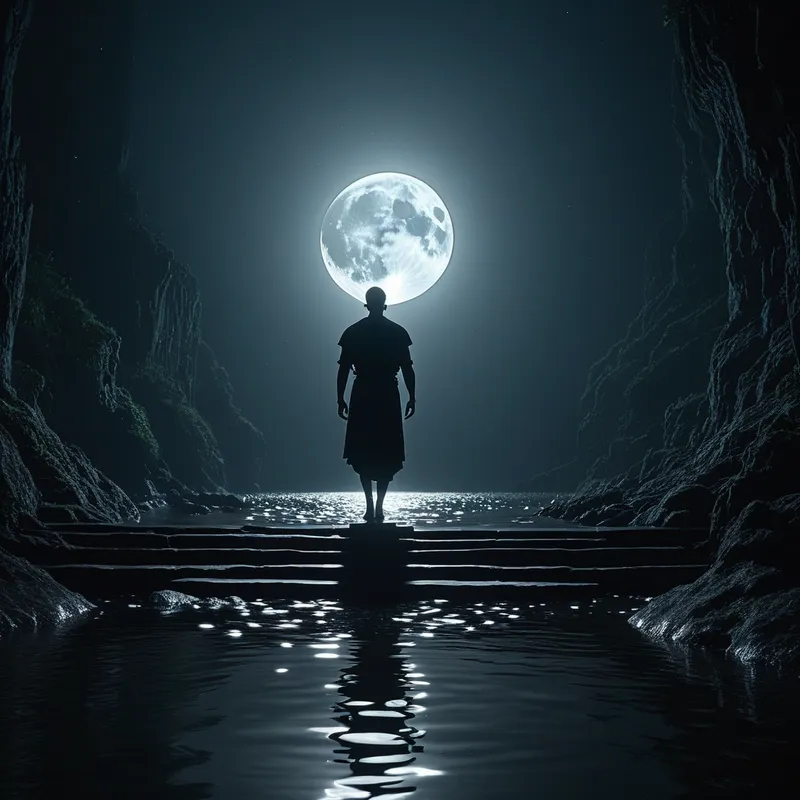
No bridge was built, no grand path was laid. Bulan simply allowed himself to fall, not as a meteor, but as a slow, deliberate descent, a silver tear from the eye of the sky. He followed the path of the deepest rivers down into the roots of the world, into the mouth of the great cave that led to Kasamaan. The waters of the underworld river, black as oblivion, parted before his glowing form.
When he emerged into the vast cavern of the dead, his light did not flood the space. It pooled. It gathered in gentle puddles on the stone floor. It traced the edges of the wandering spirits, not exposing them, but outlining them in silver, giving them back their form, their shape. The oppressive, formless dark receded, replaced by a world of soft shadows and silver outlines. The wailing ceased. The spirits stopped their aimless wandering and looked at their own hands, seeing them clearly for the first time since death. They saw each other. In that reflected, gentle light, they remembered not just light, but connection.
Sidapa, from his dark throne, watched. He expected defiance, a challenge to his domain. Instead, he received a gift. Bulan’s presence asked for nothing, demanded nothing. It simply was. A pact, unspoken, was forged. Bulan would remain, a perpetual guest in the land of the dead, his cyclical waning and waxing mirroring the journey of the souls he comforted. And so, the beautiful god chose the underworld as his home, his eternal sacrifice painting the darkness with the soft, remembering light of the moon, a beacon not of escape, but of abiding presence in the heart of loss.
Cultural Origins & Context
The myth of Bulan finds its roots in the pre-colonial animist and polytheistic belief systems of the Philippine archipelago, particularly among the Bicolano and Visayan peoples. Unlike centralized religious texts, these stories lived in the oral tradition, passed down through generations by the community’s storytellers, the babaylan (shamans) and the elders. These narratives were not mere entertainment; they were cosmological maps and psychological guides.
The story functioned as an etiological myth, explaining the nature of the moon, its phases, and its gentle light. More profoundly, it served to mediate humanity’s deepest anxiety: death and the fate of the soul. By positioning a benevolent, beautiful deity within the underworld, the myth transformed Kasamaan from a place of pure terror to one of somber, moonlit rest. It provided a cultural container for grief, suggesting that our departed are not lost in absolute darkness, but are attended by a compassionate, luminous presence. This reflects a worldview where the celestial and the chthonic are in constant, necessary dialogue, and where beauty has a function—to soothe, to remember, and to make the unbearable, visible.
Symbolic Architecture
At its core, the myth of Bulan is a profound allegory for the power of conscious descent into the unconscious. Bulan represents the principle of reflective consciousness—not the scorching, analytical light of the solar ego, but the receptive, illuminating light of the soul. His beauty is not vanity, but an attribute of wholeness and allure that draws us toward the depths.
The moon does not create light; it reflects a greater source, making it visible in the darkness. In the same way, consciousness does not create the psyche; it illuminates what already exists within the shadow.
The underworld symbolizes the personal and collective unconscious—the repository of all we have forgotten, repressed, or deemed "dead": old grief, unprocessed trauma, lost memories, and the forgotten parts of the self. Bulan’s voluntary descent is the ego’s choice to engage with this material, not to conquer it, but to be present with it. His pact with Sidapa signifies the necessary agreement between consciousness and the autonomous, often daunting, powers of the unconscious. One does not defeat the shadow; one agrees to visit it regularly, to shed a gentle light upon its contents.

The Dreamer's Resonance
When the pattern of Bulan’s myth activates in the modern psyche, it often manifests in dreams of deliberate descent. One may dream of willingly walking down a staircase into a flooded basement, of entering a cave behind a waterfall, or of diving into deep, dark water that is strangely calming. The somatic feeling is not of panic, but of solemn, purposeful movement into.
This dream motif signals a psychological process of turning toward the interior. The dreamer is likely encountering a period of grief, depression, or a need to integrate forgotten aspects of their history or personality. The Bulan energy in the dream does not promise a quick fix or a heroic rescue. Instead, it offers the gift of presence. It suggests the psyche is ready to hold a gentle, non-judgmental awareness toward its own darkness. The light in these dreams is always reflected, soft, and silver—it outlines the shapes of the "ghosts" (unprocessed emotions, memories) without burning them away, allowing them to be seen, acknowledged, and thus, pacified.

Alchemical Translation
The alchemical journey modeled by Bulan is the opus of illumination, not ignition. In the alchemical process of individuation, there is a crucial stage known as the nigredo, a descent into the blackness, the primal matter. The solar ego, with its desire for control and clarity, often fails here, as its light is too harsh and causes the shadow to recoil or fight back.
Bulan provides the alternative model: the lunar ego. His sacrifice is the sacrifice of solar supremacy—the need to be the brilliant, unchallenged source of all light. By accepting a reflected, softer light, he gains access to realms the sun cannot touch.
The transmutation occurs not when the darkness is destroyed, but when it is seen clearly for the first time. What we can see, we can relate to. What we can relate to, we can integrate.
For the modern individual, this translates to the practice of approaching one's inner darkness—shame, fear, trauma—not with the harsh light of judgmental analysis ("Why am I like this?"), but with the gentle, reflective light of compassionate observation ("This, too, is part of me"). It is the process of making a pact with one's own inner Sidapa, the lord of the repressed, agreeing to visit regularly, to shed the moonbeam of awareness. The triumph is not an escape from the underworld, but the establishment of a permanent, illuminating presence within it. The individual becomes whole not by living only in the light, but by becoming the one who carries a trustworthy light into the dark corners of their own soul, thereby making the entire psyche a habitable, connected realm.
Associated Symbols
Explore related symbols from the CaleaDream lexicon:
- Moon — The central symbol of reflected consciousness, gentle illumination, and cyclical presence within darkness, directly embodying Bulan's essence and sacrifice.
- Water — Represents the unconscious, the emotional realm, and the fluid medium through which Bulan descends into the underworld, symbolizing the depths of the psyche.
- Cave — The entrance to the underworld and the unconscious, a place of inward journey, containment, and the confrontation with what is hidden.
- Underworld — The realm of the dead and the repressed, symbolizing the personal and collective shadow where unintegrated aspects of the self reside.
- Descent — The voluntary movement into the depths, representing the conscious choice to engage with psychological shadow material and difficult emotions.
- Reflection — The core action of the moon, symbolizing the psyche's capacity to perceive and illuminate inner contents through receptive awareness, not direct creation.
- Light — Not as a blazing sun, but as a gentle, revealing luminescence that makes form visible in the darkness, representing compassionate consciousness.
- Sacrifice — Bulan's choice to dwell in the underworld, representing the ego's necessary sacrifice of total solar control to achieve a deeper, lunar wholeness.
- Death — Not as an end, but as a state of being that requires illumination, symbolizing psychological states of grief, endings, and the "dead" parts of the personality.
- Grief — The primary emotion of the underworld spirits, representing the unprocessed sorrow and loss that the lunar light gently outlines and makes bearable.
- Shadow — The contents of the unconscious realm, which are not evil but unknown, and which require the soft light of Bulan to be integrated into the whole self.
- Moonlit Path — The trail of silver consciousness left in the darkness, symbolizing the way forward through inner turmoil via gentle, persistent awareness.