Bronze Age ritual vessels Myth Meaning & Symbolism
A myth of artisans channeling celestial patterns into bronze, forging vessels that bind heaven, earth, and the human realm through ritual and sacrifice.
The Tale of Bronze Age ritual vessels
Hear now the tale that is not spoken, but cast. It begins not with a king, but with a silence—a silence so deep it was the womb of the world, before the first name was given. In that silence, between the vault of Tian and the breast of the earth, chaos swirled: formless winds, unmapped waters, the restless whispers of un-ancestored ghosts.
Then came the Fire-Keepers, the ones who listened to the cracks in turtle shells and read the future in the veins of ox bones. They heard the complaint of the spirits. "We are adrift," the winds moaned. "We are hungry," the earth sighed. "We are forgotten," the dead murmured. The human realm was a fragile echo, lost between the great powers.
So the Fire-Keepers went to the Mountain of the Nine Furnaces, where the earth’s veins bled ore of green and copper-red. They summoned the Master of Forms, Kuang. He did not speak with words, but with his hands in clay, tracing the paths of the stars and the curves of the sacred hills. "We must build a home for the pattern," he said, his voice the sound of grinding stone. "We must cast a cup for the cosmos."
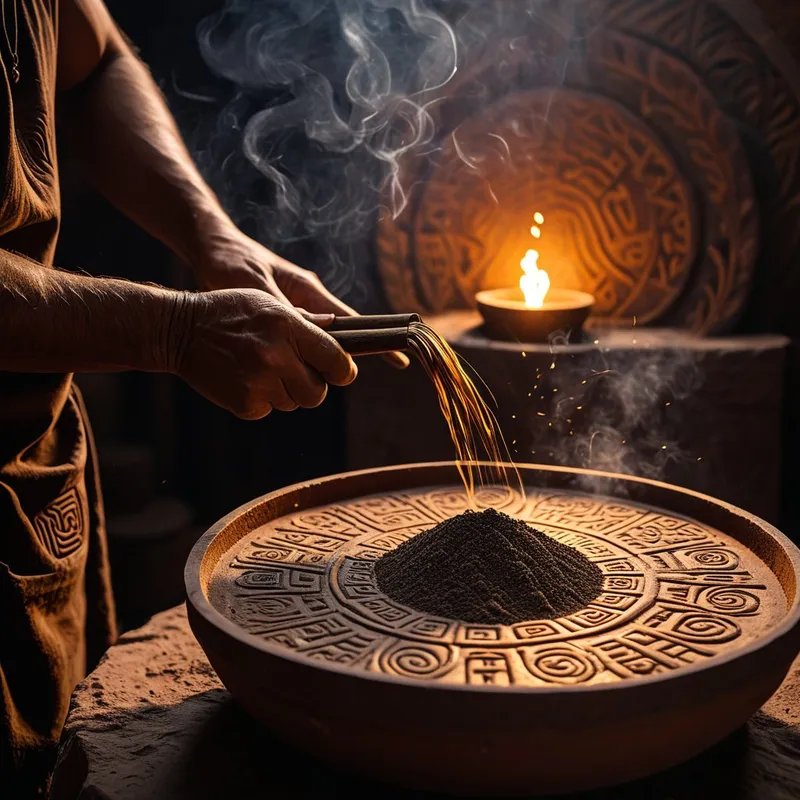
For nine days and nights, the bellows roared like dragons. The ore wept in the crucible, becoming a liquid sun, a captured sunset of molten metal. This was the perilous moment—the marriage of fire and earth, a union that could birth a masterpiece or a screaming, broken slag. Kuang chanted the names of the ancestors, the directions of the winds, the phases of the moon. He poured the searing light into the waiting clay womb, inscribed with the faces of the old gods and the signs of the Bagua.
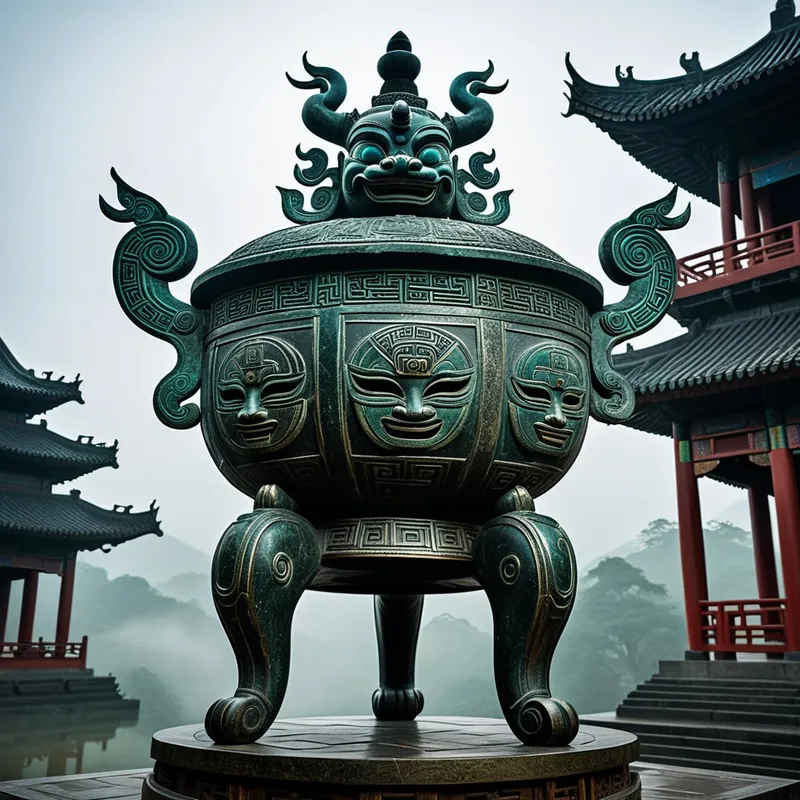
When the mold was broken, there it stood, cooling in the dawn mist: not merely a pot, but a Ding. Its three legs were the three realms: Tian, Earth, and Humanity. Upon its surface, the Taotie stared forth, a gaze that held both terror and order, consuming chaos to define form. There were spirals like thunderclouds, lines like fields, a map of all-that-is in bronze.
They filled the first vessel with millet wine and the blood of a dedicated bull. The steam did not scatter to the random winds. It rose in a single, straight column, a ladder of scent, connecting the offering on earth directly to the court of heaven. The wandering spirits gathered, not as a hungry mob, but as honored guests, taking their designated place. The winds found their paths. The earth settled. The ancestors received their due. The vessel had done what words could not: it had negotiated reality. It had made the invisible contract visible, solid, eternal. And so the first ritual was not performed, but contained.
Cultural Origins & Context
This is the myth born not from a single story, but from ten thousand artifacts—the magnificent bronze jue, gui, and zun that emerged during the Shang and Zhou dynasties (c. 1600–256 BCE). It was a myth enacted, not narrated. The "story" was the ritual itself, performed by kings and nobles who were the intermediaries between the human and spirit worlds.
The myth was passed down through the casting itself. The intricate iconography—the Taotie, the kui dragons, the cicadas symboling rebirth—was a symbolic language. To possess and use these vessels was to assert a divine mandate, the Tianming, proving one's ability to maintain cosmic and social order. The vessels were the hardware of the state's spiritual software; their possession and deployment in ancestral rites legitimized power, organized society, and communed with the forces that governed harvest, war, and destiny. The myth was told every time smoke rose from a Ding in the temple of the ancestors.
Symbolic Architecture
At its core, the myth of the ritual vessel is about the human psyche confronting the formless and giving it a sacred container. The unorganized spirits represent the chaotic, unintegrated contents of the unconscious—primal fears, ancestral complexes, raw instincts, and numinous energies. Left unattended, they are "hungry ghosts" that plague the kingdom of the self.
The vessel is the archetype of the temenos, the sacred precinct. It does not destroy chaos; it transforms it by providing a defined, bounded space where it can be encountered, addressed, and integrated.
The Master Artisan represents the conscious ego aligning itself with a transcendent pattern—the logos or cosmic order. The molten bronze is the fiery, passionate, and potentially destructive libido or life force. The casting process is the critical act of psychological formation: applying the heat of attention and the mold of symbolic understanding to raw, psychic energy to create a durable structure of the soul. The Taotie face is a profound symbol of the "terrible mother" or the devouring aspect of the unconscious, but here, rendered in precise bronze, it becomes a guardian. It stares down chaos, its very presence stating, "This far, and no further. Here, you have a form and a function."
The Dreamer's Resonance
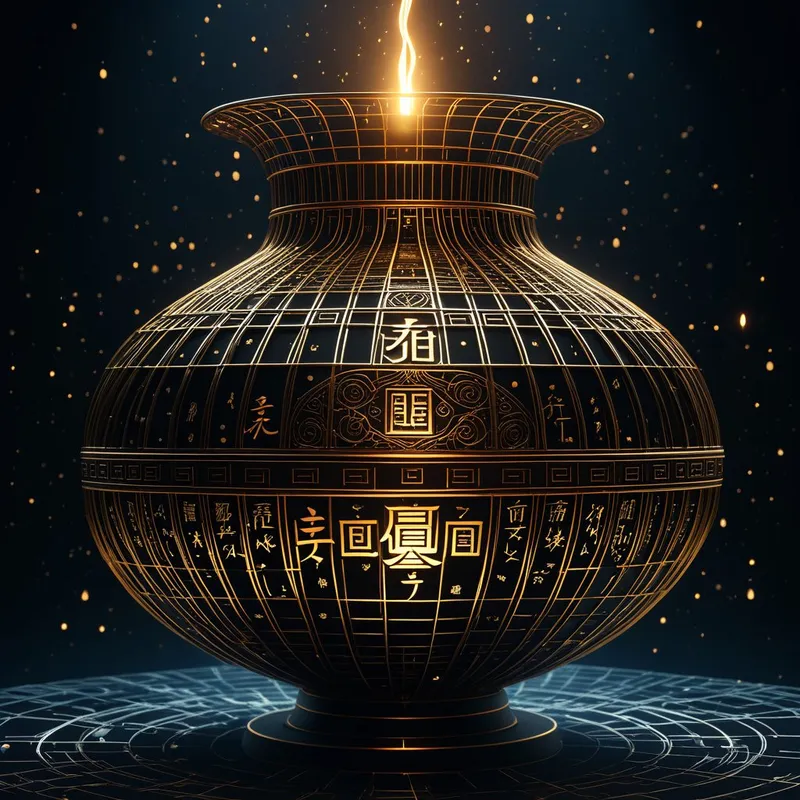
When this myth stirs in the modern dreamer, it often manifests as dreams of finding or crafting a potent, intricate object—a box, a cup, a strange piece of machinery—that feels profoundly containing. One might dream of trying to pour a volatile, luminous liquid into a vessel that keeps changing shape, or of discovering a heavy, metallic artifact in a basement or garden, covered in cryptic symbols.
Somatically, this can correlate with a felt sense of fragmentation or emotional overflow—a "spillage" of affect. The psyche is signaling a need for vessel-making. The dreamer is in a process where overwhelming feelings, ancestral patterns, or unprocessed trauma (the "hungry ghosts") are seeking a form. The psychological task is not to rationalize them away, but to engage in the inner craftsmanship of finding or creating a symbolic "container"—perhaps through art, journaling, ritual, or therapeutic dialogue—that can hold these contents safely, allowing them to be transformed from disabling chaos into a source of personal order and meaning.
Alchemical Translation
The individuation journey modeled here is the opus of self-creation. We are all born into an inner chaos—the prima materia of inherited complexes, societal expectations, and instinctual drives. The modern individual, like the ancient king, must become the artisan of their own soul.
The first step is to heed the "complaint of the spirits"—to acknowledge the symptoms, anxieties, and compulsions as signals from disenfranchised parts of the self. The second is the descent to the "Mountain of Ore," the shadow work of confronting the raw, unrefined aspects of one's nature. The third, and most delicate, is the firing and pouring: applying the focused heat of conscious attention (suffering, introspection, discipline) to this raw material within the mold of a chosen symbolic framework (a philosophy, a creative practice, a psychological model).
The goal is not to eliminate the molten, passionate, or terrifying elements, but to give them a lasting, beautiful, and functional form—a personality that can contain its own contradictions.
The resulting "vessel" is the integrated Self. Its three legs are the balanced alignment of thought, feeling, and sensation. Its engraved patterns are the unique, coherent narrative of one's life. It allows one to perform the ultimate ritual: to offer one's own experience—the joy and the suffering—to something greater, transforming personal history into sacred communion. In the end, we do not find ourselves; we cast ourselves, again and again, in the foundry of lived experience, striving to become a vessel worthy of holding the spirit.
Associated Symbols
Explore related symbols from the CaleaDream lexicon: