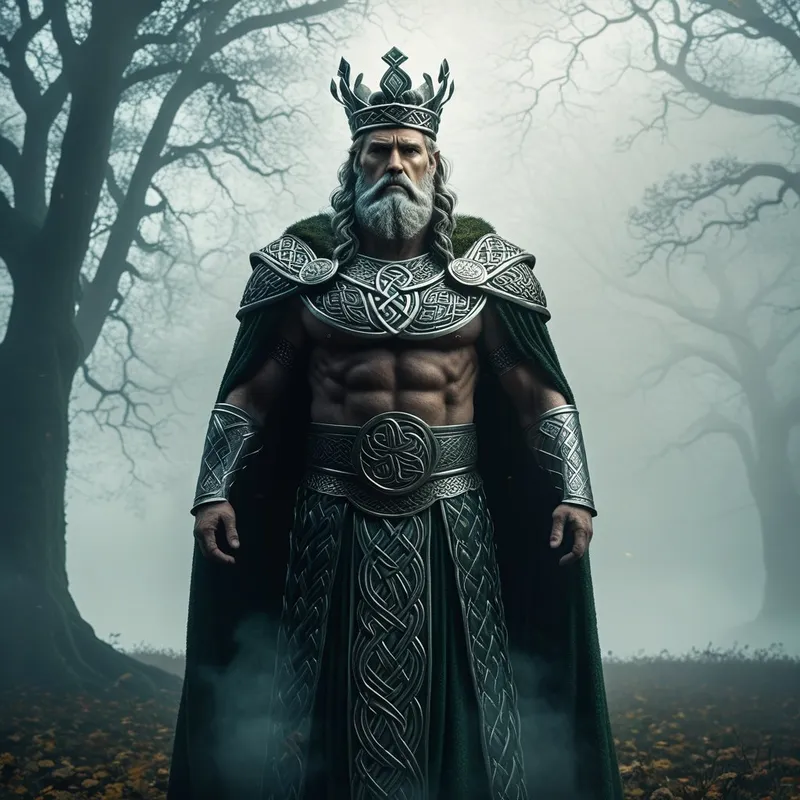
Bran the Blessed Myth Meaning & Symbolism
A giant king's severed head sings for eighty years, guarding his people, embodying the ultimate sacrifice of the self for the sovereignty of the whole.
The Tale of Bran the Blessed
Listen now, and let the fire’s crackle become the crash of waves on the shores of the Isle of the Mighty. In the days when the world was woven tighter with the Annwn, there lived a king who was not a man as others are. He was Bran the Blessed, son of Llyr, of the line of the deep sea. From crown to heel, no house could contain him; he was a mountain that walked, a fortress made flesh.
His sovereignty was the land’s own breath. Yet a shadow fell upon his hall when his sister, Branwen, was given in marriage to Matholwch, King of Ireland. A gift of peace, a weaving of two lands. But the weaving was torn by an insult, a secret mutilation of Matholwch’s horses by Bran’s jealous half-brother. To mend the rift, Bran gave Matholwch a cauldron of miraculous power—a vessel that could restore the dead to life, though without speech. A gift of profound ambiguity, born of guilt.
In Ireland, Branwen’s welcome turned to ash. She was made a servant, beaten each day. She trained a starling to carry a message across the sea, a tiny bird bearing a king’s grief. When Bran read the message tied to its leg, the very sea recoiled at his wrath. He waded across the channel, his warriors sailing beside him like chicks beside a swan, his body the bridge for his host.
War, terrible and inevitable, erupted. The Irish used the cauldron, resurrecting their fallen, creating a silent, endless army. The battle was a slaughterhouse of renewal and death. In the end, only seven of Bran’s men survived, and Bran himself was struck in the foot by a poisoned spear—the one vulnerability of the sacred king.
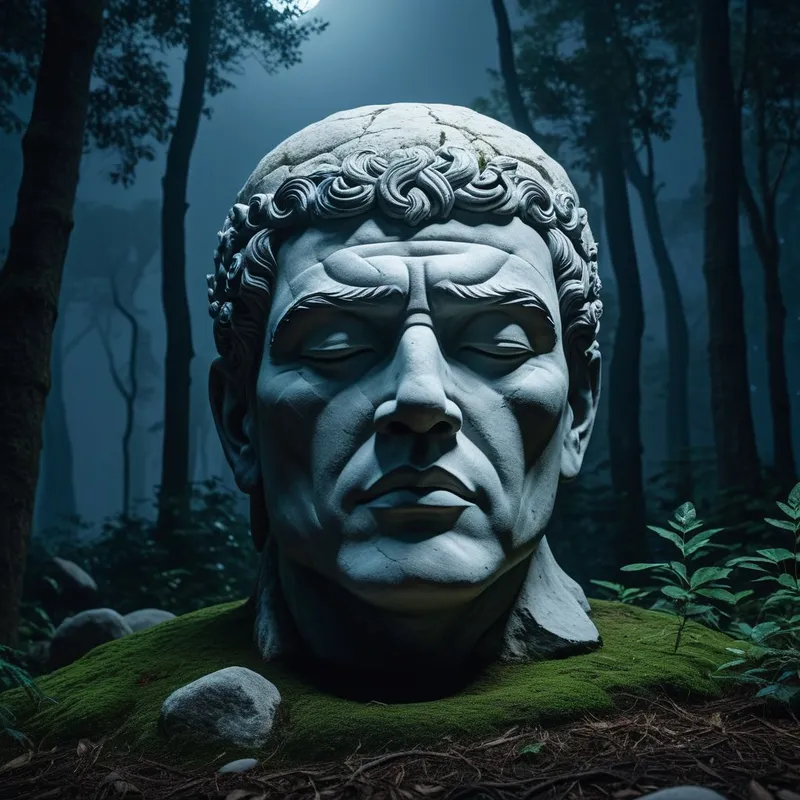
Feeling the life seep from his giant’s form, Bran gave his final command. “Cut off my head,” he said, his voice like stones grinding in the deep. “Carry it with you. Bury it in the White Hill of Llundain, facing the continent, that I may forever guard this land from invasion.” His companions, hearts breaking, did as he bade. The head was severed, yet it lived. It spoke. It sang.
For eighty-seven years, they dwelt in a timeless feasting hall in Gwales, the head their companion and lord, its presence a ward against all sorrow and decay. They feasted, they laughed, they forgot the world of grief. But one man, driven by a compulsion he could not name, opened a forbidden door facing Kernow. The memory of all their loss, the weight of their duty, rushed in. The enchantment broke.
The company, aged in an instant, took up their burden once more. They bore the head to the White Hill and buried it as commanded. For as long as it lay there, facing the east, the Island of the Mighty would be safe. The king’s body was gone, but his watchful consciousness remained, a silent guardian in the dark earth.
Cultural Origins & Context
This profound narrative is preserved in the Mabinogion, specifically in the branch titled Branwen ferch Llŷr. While recorded in medieval Wales, its roots sink deep into the pre-Christian, pan-Celtic worldview. It is a king-tale, a echtra, and a sovereignty myth all at once.
The bard who recited this tale was not merely an entertainer but a custodian of cosmic order. The story functioned as a societal anchor, explaining the nature of sacred kingship: the king is the land. His physical integrity ensures its fertility; his moral integrity ensures its peace. Bran’s wounding in the foot—a common motif in Celtic myth—signals a break in this covenant. His subsequent command to decapitate himself is the ultimate ritual act, transferring his sovereignty from a perishable body to an imperishable, oracular head. The tale legitimized rulership, framed the relationship with the Otherworld, and provided a mythic template for sacrifice and eternal vigilance.
Symbolic Architecture
Bran represents the archetype of the Dying and Reviving God, but with a uniquely Celtic inflection. His journey is not one of seasonal return, but of conscious transformation into a permanent, watchful state.
The head is the seat of wisdom, the cauldron is the vessel of transformation. In sacrificing his body, Bran does not lose his mind; he becomes pure mind, pure guardianship.
His giant stature symbolizes the ego in its inflated, identified state—he is the kingdom, literally and psychologically. The poisoned foot is the prick of reality, the flaw that forces a crisis. The request for decapitation is the ultimate act of ego-dissolution for a higher purpose. The talking, feasting head represents the liberated consciousness that persists after the death of the identified self. It is wisdom severed from personal desire, presiding over a timeless, nourishing space (Gwales) until duty recalls it to the world.
The Cauldron of Rebirth is the shadow of this process. It regenerates life, but without speech—without spirit or true consciousness. It is the promise of mere survival, of endless repetition without growth, which Bran’s final sacrifice ultimately transcends.
The Dreamer's Resonance
When this myth stirs in the modern psyche, it often manifests in dreams of profound responsibility coupled with a sense of impending dissolution. One might dream of a giant, wounded figure who cannot fit inside a house (the constrained ego), or of carrying a heavy, sacred object that must be placed somewhere specific (the burden of purpose).
Somatically, this can feel like a pressure in the head or a weakness in the feet. Psychologically, it is the process of a “necessary death.” The dreamer may be in a role—a leader, a caregiver, a protector—that has become so all-consuming it is their identity. The dream signals that this identification must be “beheaded.” The conscious, guiding intelligence (the head) must be separated from the exhausting, vulnerable, and ultimately mortal role (the body). It is the psyche’s move from “I am my job/family/struggle” to “I hold this duty from a place of witness.”
Alchemical Translation
For the individual, Bran’s myth maps the alchemical nigredo and albedo on a grand scale. The king’s wounding and the brutal war represent the nigredo: the crushing of the old, inflated identity in the crucible of life’s conflicts and betrayals.
The command to sever the head is the moment of radical surrender, where the will of the ego submits to the imperative of the Self.
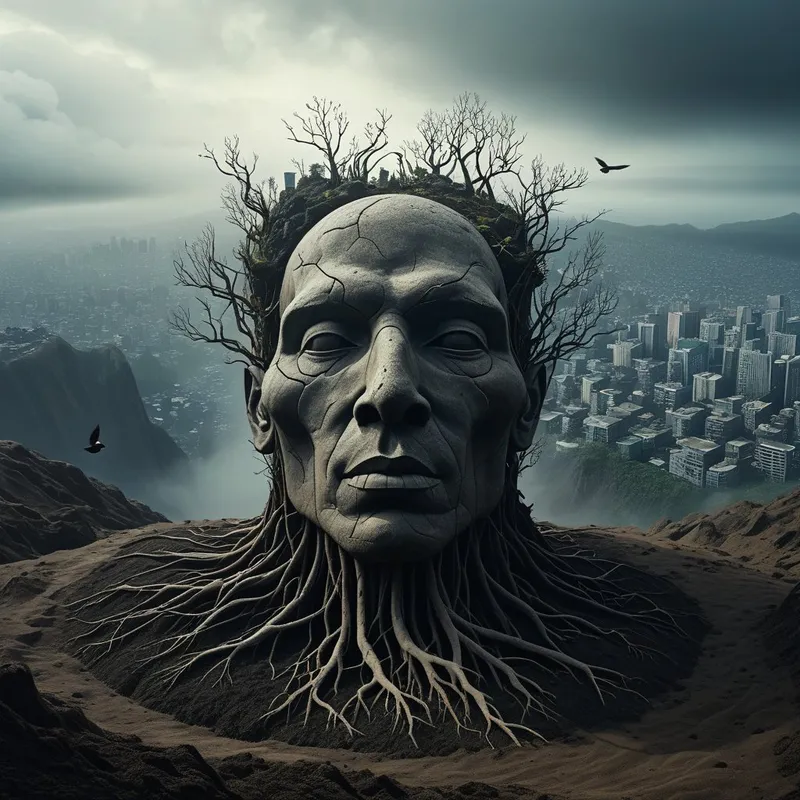
The eighty-seven years in Gwales are the albedo. The head, now the purified Lapis Philosophorum, creates a temporary paradise—a state of psychic integration where conflict ceases, and the personality is nourished by its own wisdom. But individuation is not an escape from the world. The opening of the forbidden door is the call back to life, to history, to duty. The final burial is the rubedo: the fixed, enduring placement of this hard-won consciousness into the foundation of one’s being (“the White Hill”). The guardian is no longer a person struggling on the surface, but a principle buried deep within, facing outward, providing silent, unwavering protection and orientation for the entirety of one’s psychic landscape. One becomes, not the king who rules, but the buried head who watches—sovereignty internalized, eternal, and at peace.
Associated Symbols
Explore related symbols from the CaleaDream lexicon: