Bragi's Harp Myth Meaning & Symbolism
The god of poetry's harp is stolen, silencing the halls of the gods until a perilous journey to the underworld restores the music of creation.
The Tale of Bragi's Harp
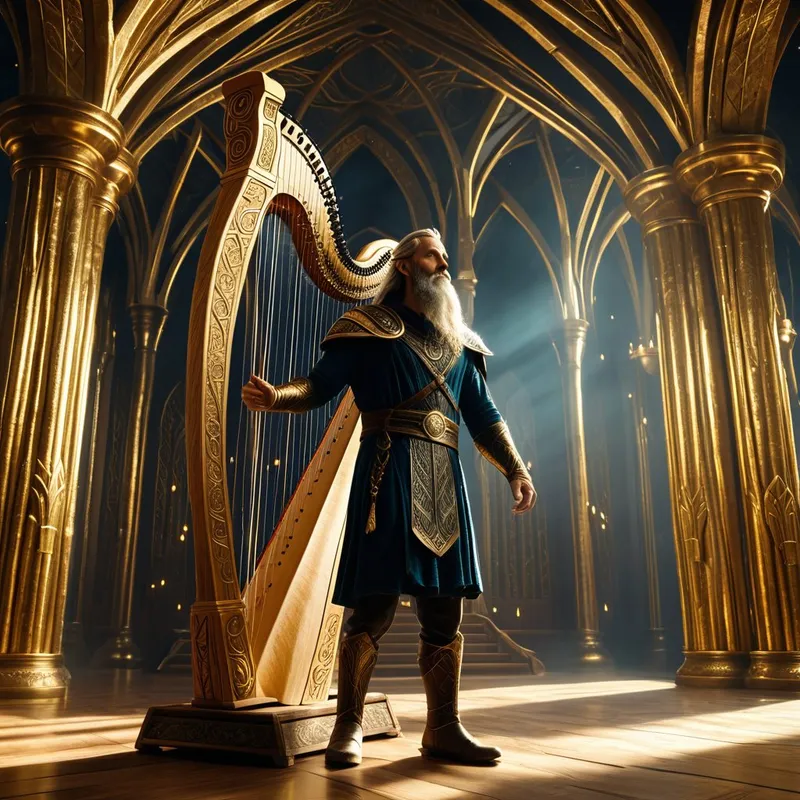
Listen, and hear the silence that fell upon the golden halls. It began not with a clash of swords, but with an absence—a theft so profound it stilled the very breath of the gods. In Asgard, where the mead flowed like rivers and laughter echoed from rafters hung with shields, there was one sound that wove it all together: the music of Bragi's harp.
Crafted by the dwarves in the world's deep roots, its frame was of ash wood, its strings of golden light. When Bragi's fingers danced upon them, they did not merely play notes. They spun fate. They sang of glorious deeds done and yet to come, of the sorrows of loss and the fierce joy of life. His music was the glue of memory, the spark of courage, the balm for grief. It was the sound of Yggdrasil's sap rising.
But a shadow watched from the cold edges of the world. The giantess Gunnlod, keeper of a different treasure, hungered for this one. Not for drinking, but for silencing. In a moment when the gods were distracted by their own splendour, when Bragi had laid his instrument aside to drink from the horn of wisdom, she came. Not with storm or fire, but with a whisper of mist, and she took it. The harp vanished from the high seat of Asgard and was carried down, down through the roots of the world, into the sunless lands where the goddess Hel holds court.
The silence that followed was a physical weight. The great hall Valhalla felt like a tomb. Warriors sat listless, their tales untold. Odin's single eye grew dim without a skaldic verse to feed it. Frigg's distaff froze. The very light in Asgard seemed to grey. The gods convened, their voices hollow in the quiet. The source of their inspiration, the rhythm of their cosmos, was gone.
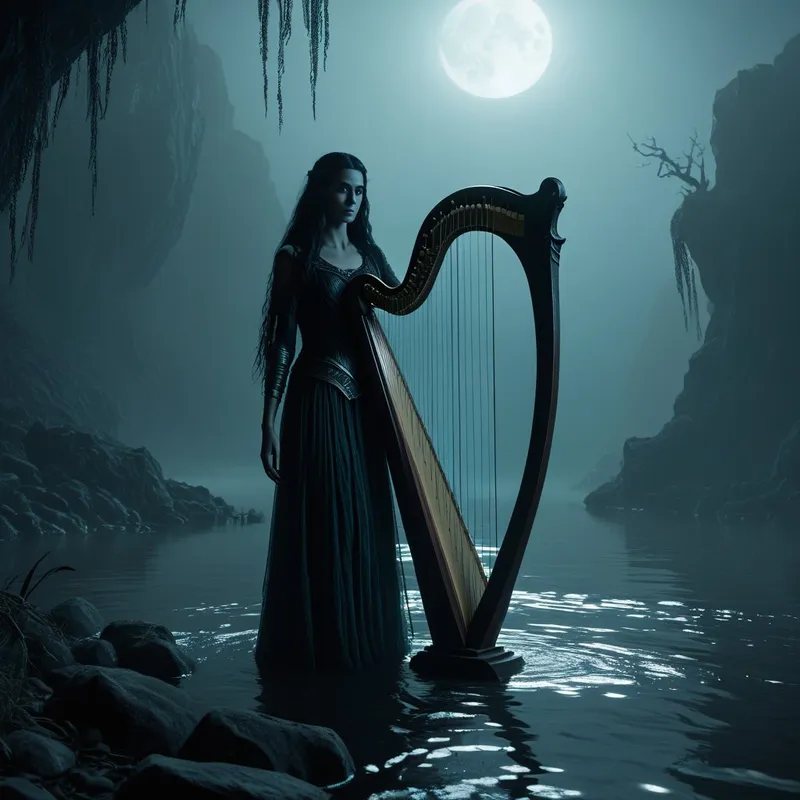
Only one was suited for the quest: Bragi himself. The poet had to become the hero. Cloaked not in wolf-skin but in resolve, he descended from the bright realm. He traversed the Muspelheim-touched wastes, forded the roaring river that rings Hel's gate, and stood before the towering, bone-pale walls. Here, in the land of the silent dead, his own voice was his only weapon. He did not demand; he petitioned. He spoke to Hel not with threats, but with a poet's truth. He sang a lament for the silence above, a hymn for the stolen harmony, a prophecy of the dull, grey twilight that would engulf all worlds, even this one, if the music did not return.
Moved by the sheer artistry of his plea—for even in Hel, the power of a well-wrought verse is known—the giantess Gunnlod was compelled to parley. She had not broken the harp; she had only stilled it. A contest was proposed: a battle of song. Bragi, empty-handed, would sing against the harp's own stolen voice in her hands.
What followed was not a clash, but a conversation. Gunnlod played a tune of endless twilight, of rest without dreams, of the final, cold peace. It was beautiful and terrible. Bragi answered with the song of a single green shoot cracking a stone, of a heartbeat in the womb of winter, of a name remembered on the lips of the living. His voice, raw and true, did not overpower the harp's melody; it invited it. One by one, the golden strings began to hum in sympathy, vibrating not to the giantess's touch, but to the god's call. The harp recognized its master. With a sound like a sunrise, it flew from Gunnlod's grasp back into Bragi's arms.
The return journey was a crescendo. As he climbed back toward the light, he plucked the strings, and with each note, colour and life bled back into the worlds. He arrived at the gates of Asgard not as a warrior returning from slaughter, but as a healer returning with the cure. And when he struck the first chord in the silent hall, the roar of joy that answered it was the finest harmony he had ever composed.
Cultural Origins & Context
The figure of Bragi is deeply woven into the Norse skaldic tradition. Often considered a deified representation of the 9th-century poet Bragi Boddason, his mythic persona embodies the societal role of the skald. These poets were not mere entertainers; they were historians, moralists, and magicians of language. Their verses preserved lineage, cemented political alliances, and could curse or bless with the power of ørlög.
The tale of his stolen harp, while not preserved in a single, canonical text like the Poetic Edda, is a mythic pattern inferred from kennings (poetic metaphors) and later folkloric motifs surrounding stolen poetic mead or inspiration. It functions as an etiological myth for the creative process itself. Inspiration (Öðr, a word related to Odin and meaning ecstatic fury) is portrayed as a divine force that can be captured, lost, or stolen. The myth dramatizes the terrifying creative drought—the silence of the muse—and the perilous inner journey required to recover one's "voice." It was a story told to and by skalds, a reminder that their art was a sacred, hard-won conduit between the gods and men, as vital to the community's soul as the smith's craft was to its body.
Symbolic Architecture
At its heart, this is a myth of the stolen logos—the animating word, the song of the self. Bragi's harp is not merely an instrument; it is the integrated voice of consciousness, the ability to shape raw experience into meaningful narrative.
The stolen harp is the soul's voice held captive by the unconscious—by unresolved grief, frozen trauma, or the seductive pull of nihilistic silence.
Bragi represents the conscious ego, specifically the creative function. His descent into Hel is not a raid, but a negotiation. He does not slay the giantess (the shadow), but he wins back his treasure from her through superior artistry and authentic expression. Gunnlod and the realm of Hel symbolize the underworld of the psyche: the place where forgotten memories, unlived lives, and repressed energies reside. She is not pure evil; she is the keeper of what has been silenced. The harp in her hands represents creative potential turned inward, becoming stagnation, melancholy, or the cold comfort of despair.
The triumphant return signifies the reintegration of this lost content. The music restored is richer for its journey; it now contains the knowledge of the dark. This is the alchemy of art: transforming the base lead of suffering into the gold of song.
The Dreamer's Resonance
When this mythic pattern stirs in the modern dreamer, it often manifests as dreams of lost or broken instruments, silent phones, or a voice that won't emerge. One may dream of searching through a vast, familiar-yet-alien basement (the personal Hel) for a crucial object that holds their identity. The somatic experience is one of constriction in the throat and chest, a literal feeling of being unable to "give voice."
Psychologically, this signals a state where the individual's authentic mode of expression—their personal "music"—has been compromised. This could be due to external censorship (a stifling job, relationship) or, more commonly, internal censorship: the critical inner giantess who says one's creation is worthless, the fear of exposure, or a deep-seated belief that one's truth is too dangerous to sing. The dream is a map. The descent into the underworld in the dreamscape is the psyche's imperative to confront what has silenced it. The recovery of the object, however fragmentary in the dream, is the first promise of healing, indicating the beginning of a journey to reclaim one's narrative authority.

Alchemical Translation
The process mirrored in Bragi's journey is the core of Jungian individuation: the retrieval of the treasure hard to attain from the realm of the shadow. For the modern individual, the "harp" is one's unique vocation, authentic self-expression, or the cohesive story of one's life.
The alchemical work is not in fighting the darkness, but in learning to sing so truly within it that what is yours recognizes your voice and returns.
The first stage is Recognizing the Silence (the nigredo). This is the depressive, listless state where life loses its melody. One must acknowledge the theft, the loss of vitality and meaning.
The second is the Descent (the mortificatio). This is the conscious engagement with the unconscious—through therapy, active imagination, journaling, or artistic exploration. It is a voluntary journey into one's personal Hel to face the Gunnlod within: the complexes, traumas, and fears that hold one's creative energy captive.
The third is the Contest of Song (the albedo). Here, one does not battle the shadow with brute force (which only strengthens it), but meets it with the superior power of conscious articulation. One must express the truth of the pain, the shape of the silence, with more authenticity than the shadow uses to maintain its grip.
The final stage is the Return and Integration (the rubedo). The reclaimed voice is not the innocent one lost; it is a voice tempered by the depths. It can now sing of wholeness, containing both light and dark. The individual becomes their own skald, weaving the disparate threads of experience—joy, sorrow, triumph, failure—into a coherent, life-affirming saga. They no longer just have a life; they author it, their very existence becoming a restorative chord in the world's great, unfinished song.
Associated Symbols
Explore related symbols from the CaleaDream lexicon: